Go Al Go!
Olympic Torch Twittered out of San Francisco
Here’s how Twitter helped Team Tibet follow the secret torch route as authorities tried to hide the Olympic flame’s dash through San Francisco. It’s nice to see Twitter being put to serious use as a real-time communication tool for its customers.
You can add your voice to the chorus here >>

China has already lost!
Bishop Tutu stands up and tells it…
Will China develop Africa?
Because resource-rich Africa has been left out of the development plans of most Western companies, doesn’t mean that Africa won’t find a way to join the wave of globalization sweeping the world from Asia to Eastern Europe and South America.
So how will Africa do it? Through China and India.
This is a not good news for democracy:
In February 2007, Hu Jintao proudly announced the creation of a new special economic zone complete with the usual combination of export subsidies, tax breaks and investments in roads, railways and shipping. However, this special economic zone was in the heart of Africa—in the copper-mining belt of Zambia. China is transplanting its growth model into the African continent by building a series of industrial hubs linked by rail, road and shipping lanes to the rest of the world. Zambia will be home to China’s “metals hub,” providing the People’s Republic with copper, cobalt, diamonds, tin and uranium. The second zone will be in Mauritius, providing China with a “trading hub” that will give 40 Chinese businesses preferential access to the 20-member state common market of east and southern Africa stretching from Libya to Zimbabwe, as well as access to the Indian ocean and south Asian markets. The third zone—a “shipping hub”—will probably be in the Tanzanian capital, Dar es Salaam. Nigeria, Liberia and the Cape Verde islands are competing for two other slots. In the same way that eastern Europe was changed by a competition to join the EU, we could see Africa transformed by the competition to attract Chinese investment.
As it creates these zones, Beijing is embarking on a building spree, criss-crossing the African continent with new roads and railways—investing far more than the old colonial powers ever did. Moreover, China’s presence is changing the rules of economic development. The IMF and the World Bank used to drive the fear of God into government officials and elected leaders, but today they struggle to be listened to even by the poorest countries of Africa. The IMF spent years negotiating a transparency agreement with the Angolan government only to be told hours before the deal was due to be signed, in March 2004, that the authorities in Luanda were no longer interested in the money: they had secured a $2bn soft loan from China. This tale has been repeated across the continent—from Chad to Nigeria, Sudan to Algeria, Ethiopia and Uganda to Zimbabwe.
Read more here >>
Africa’s “imperialism challenges” will now come from the East.
Pranab Mukherjee, India’s Minister of External Affairs, talks a good game.
So why all the fuss over Africa? And why now?
Do China and India really care about African development?
Or is it the news that Africa is the new oil frontier.
Apparently Africa will account for 12% of global oil supplies in the next few years. And that’s not counting other mineral riches…
Don’t be too eager, Africa. Trust, but verify – as someone once said. And heed this African saying: If a little tree grows in the shade of a larger tree, it will die small. But if a little tree stands side by side with a larger tree, you have the start of a forest.
Theater of the Absurd: China stages “monk violence”?

in case you wondered why these “Tibetan monks” were so violent in Lhasa….
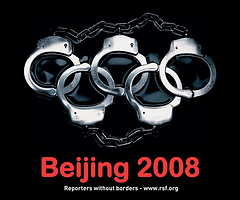
A Theme Song for Tibet: Get Up, Stand Up (Stand Up for Your Rights)
David “Dread” Hinds (Steel Pulse), Sly & Robbie, Aswad, Ini Kamoze and Dennis Brown… mash it!
And here’s the original version by Robert Nesta:
Get Up, Stand Up!
Rice Revolution Ahead?
From the NYTimes >>
“Rising prices and a growing fear of scarcity have prompted some of the world’s largest rice producers to announce drastic limits on the amount of rice they export.”
And The Economist >>
I remember when Indira Gandhi was kicked out of office when the price of onions got too high. And rice is the staple food of most of Asia… It’s all about the price of rice.
And then there’s Marie Antoinette who, it turns out, did not say: “Qu’ils mangent de la brioche” (let ’em eat cake)…
Earth Hour
More fun facts:
The average American produces about 20 tons of the major greenhouse gas carbon dioxide (CO2) every year. That might sound like a lot — and Americans do have among the biggest carbon footprints in the world — but the entire world emits around 27 billion tons of CO2 each year, through transportation, electricity use, deforestation.
So now we have Earth Hour.
Let’s rearrange the deck chairs…
Chinese Democracy: Patriotic Education

The Economist story Welcome to the Olympics states:
“Resenting criticism of its handling of unrest in Tibet, China wages a gruesome propaganda offensive…”
“Meng Jianzhu, China’s most senior police official, also toured Lhasa on March 23rd and 24th. His words were not encouraging. Monasteries, he said, should step up “patriotic education”—ie, a much resented government-led campaign that requires monks to state their rejection of the Dalai Lama, who is hugely revered in Tibet.”
Patriotic Education? Sounds a bit like our Republicans…
Nice.
Read this report as well: “Trashing the Beijing Road”
As the Earth Lay Dying…
Here are three stories I came across in the last week or so:
1. Chinook Salmon Vanish Without a Trace – “The Chinook salmon that swim upstream to spawn in the fall, the most robust run in the Sacramento River, have disappeared. The almost complete collapse of the richest and most dependable source of Chinook salmon south of Alaska left gloomy fisheries experts struggling for reliable explanations — and coming up dry.”
Here’s my explanation. Apparently this kind of thing happens up and down the Pacific coast of California.
2. Why are thousands of bats dying in New York? – “Bats in New York and Vermont are mysteriously dying off by the thousands, often with a white ring of fungus around their noses, and scient ists in hazmat suits are crawling into dank caves to find out why.”
3. Massive ice shelf collapsing off Antarctica – “Scientists are citing ‘rapid climate change in a fast-warming region of Antarctica’ as the cause of an initial collapse of the Wilkins Ice Shelf. The damage got started at the end of February when an iceberg dropped off and triggered the “runaway disintegration” of a 160-square-mile portion of the 5,282-square-mile shelf.”
Why is it that we’re still sitting here doing nothing?
I’m amazed at companies like Exxon Mobil – they still try to shirk their responsibility for the damage they cause…
And here’s a story about the Japanese whalers – they’re ready to kill Moby Dick!
Wait, there’s more >>
Please pass the popcorn.
The Ghost of Tiananmen: China, Tibet and the Olympics

When I was a kid in India, one of the fondest memories I have is of a family vacation in the foothills of the Himalayas – eating at a tiny Tibetan roadside dhaba, being fed tons of cho-cho-momo and heaping piles of noodles. The food was great, but what struck me was the poor Indian peasant family sitting across from me eating their fill as well. Why? because the food was so cheap and so good that everyone could afford to eat well. I’ve never forgotten that day.
The family that ran the dhaba were refugees from Tibet, and I was fascinated by the store, the food, and the way they used an abacus to add up the transactions as they happened. That day I became a believer in a free Tibet.
I wrote earlier about China’s country branding issues and the upcoming Olympics.
I’ve also written about how to measure democracy with the “Journalists-in-Jail Index.”
And now we have pictures of the Chinese government beating up on Tibetans splashed across the pages of every major newspaper and magazine.
And don’t forget YouTube:
Here we go again.
This time Chinese officials are blaming the Dalai Lama for the violence. Give me a break. They’ve even got an army of bloggers and hackers working the media sites posting “pro-chinese” accounts all over the place.
Bush, of course, is silent. He knows that China’s in Tibet for the uranium.
I get a feeling the sponsors of the Olympics are in for a rough ride. Here are the brands which stand to get a black eye:
Coca-Cola
McDonalds
General Electric
Visa
Johnson and Johnson
Kodak
Samsung
Panasonic
Atos Origin
Lenovo
ManuLife
Omega
And let’s not forget the Olympic brand itself. This could do it in completely!
Stay tuned and sign a petition>>
UPDATE: More video >>
Video: Ricardo Semler’s Open-Capitalism
I’ve been following Ricardo Semler for many years now.
In 1993, in a fit of madness I slipped a copy of Maverick into the hands of Riley Bechtel – thinking as I did at the time, that this is the only way to get Bechtel to re-engineer itself. Of course I was a little too naive…
Today I don’t think I could work at Semco because I’d rather work for myself. But if I had to get a corporate job again (heaven forbid) I’d choose Semco.
Question: when are they opening a “Semco-proper” office in the US? You can check Semco’s company history here.
Anyway, the revolution has happened and it was televised. Here’s what to expect:
And definitely check this out >> (Journeyman Pictures doesn’t understand YouTube – hence the “Embedding disabled by request”)
Open-capitalism is thriving at Semco, and one of these days, it will show up in your industry. What strikes me though is the fact that this model can be used in non-profits, in government (are you listening, Barack Obama?) and even in the fields without hope – like education. Apparently Bill Gates’ foundation is keeping close tabs on Semler’s schooling experiment.
Online Buzz Bubble-Popper: Positive reviews don’t necessarily mean more sales
Positive online buzz for cars and trucks doesn’t necessarily translate to volume sales, period.
Here’s the story in AdAge: “What Web Buzz Does for Car Sales: Not Much”
Turns out that BrandIntel has been monitoring 450,000 comments over the past year. Comments made by “enthusiasts” in consumer discussion forums on auto-information sites such as Edmunds.com, newspaper and magazine sites, and blogs.
Let’s look at the print/paper analogy. This is the equivalent counting the number of press-clippings in the trade mags. As a measure of PR efficacy of getting stories published, it worked great. As an indicator of sales, it didn’t.
What matters in print and online is the credibility of the messenger and the size of the audience. A story in Rupert Murdoch’s WSJ or the NY Times may have a dramatic impact compared to the same story in your local rag.
Online, credibility and audience-size still matter, but so does findability. How easy is the story to find? Does it come up high in Google and to a lesser extent Yahoo? If there is buzz, is the buzz on a hub or a backwater site? Is it getting attention or play through links from other noteworthy sites?
How does one measure that? There is a way – ecosystem relevance – which measures the position and rank of a site within its industry/category ecosystem.
C. K. Prahalad: Democratizing Opportunity
A viable, sustainable economic model is crucial for the future of the planet. Tell ’em, C.K.!
Marketing in a Downturn
Seth Godin writes about “marketing in a recession” :
The challenge for marketers is to figure out how to change the story they are living so that their customers can change the story they tell themselves. What you make, where you make it, who makes it, how it’s priced and sold and … it all adds up to a perception. If you change these elements the story will change too.
His point is that Starbucks becomes the indulgence of someone who has just traded down to a small rental apartment. Gone are the days of $4.00 coffee just for the heck of it.
I think Starbucks is busy changing their story. They’re trying to be a new, upscale McDonald’s – rapidly working to add in a “drive-in have a happy meal” component to their business model. The trouble is in the demographics. Bill Tancer at TIME tells us that “the Big Mac customer base has remained relatively stable, while Starbucks’ coffee-drinkers have diversified. It used to be that Starbucks attracted customers from a small, elite segment of the country; now, its visitors pervade many more segments across America.”
From my own observations at the local Target, I see far more customer buying ICEEs rather than Starbucks coffees. This is the “threat of substitution” that is always around the corner, no matter how good your product is. Seems like the days of mass-luxury are over.
So where does retail find its consumer, er, citizen? Turns out they’re not citizens at all – you’ve got to sell overseas. India and China are experiencing a huge boom in luxury, thanks to an explosion in middle class prosperity. The fortune is in the middle and the bottom of the pyramid.
And if you can’t reach those consumers? I wrote about that in an earlier post about advertising in a recession.
Jeffrey Immelt: India versus China – Trust is a Global Issue for GE
I was talking to Bill Dunk this morning, and we got to the topic of trust as an issue in global business.
I told him I’d seen a video in which Jeff Immelt said something to the effect that in China the concept of win-win is an issue, whereas India is much better at partnerships.
Immediately, Bill dug up this article for me – an interview with Nani Beccalli-Falco, GE International’s chief executive.
From the article:
This is a difficult challenge and it is one that Beccalli-Falco speaks of with surprising candour. He talks of the problems of striking deals in China, where, he says, the values of equity and fairness implied in the West’s ‘win/win’ approach to business are replaced by a more naked self-interest. “In China, they have a tendency to think ‘win for China, OK for you’,” he says. “It makes forming partnerships difficult.”
If you want to get a global perspective on business, you must subscribe (for free) to Bill Dunk’s Global Province >>
And yes, I finally dug up the video:
Watch Immelt’s interview with Rajat Gupta, and listen carefully as Immelt talks about India versus China – right at the very end of the video:
“China has a hard time with win-win. That’s a problem over the long term.India’s much better. There’s a much better sense that India can be a real ally…”
Wow.
China’s got the Olympics this summer… wonder if they’ll let anyone else win a medal…
Kevin Coyne’s 21 Questions for Developing New Products
The December 2007 HBR had an interesting article by Kevin Coyne called Breakthrough Thinking from Inside the Box. There’s far more to this article than just the 21 questions, so I urge you to go grab it here!
The approach Coyne and friends describe supposedly works better than brainstorming or strict quantitative analysis >>
“De-average” buyers and users
Which customers use or purchase our product in the most unusual way?
Do any customers need vastly more or less sales and service attention than most?
For which customers are the support costs (order entry, tracking, customer-specific design) either unusually high or unusually low?
Could we still meet the needs of a significant subset of customers if we stripped 25% of the hard or soft costs out of our product?
Who spends at least 50% of what our product costs to adapt it to their specific needs?
Explore unexpected successes
Who uses our product in ways we never expected or intended?
Who uses our product in surprisingly large quantities?
Look beyond the boundaries of our business
Who else is dealing with the same generic problem as we are but for an entirely different reason? How have they addressed it?
What major breakthroughs in efficiency or effectiveness have we made in our business that could be applied in another industry?
What information about customers and product use is created as a by-product of our business that could be the key to radically improving the economics of another business?
Examine binding constraints
What is the biggest hassle of purchasing or using our product?
What are some examples of ad hoc modifications that customers have made to our product?
For which current customers is our product least suited?
For what particular usage occasions is our product least suited?
Which customers does the industry prefer not to serve, and why?
Which customers could be major users, if only we could remove one specific barrier we’ve never previously considered?
Imagine perfection
How would we do things differently if we had perfect information about our buyers, usage, distribution channels, and so on?
How would our product change if it were tailored for every customer?
Revisit the premises underlying our processes and products
Which technologies embedded in our product have changed the most since the product was last redesigned?
Which technologies underlying our production processes have changed the most since we last rebuilt our manufacturing and distribution systems?
Which customers’ needs are shifting most rapidly? What will they be in five years?
Finally, if you want to hire Kevin Coyne, he’s available here >>
JSB on Creativity: Building the DNA of Innovation (Listen up Yahsoft/Microhoo!)
Microsoft and Yahoo need to listen to this carefully…
Innovation is Everyone’s Job
Years ago, I was one of the youngest employees to be invited (to this day I still don’t know who nominated me) to speak at Bechtel’s Management Advisory Seminar – a yearly gathering of top managers and staff to discuss the topic of innovation.
While this was supposed to a great honor, it turned out to be a lot of work. It was a day-long affair, and I was to give two speeches. One on “Innovation in Marketing & Sales,” and the other was something like “Innovation in Being Global.” So there I was, the only one foolish enough to be suckered into making two presentations with about 400 people in the room.
As usual I talked too much, waved my hands around too much, and irritated the heck out of the head of our regional office. After the presentation was over, no one had any questions. Later, the head of the office actually asked me to explain everything in a written memo to him.
We never talked about innovation again, but he must have liked my writing style because I ended up doing some serious speech writing for him and a few other senior managers.
That was the extent of my encounter with innovation in the staid world of engineering and construction.
“At least they let you speak,” said one of my supervisors when I asked why no one cared about my recommendations.
So why did no one pay attention in an official capacity? Why is it that everyone praised me in private, and patted me on the head in public, dismissing me as “that passionate fellow”?
Gary Hamel’s blog post “Making Innovation Everyone’s Job” helps me understand why years later.
Here’s what Hamel says:
… it’s surprising that so few companies have made innovation everyone’s job. For the most part, innovation is still relegated to organizational ghettos—it is still the responsibility of dedicated units like new product development and R&D, where creative types are kept safely out of the way of those who have to “run the business.”
Today innovation is the buzzword du jour, but there’s still a yawning chasm between rhetoric and reality. If you doubt this, seek out a few entry-level employees and ask them the following questions:
1. How have you been equipped to be a business innovator? What training have you received? What tools have you been supplied with?
2. Do you have access to an innovation coach or mentor? Is there an innovation expert in your unit who will help you develop your breakout idea?
3. How easy is it for you to get access to experimental funding? How long would it take you to get a few thousand dollars in seed money? How many levels of bureaucracy would you have to go through?
4. Is innovation a formal part of your job description? Does your compensation depend in part on your innovation performance?
5. Do your company’s management processes—budgeting, planning, staffing, etc.—support your work as an innovator or hinder it?
Don’t be surprised if these questions provoke little more than furrowed brows and quizzical looks. Truth is, there are not more than a handful of companies on the planet that have, like Whirlpool, built an all-encompassing, corporatewide innovation system.
Ouch. Innovation wasn’t supposed to happen from the ground up at Bechtel, it was top down. I had crossed the boundaries of the culture of the time. And that’s the point at which I decided I had to leave.
I stuck around for a year or two more – helping build the Bechtel Intranet, working on a company-wide reengineering project, sending a few emails to Riley Bechtel, meeting Fred Gluck, making a few people mad. For some reason, I loved it all.
My seven year “career” at Bechtel ended when I left to teach high school math (that lasted for a year) and never returned to the engineering world again. So much for innovation.
I still look back at my days at Bechtel as a great experience which prepared me for the Internet and consulting in a way that I could not have experienced if I had been an outside-consultant. I saw what worked and why. I understood culture and its contribution to decision-making. I learned about fear and resistance to change. I made a lot of good friends, some of whom I still look up to this very day.
And, most of all, I learned the importance of working for myself.
Here’s more from Hamel >>
Ram Charan: 6 Secrets of Execution
What happens when you work 24X7 for 30 years? You may become Ram Charan.
When I think of Ram I think: “here’s a Peter Drucker without imagination.”
On one hand this is a flaw. On the other hand, it is also his strength. He has shown a remarkable ability to focus like a laser on the business of business. But along the way he may have forgotten how to live. Ram Charan has lived on the road for 30 years – no home, no family. That’s some focus.
Now listen to him on the video as he reveals the “6 secrets of execution.”
The 7th one is obvious: “Life is Work, Work is Life.”
PR Nightmare? The World Bank chops down the Amazon rainforest
Here we go again.
The World Bank is busy funding the destruction of the Amazon rainforest, alleges this article in The Independent.
The World Bank has emerged as one of the key backers behind an explosion of cattle ranching in the Amazon, which new research has identified as the greatest threat to the survival of the rainforest.
Nice. I wonder if this story will be picked up by the “corporate media” in this country. Not if Britney Spears has another nervous breakdown…
Now let’s see… who was the bright guy in charge of the World Bank when this policy was put into place?
Why, none other than our good friend Paul D. Wolfowitz – the mastermind who took us into Iraq.
Good luck going green Mr. Zoellick!
Foreign Affairs: It’s Judgement, Not Experience!
For those of us who say that Obama doesn’t have the experience to lead us in foreign affairs, let me just remind everyone that it’s not experience that counts but judgment. Unlike Dubya, Rumsfeld, Cheney and gang had plenty of experience, but they lacked judgment.
And it was this lack of judgment which led us into Iraq, diverted our attention and resources from Al-Qaeda, and ultimately caused severe damage to our relationships with allies like Germany, France, and yes, England (just ask Tony Blair). And that doesn’t take into account that we’ve dropped the ball on nuclear non-proliferation, Pakistan, Russia, North Korea, Iran, and Saudi Arabia.
So how does a President reach out to mend fences?
It helps if they are liked.
Remember JFK’s “ich bin ein Berliner” line? Well, now the Germans have taken a liking to Obama. Check out these headlines:
– Lincoln, Kennedy, Obama Frankfurter Rundschau
– Der neue Kennedy Berliner Morgenpost
– Dieser schwarze Amerikaner wird der neue Kennedy! Bild
Even the French are into it:
– Obama Superstar Le Monde
In Spain:
Barack Obama: “El cambio ha llegado esta noche a América” El Pais
And how about the UK?
– The first caucus of the revolution Financial Times
– Groundswell for Obama leaves Clinton campaign on the rack Guardian
– The White House? Political earthquake propels Obama towards presidency Independent
– Hope and experience gave Obama the edge Telegraph
– Iowa voters hail ‘turning point’ BBC
Finally, in India, of course the Indians are taking credit for Obama’s victory:
– South Asian organisation a factor in Obama’s success in Iowa Times of India
So much for experience. It’s change, stupid.
8 Business Tech Trends to Watch in 2008
The McKinsey nerds have been doing their homework. In particular they seem to be paying attention to the ideas of McKinsey alumnus John Hagel who foretold almost every single one of these “trends” a decade ago.
In Eight business technology trends to watch they tell us that “Technology alone is rarely the key to unlocking economic value: companies create real wealth when they combine technology with new ways of doing business.”
Here are the eight technology-enabled business trends they’ve identified:
1. Distributing cocreation
“Technology now allows companies to delegate substantial control to outsiders—cocreation—in essence by outsourcing innovation to business partners that work together in networks.”
2. Using consumers as innovators
“As the Internet has evolved—an evolution prompted in part by new Web 2.0 technologies—it has become a more widespread platform for interaction, communication, and activism. Consumers increasingly want to engage online with one another and with organizations of all kinds. Companies can tap this new mood of customer engagement for their economic benefit.”
3. Tapping into a world of talent
“Top talent for a range of activities—from finance to marketing and IT to operations—can be found anywhere. The best person for a task may be a free agent in India or an employee of a small company in Italy rather than someone who works for a global business services provider. Software and Internet technologies are making it easier and less costly for companies to integrate and manage the work of an expanding number of outsiders, and this development opens up many contracting options for managers of corporate functions.”
4. Extracting more value from interactions
“The application of technology has reduced differences among the productivity of transformational and transactional employees, but huge inconsistencies persist in the productivity of high-value tacit ones. Improving it is more about increasing their effectiveness—for instance, by focusing them on interactions that create value and ensuring that they have the right information and context—than about efficiency. Technology tools that promote tacit interactions, such as wikis, virtual team environments, and videoconferencing, may become no less ubiquitous than computers are now. As companies learn to use these tools, they will develop managerial innovations—smarter and faster ways for individuals and teams to create value through interactions—that will be difficult for their rivals to replicate. Companies in sectors such as health care and banking are already moving down this road.”
5. Expanding the frontiers of automation
“Companies, governments, and other organizations have put in place systems to automate tasks and processes: forecasting and supply chain technologies; systems for enterprise resource planning, customer relationship management, and HR; product and customer databases; and Web sites. Now these systems are becoming interconnected through common standards for exchanging data and representing business processes in bits and bytes. What’s more, this information can be combined in new ways to automate an increasing array of broader activities, from inventory management to customer service.”
6. Unbundling production from delivery
“Technology helps companies to utilize fixed assets more efficiently by disaggregating monolithic systems into reusable components, measuring and metering the use of each, and billing for that use in ever-smaller increments cost effectively. Information and communications technologies handle the tracking and metering critical to the new models and make it possible to have effective allocation and capacity-planning systems.”
7. Putting more science into management
“Just as the Internet and productivity tools extend the reach of and provide leverage to desk-based workers, technology is helping managers exploit ever-greater amounts of data to make smarter decisions and develop the insights that create competitive advantages and new business models. From “ideagoras” (eBay-like marketplaces for ideas) to predictive markets to performance-management approaches, ubiquitous standards-based technologies promote aggregation, processing, and decision making based on the use of growing pools of rich data.”
BTW, this “trend” is owned by one Tom Davenport.
8. Making businesses from information
“Accumulated pools of data captured in a number of systems within large organizations or pulled together from many points of origin on the Web are the raw material for new information-based business opportunities.”
Take for example, ecosystema >>
So what have they left out? What business-tech trends have they overlooked?
Here are a few I came up with:
a. Internal Branding
The use of technology to improve internal communications and encourage employee engagement. Read up on Tammy Erickson!
b. The Return of Online Communities
An old idea, but with Web 2.0, companies must learn to engage their partners, suppliers, customers, and yes their competition. This does overlap trend # 4 (extracting value from interactions) but it’s far more than that. More about this from John Hagel >>
c. Greenwashing
Every business, even in the technology world, must learn how to become sustainable in this age of environmental activism. Companies that do so half-heartedly will pay the price.
d. Authentic Marketing
Using technology to drive a company’s message to capture attention using techniques that are authentic and reflect the core values of the company. The key to this will be ecosystem management.
What else?
Cartoon: Rasputin – TIME’s Person of the Year

Management Secrets of Chairman Mao
Years ago, I read an article in the McKinsey Quarterly about the totalitarian structure of corporate governance. Why is it, asked Rajat Gupta (this was before he became the head of McKinsey), that in a democracy like the US, our corporate institutions are so undemocratic?
The Economist reminded me of that article a few days ago when they published an article titled “Mao and the art of management.”
Here are some “best practices” –
1. A powerful, mendacious slogan (in Mao’s case “Serve the People”…)
2. Ruthless media manipulation
3. Sacrifice of friends and colleagues
4. Activity substituting for achievement
Who does that remind you of? Exxon Mobil? The Republican Party? Cheney & W? All of the above?
By the way, here’s the answer to Rajat’s question = $$$.
Back in the US of A
After spending some time in Europe over the last few months I have to say I’m glad to be back in the good ol’ USA.
Yes, we have our issues – bad government, dismal healthcare, guns everywhere, corporate greed, etc. etc., but at least we Americans do seem to question authority – far more, it seems to me, than the Europeans.
I was amazed at how fatalistic the European view of the world is. It reminded me of the old Indian view of life – you can’t do anything to change anything, so don’t do anything. It’s all kismet, so let it go.
The conservatives paint it this way. But they’re wrong. It’s not a culture war. It’s a war for individual rights. The right of individuals to decide their own destiny. The irony is that the conservatives focus on freedom, and use groupthink to enforce their views.
In their own blind way, the conservatives have destroyed our Bill of Rights, the very thing they claim they are protecting. It doesn’t have to be us versus them. It’s time to stop the Assault on Reason
The absence of US political leadership has hurt us (and the world) over the past eight years. But what’s amazing to me is that Europe can’t lead at all, period. Maybe it has something to do with not rocking the boat, but European bureaucrats will never stick their necks out to change anything. Tony Blair, Gordon Brown, Angela Merkel and Sarkozy. Have any of them made a difference? Will they?
As for customer service, forget it. In some ways European customer service is almost as bad as India. (More about this in future posts.) The sheep-like character of the European consumer doesn’t improve matter either (more fodder for future posts). The European consumer is trapped – in a marketplace without alternatives.
On the positive side, Europe does have some nice monuments and museums, but again, many of them exist because they were saved, er, underwritten by Americans.

Also their healthcare system does work, despite claims to the contrary. In the US, we’re owned by the drug companies. In Europe the drug companies have been kept in their place.
I expected the Europeans to be more green and care more about the environment. No such luck. Businesses are more sophisticated at pretending to be green, but the general populace – from Italy to Austria, France to England fall way short.
Has anyone seen the dismal condition of the Bern bears in Switzerland? It’s just another PR nightmare waiting to happen for the “enlightened” Swiss.
Whoever said the Swiss care about the environment got it wrong. The Alps were so polluted with a gray haze that you couldn’t even see across Interlaken. And the smog lasted for weeks.
Finally, I tell you this: I’ll never forget Omaha beach. Or Utah. God bless the USA and the good men who gave their lives on those beaches.
And may God help us elect a real president this time around. Not just to lead America, but to lead the world. It’s about time. Time for some hope. And some good old fashioned reason.
Chindogu anyone?

Being stalked? Just go ahead and camouflage yourself as a Coke machine.
Martin Fackler’s NYTimes article Fearing Crime, Japanese Wear the Hiding Place gives us a look at the peculiar world of Japanese innovation.
Writes Fackler:
[Japan is] home to a prolific subculture of individual inventors, whose ideas range from practical to bizarre. Inventors say a tradition of tinkering and building has made Japan welcoming to experimental ideas, no matter how eccentric.
“Japanese society won’t just laugh, so inventors are not afraid to try new things,” said Takumi Hirai, chairman of Japan’s largest association of individual inventors, the 10,000-member Hatsumeigakkai.
In fact, Japan produces so many unusual inventions that it even has a word for them: chindogu, or “queer tools.”
A chindogu manifesto is available online for all you budding inventors. The ten tenets are:
1. A Chindogu cannot be for real use.
2. A Chindogu must exist.
3. Inherent in every Chindogu is the spirit of anarchy.
4. Chindogu are tools for everyday life.
5. Chindogu are not for sale.
6. Humor must not be the sole reason for creating Chindogu.
7. Chindogu are not propaganda.
8. Chindogu are never taboo.
9. Chindogu cannot be patented.
10. Chindogu are without prejudice.
And here are a few examples of chindogu from the King of Chindogu – Kenji Kawakami.
Finally, here’s more from the International Chindogu Society. Check out the “portable zebra crossing” >>
Pankaj Ghemawat on Globaloney!
Why do so many global strategies fail—despite companies’ powerful brands and other border-crossing advantages?
Seduced by market size, the illusion of a borderless, “flat” world, and the allure of similarities, firms launch one-size-fits-all strategies.
But cross-border differences are larger than we often assume, explains Pankaj Ghemawat in his new book: Redefining Global Strategy
Here’s Ghemawat’s take on globaloney >>
Here’s his globaloney quiz:
Do you basically agree or disagree with the following statements:
1. Competing the same way everywhere is the purest form of global strategy (Uniformity)
2. The truly global company has no home base (Statelessness)
3. Globalization tends to make industries become more concentrated (Consolidation)
4. Globalization offers virtually limitless growth opportunities (Endless Growth)
5. Global expansion is an imperative rather than an option to be evaluated (Act of Faith)
Give yourself—or your colleagues—1 point for each yes answer, and add them up to get to the total score. Zero implies an absence of globaloney. A score of 1 or 2, while indicating some globaloney, is still better than average. A score of 3 puts you at the average for several hundred managers who responded to an online survey—see below—but note that the average is pretty unhealthy given the number of problems it can lead to (think Coke). And a score of 4 or 5 rises beyond globaloney to the level of globalmania.
One wonders whether Tom Friedman will read this book…
Gore Kicks off Presidential Run by Winning Nobel Prize
That’s the kind of headline I’d like to see…
While Gore is unexpectedly leaving the country to pick up his Nobel Prize, DraftGore.com has turned up the volume with an ad in the NYTimes (see full text below – I’ve added a few hyperlinks and a video or two to add context).
An Open Letter To Al Gore
Dear Mr. Vice President:
In the dark days of December 2000, when you bravely conceded the election you knew in your heart you had won, you said:
“I do have one regret: that I didn’t get the chance to stay and fight for the American people … especially for those who need burdens lifted and barriers removed, especially for those who feel their voices have not been heard. I heard you and I will not forget.”
Today we respectfully ask that you honor that pledge and hear us now.
You say you have fallen out of love with politics, and you have every reason to feel that way. But we know you have not fallen out of love with your country. And your country needs you now — as do your party and the planet you are fighting so hard to save.
You often quote Winston Churchill to remind us that we are entering a period of consequences with regard to the global climate crisis. You have done a superhuman job of bringing world attention to this issue. But this effort needs to be raised to a higher level. Only from the Oval Office can you wield the kind of influence needed to move countries, policies and corporations to bring about meaningful change.
The period of consequences you talk about is upon us in many other equally critical areas as well. Our Constitution is being trampled and our most cherished civil liberties are in grave danger. The executive branch is not accountable to anyone. And the people most in need of a voice in this country need someone in the White House who will speak for them.
Thousands of Americans are dying needlessly in Iraq while our reputation in the world has plummeted to an all-time low. The war on terror is backfiring as our enemies grow stronger and our resources are drained in an endless and unwinnable war. This is one of the most serious foreign policy crises our country has ever faced.
You were the first American political figure to brave political waters and warn us of the perils of starting a preemptive war in Iraq. You were right. But time to reverse the damage is running out. Given your experience, insight and the respect you enjoy among world leaders, you are uniquely positioned to bring this war to an end and restore America’s good name.
As you so often say, Mr. Vice President, these are not political issues. They are moral issues.
That’s why more than 136,000 people have signed our petition asking you to run for president in 2008. Ours is an urgent call to service on behalf of the country we love, the democracy that’s slipping away from us, and a world and planet that are in peril. We write on behalf of our children and grandchildren and plead with you to to lead us to a brighter future.
Many good and caring candidates are contending for the Democratic nomination. But none of them has the combination of experience, vision, standing in the world, and political courage that you would bring to the job. Nor do they have the support among voters that you enjoy and that would lead you to victory in 2008.
Mr. Vice President, there are times for politicians and times for heroes. America and the Earth need a hero right now — someone who will transcend politics as usual and bring real hope to our country and to the world. Please rise to this challenge, or you and millions of us will live forever wondering what might have been.
Sincerely yours,
Draft Gore,
on behalf of the thousands of our volunteers and the 136,000 people who signed our petition asking you to run for president
Download PDF version here>>
Cool Company: Norway’s TH!NK

Another product innovation company, TH!NK is just a fantastic Norwegian company whose time has come. The green cousin of the SMART car… that’s how I think of it.
CEO Jan-Olaf Willums says that this car is coming WIFI enabled, with insurance, and most importantly, with no carbon emissions.
Sounds great! This is destined to be the iPod of cars – everyone will want one, just to be cool, if nothing else. Heck, this is what China and India need as well, not more pollution causing tin-can cars.
The Long March to Freedom
Feel free to add your signature here>>
Vaclav Havel’s Moral Footprint
Here’s a short quote from Havel’s op-ed piece in the NYTimes:
The end of the world has been anticipated many times and has never come, of course. And it won’t come this time either. We need not fear for our planet. It was here before us and most likely will be here after us. But that doesn’t mean that the human race is not at serious risk. As a result of our endeavors and our irresponsibility our climate might leave no place for us. If we drag our feet, the scope for decision-making — and hence for our individual freedom — could be considerably reduced.
Also:
Maybe we should start considering our sojourn on earth as a loan. There can be no doubt that for the past hundred years at least, Europe and the United States have been running up a debt, and now other parts of the world are following their example. Nature is issuing warnings that we must not only stop the debt from growing but start to pay it back. There is little point in asking whether we have borrowed too much or what would happen if we postponed the repayments.
Time to wake up everybody!!>>
Intelligent Aggregation: TheIssue.com
The previous post on this blog just got picked up by theissue.com – which describes itself as a “blog newspaper.”
The site describes itself as follows:
The Issue is a non-partisan blog newspaper that provides a window to an emerging world of diverse and informed opinions. We cull the blogosphere for its wise insights, probing analyses, and diverse perspectives, drawing together a borderless newspaper. By combining the democratization and diversity of new media with the format and editorial standards of traditional news, we hope to offer a hybrid news source that provides the best of both worlds.
Now I don’t usually believe anyone who says they’re non-partisan (all the Republican attack sites do this), but I do understand the concept. In essence, this is a very valuable function, one that delivers real value to the busy reader.
I think we’re about to see a flood of these blog aggregators in the marketspace – many of them tightly focused on niche topics.
The news media is actually fairly weak at blog aggregation, even though it’s a technique which could help them drive traffic and revenue. Especially if they’d embed videos.
Country Branding: China’s Olympic Nightmare
I always warn my clients that taking a half-baked product to market will actually do more damage than good. Now let’s see if the same applies to nation-branding.
The Olympics will focus the media spotlight on China. But will China actually enjoy the focus? Will the Olympics help or hurt brand China?
The hurt has already begun.
In a recent New York Times article “As China Roars, Pollution Reaches Deadly Extremes”, Joseph Kahn and Jim Yardley tell us that “Environmental degradation is now so severe, with such stark domestic and international repercussions, that pollution poses not only a major long-term burden on the Chinese public but also an acute political challenge to the ruling Communist Party.”
Apparently the government has banned publication of data on the subject for “fear of inciting social unrest.”
But the Kahn and Yardley give us some data nevertheless:
– An internal, unpublicized report by the Chinese Academy of Environmental Planning in 2003 estimated that 300,000 people die each year from ambient air pollution, mostly of heart disease and lung cancer. An additional 110,000 deaths could be attributed to indoor air pollution caused by poorly ventilated coal and wood stoves or toxic fumes from shoddy construction materials, said a person involved in that study.
– Another report, prepared in 2005 by Chinese environmental experts, estimated that annual premature deaths attributable to outdoor air pollution were likely to reach 380,000 in 2010 and 550,000 in 2020.
and:
– A World Bank study done with SEPA, the national environmental agency, concluded that outdoor air pollution was already causing 350,000 to 400,000 premature deaths a year. Indoor pollution contributed to the deaths of an additional 300,000 people, while 60,000 died from diarrhea, bladder and stomach cancer and other diseases that can be caused by water-borne pollution.
Wait, there’s more.
An official study to estimate the environmental cost of China’s runaway economic growth was shut down prematurely.
Greenwashing, apparently, is in. Here’s an absurd story which drives the point home: “Villagers in southwestern China are scratching their heads after an estimated more than $60,000 was spent to paint an entire barren mountainside green.”
Whoo-hoo.
Smog from China is contributing to bad air quality and possibly even affecting the climate in parts of the western United States. The Telegraph also reports: “Almost a third of the air over Los Angeles and San Francisco can be traced directly to Asia…”
And now, to make things worse, they’re probably going to beat up the Chinese enviromentalists who dare to speak up. Again from NYTimes:
“At least two leading environmental organizers have been prosecuted in recent weeks, and several others have received sharp warnings to tone down their criticism of local officials. One reason the authorities have cited: the need for social stability before the 2008 Olympics, once viewed as an opportunity for China to improve the environment.”
Ouch.
Nation Branding 101: Embrace reality.
Maybe we can just cheer everyone up by watching a movie:
Tiananmen 2.0 – Chinese Blogger Zeng Jinyan
Arianna Huffington calls Zeng Jinyan, a 22-year old dissident blogger, “the online progeny of Wang Wei Lin, the protester who blocked a column of advancing tanks during the Tiananmen Uprising in 1989.”
I still think about Wei Lin – the poor man was executed 14 days after his brave stand.
I will never forget that moment. The bravery, the tragedy.
China will never be a great country, in my eyes, until Wei Lin gets a posthumous medal from the Chinese government.
Someday.
Back to Zeng Jinyan.
Her blog is in chinese, but take a look at this translation.
“House Arrested Again,” says her T-shirt. Read about her funny T-shirt incident, and pray for her life >>
The Best Spice Blog on the Web
And the award goes to Spicelines.com – the best spice blog on the web!
Move over Victoria Beckham! The authentic spice girl is Courtenay Beinhorn Dunk.
She describes herself as an “obsessive cook, style fanatic, avid traveler, reluctant writer, food photographer when the light is right…” Judge for yourself by visiting the Spiceline archives >>
Wait, there’s more. Spices, you see, are part of our global heritage.
Says Dunk:
“The more I traveled, the more I noticed that spices and their flavors are global. It’s the local tastes that are different.
“When I ate fish head curry in Singapore I could taste the earthiness of the cumin that flavors carrot salad in Morocco and tomatillo salsa in Mexico. In Paris at Ze Kitchen Galerie, William Ledeuil used flowery Tahitian vanilla to bring out the sea-sweet taste of perfectly fresh sea bass. In the West we think of cinnamon as a dessert spice, yet at La Maison Bleue in Fez, it was the dominant spice in a savory 14th century lamb and couscous dish.”
Wow.
Check out:
– Aurora’s Chicken Enchiladas in Tomatillo Sauce with Garlic and Cumin
– Salt, Salt Everywhere: The Five Salts You Really Need
– Great Reads: Climbing the Mango Trees, a Spicy Memoir of India
There’s even fiction like this bit – SpiceTales: Claire’s Dream
Whew!
I’ve been so buried lately, that I hadn’t notice that Courtenay has actually answered my request for “butter chicken“… the recipe I’ve been experimenting with for over seven years now. I’ll try it this weekend! Thanks, Courtenay!! 🙂
Japanese Whalers vs. Greenpeace
How ironic is this?
“Imagine you’re the skipper of the mother ship of a Japanese whaling fleet. A massive fire disables the ship’s engines in the frigid waters off Antarctica, and one of your crew goes missing. Who would you least like to hear from right now? That’s right — Greenpeace.”
Read all about it>>
So why are these Greenpeacers so upset at the Japanese? The answer may be here >> [Warning: this is not kid friendly stuff!]
In my eyes, this whaling junk is going to hurt all of Brand Japan. Sort of like our misadventure in Iraq has hurt Brand USA…
Surely Japan can do better.
What Happened to Design?
1958 ain’t coming back. The nearest thing we got is the iPod which was designed in Taiwan.
Michael Porter’s Business Competitiveness Index: US #1
The United States and Germany remain atop the latest Business Competitiveness Index, with China continuing to slip in the rankings while India ascends, according to a report released from Michael Porter’s Institute for Strategy and Competitiveness.
The U.S., ranked number one in four of the last six years, scored high on business environment, financial markets, and innovative capacity. Germany, number two, benefited from its orientation on exports, the unique competitive positions of its companies, and the quality of its legal and regulatory framework.
Rounding out the Top 10 were Finland, Switzerland, Denmark, Netherlands, Sweden, United Kingdom, Japan, and Hong Kong SAR. Hong Kong increased its ranking by seven, in part by strengthening management education, the efficacy of government boards, and local availability of process machinery, the ISC reported.
Other high-income nations increasing their ranking included Qatar, Norway, and Malta. Advanced economies on the decline included Cyprus, the Czech Republic, Taiwan, and France.
China, which has retreated in the rankings since 2002, fell nine spots to 64, according to the ISC. “This year’s decline was driven especially by higher levels of corruption, weaker assessment of buyer sophistication, and concerns about labor relations,” the study found. Also contributing were weak property rights, poor board governance, and low quality of management education. “Overall it is clear that euphoria about China is moderating as the realities of its competitiveness become more apparent,” the report concludes.
India moved up four rankings to 27, aided by improvements in its business environment and increasing levels of company sophistication.
Hmmmm. Porter’s Index should be put next to a Global Standard of Living Index. Then we can learn which countries are the best for both employees and employers. But that might be too much to ask from Harvard. Maybe Yale could do that…