Mohandas Karamchand Gandhi [मोहनदास करमचन्द गान्धी] :
“Whenever I despair, I remember that the way of truth and love has always won. There may be tyrants and murderers, and for a time, they may seem invincible, but in the end, they always fail. Think of it: always.”
“I object to violence because when it appears to do good, the good is only temporary; the evil it does is permanent.”
“Poverty is the worst form of violence.”
“What difference does it make to the dead, the orphans, and the homeless, whether the mad destruction is wrought under the name of totalitarianism or the holy name of liberty and democracy?”
“Strength does not come from physical capacity. It comes from an indomitable will.”
“It is easy enough to be friendly to one’s friends. But to befriend the one who regards himself as your enemy is the quintessence of true religion. The other is mere business.”
“The only tyrant I accept in this world is the still voice within.”
“The best way to find yourself is to lose yourself in the service of others.”
“Fear is not a disease of the body; fear kills the soul.”
“They cannot take away our self-respect if we do not give it to them.”
“It is unwise to be too sure of one’s own wisdom. It is healthy to be reminded that the strongest might weaken and the wisest might err.”
“No culture can live, if it attempts to be exclusive.”
“Satisfaction lies in the effort, not in the attainment, full effort is full victory.”
“The greatness of a nation can be judged by the way its animals are treated.”
“The weak can never forgive. Forgiveness is the attribute of the strong.”
“You must be the change you wish to see in the world.”
“Whenever you are confronted with an opponent, conquer him with love.”
“Live as if you were to die tomorrow. Learn as if you were to live forever.”
“You must not lose faith in humanity. Humanity is an ocean; if a few drops of the ocean are dirty, the ocean does not become dirty.”
“An eye for an eye only ends up making the whole world blind.”
“I am a Muslim and a Hindu and a Christian and a Jew and so are all of you.”
“The function of a civil resistance is to provoke response and we will continue to provoke until they respond or change the law. They are not in control; we are.”
“If you are a minority of one, the truth is the truth.”
“He Ram!”
It was Gandhiji’s birthday this week. I kept hearing the words of this song by Big Audio Dynamite:
I’m afraid all the profound stuff about Gandhi escapes me. Except that he knew his PR and his politics, and he had real guts.
Who is today’s Gandhi? A non-violent, all-inclusive, social activist who can move millions… Nobody on the radar… The closest we have is Nelson Mandela.
Karamchand. What’s that about?
Learn more about this crazy fellow >>
ExxonMobil: the Most Irresponsible Company on Earth?
– ExxonMobil is the world’s biggest publicly listed corporation – and one of the biggest polluters. A Friends of the Earth study found it responsible for 5% of all man-made carbon dioxide emitted over the past 120 years.
– In 2001 the White House thanked it for its ‘active involvement’ in crafting US global warming policy, describing it as ‘among the companies most actively … opposed to binding approaches to cut greenhouse gas emissions’.
– In 2005 a record 28.3% of its shareholders voted to recommend that ExxonMobil review how it will meet greenhouse gas reduction targets in countries participating in the Kyoto Protocol. Exxon’s board ignored the vote.
– When asked about global warming by the Wall Street Journal in March, outgoing ExxonMobil chief executive Rex Tillerson replied: ‘At a minimum, there’s an enormous amount of uncertainty around this whole question.’
This is brand suicide.
What is with these people? For a contrast between BP and Exxon, see here >>
The New Yale MBA: Value and Values?
Hey! Have they been reading Doug Smith?
The new MBA curriculum at Yale takes a major step (on paper at least) in the right direction…
Now will this become a trend or an anomaly?
Another (Hot) Summer Gone
And what have we learned?
I took some time off the blog to focus on some off-line activities like working on my book on Double Loop Marketing. Must say I’m having fun working on it. And like all good research projects, I just have more questions.
I’ll be presenting some of my thoughts at a Penn State ISBM webinar on Double Loop Marketing later this year, so stay tuned.
I also did some travelling and learned that it’s time for Europe to get some basic summer necessities like A/C and ice.
Why is it that European restaurants give you two tiny cubes of ice when you ask them for ice in your drink?
I’m also learning that we are running out of snow-capped mountains – both in Europe and in the States. This global-warming stuff is going to eat our lunch. Which brings me back to air-conditioning. Why are the Europeans so averse to A/C? The Germans, and the French seem to be competing against each other: who can withstand higher temperatures without A/C?
There seems to be a perfect market for a low-cost, portable, one-room A/C unit, priced under € 200. Can it be done? And who’s going to do it? I’m betting an Eastern European immigrant will figure this out and become the next German (or French) billionaire.
Oh well. Thanks to everyone for the e-mails and inquiries while I was out. I will be getting back to you all over the next two weeks.
It’s good to be blogging again. And maybe I’ll even have something halfway intelligent to say in my next post!
Dimitar Vesselinov: The World 2 Come
The World 2 Come is a wonderful blog by Dimitar Vesselinov from Plovdiv, Bulgaria.
Dimitar has a knack for finding really cool stuff on innovation and soccer! For example, see his entry: Marissa Mayer on Innovation at Google and his Event of the Month – you guessed it, the FIFA World Cup!
Go check it out >>
The Culture of Entrepreneurship
Will the boys (and girls) from Bangalore eat their lunch? Is today’s Silicon Valley too complacent?
Immelt on Leadership
Emory’s Kelly Bean tells us about Jeffrey Immelt’s 5 traits of GE’s growth leaders:
1. External focus
2. Imagination and creativity
3. Clear thinking and decisiveness
4. Inclusiveness
5. Deep domain expertise
It’s all about creating leaders for tomorrow, not today.
Seems like Immelt is not quite optimistic about the US these days. Here’s what he told Fareed Zakaria
“More people will graduate in the United States in 2006 with sports-exercise degrees than electrical-engineering degrees… So, if we want to be the massage capital of the world, we’re well on our way.”
Ouch. Please read Zakaria’s How Long Will America Lead the World?.
Here’s a quick byte:
There are some who see the decline of science and technology as part of a larger cultural decay. A country that once adhered to a Puritan ethic of delayed gratification has become one that revels in instant pleasures. We’re losing interest in the basics—math, manufacturing, hard work, savings—and becoming a postindustrial society that specializes in consumption and leisure.
Ignoring the Death of our Planet
These are sad days. The president, the business community, and the religious establishment have all turn their backs on Life on Earth.
Now Al Gore wants to save the world, with a powerpoint slideshow (and a movie).
At least he’s doing something.
The oil lobby has already come out with anti-Gore attack ads defending Carbon Dioxide (and their profits). Yay!
America, when did we lose the ability to think? At what point did we decide that the future doesn’t matter any more?
What Would Jesus Do to Save the Planet? Play bingo? Drive an SUV? Hint: He kicked the money lenders out of the temple…
Creation Nets: A Global View from JH3+JSB
On his blog, John Hagel III talks about the emergence and growth of creation nets.
Question: What is a creation net?
Answer: forms of open innovation that involve sustained relationships across large numbers of participants collaborating together to create new knowledge across traditional institutional boundaries.
Read the working paper – Creation Nets: Harnessing the Potential of Open Innovation>>
Hypocrites
Now we have the President of Iran lecturing Bush on morality… in the language of the 12th century.
Oh, great – the neo-cons have dragged America (and the world) into the New Dark Ages.
How far have we fallen? Condi Rice shows her diplomatic skills are still far below world class.
Should we be surprised by our incompetence? At the wolf at our door?
Here’s a song to cheer us up:
Meanwhile, the family values we are so caught up with in the US don’t translate to action. The US ranks 32nd out of 33 industrialized countries when it comes to newborn mortality. Is this the “culture of life” our “religious” leaders talk about?
Here’s the list of newborn deaths per 1,000 live births in the top 33 industrialised countries. They are grouped from A to F. Each group is listed alphabetically.
A – Japan 1.8/1000
B – Czech Rep 2/1000
B – Finland 2/1000
B – Iceland 2/1000
B – Norway 2/1000
C – Austria 3/1000
C – France 3/1000
C – Germany 3/1000
C – Israel 3/1000
C – Italy 3/1000
C – Luxembourg 3/1000
C – Portugal 3/1000
C – Slovenia 3/1000
C – Spain 3/1000
D – Australia 4/1000
D – Belgium 4/1000
D – Canada 4/1000
D – Denmark 4/1000
D – Estonia 4/1000
D – Greece 4/1000
D – Ireland 4/1000
D – Lithuania 4/1000
D – Netherlands 4/1000
D – New Zealand 4/1000
D – Switzerland 4/1000
D – United Kingdom 4/1000
E – Hungary 5/1000
E – Malta 5/1000
E – Poland 5/1000
E – Slovakia 5/1000
E – USA – 5/1000
F – Latvia 6/1000
We have no shame… Have a nice day.
Womenomics: The Business Value of Women
Question: What would happen to the world if the CEOs of ExxonMobil, the NY Times, Wal-Mart, GE and Microsoft were all women?

The Economist tells us that women are now the most powerful engine of global growth. Apparently over the past decade, the increased employment of women in developed economies has contributed much more to global growth than China has.
Listen to this:
Making better use of women’s skills is not just a matter of fairness. Plenty of studies suggest that it is good for business, too. Women account for only 7% of directors on the world’s corporate boards—15% in America, but less than 1% in Japan. Yet a study by Catalyst, a consultancy, found that American companies with more women in senior management jobs earned a higher return on equity than those with fewer women at the top. This might be because mixed teams of men and women are better than single-sex groups at solving problems and spotting external threats. Studies have also suggested that women are often better than men at building teams and communicating.
To make men feel even worse, researchers have also concluded that women make better investors than they do. A survey by Digital Look, a British financial website, found that women consistently earn higher returns than men. A survey of American investors by Merrill Lynch examined why women were better at investing. Women were less likely to “churn” their investments; and men tended to commit too much money to single, risky ideas. Overconfidence and overtrading are a recipe for poor investment returns.
Is anybody listening?
I posted about this a while back: Advice to Women who would be CEOs: “Stay away from HR”
I usually think of “business-women” in two camps – the toady – a conservative woman who moved up the ranks by reinforcing the stereotypes (eg. Kay Bailey Hutchison) or – the trailblazer – a talented woman who created her own way despite the barriers and obstacles thrown in her way by the good-old boys (eg. Anita Roddick).
Of course some people in certain parts of the world still think of women as property. Is it a coincidence that our problems with terrorism stem from these same places?
The BBC as a Global Online Brand
“The BBC is both an entrepreneurial anomaly and an illustration of the importance of branding on the internet. It has received considerable financial backing – from a government- mandated licence fee rather than venture capitalists. But its growth stems mostly from the reputation the BBC has earned through its old-media activities in radio and television.” writes the FT.
Darn right. The BBC has done what Rupert Murdoch could not (and would not) – it has become the online brand for trusted news, blowing away the pathetic efforts of the CBS, ABC, NBC, and FOX.
Why? Because the BBC is truly more fair and balanced. And it has something no American network has- constancy of purpose.
Read the article >>
PS- The other global British success story is the good old Economist.
How to make China even richer
That’s the Economist for you- always prodding us to think a step ahead.
What would really happen in China if the “peasants owned their own land”?
Branding in Asia: Interview with Martin Roll
I recently interviewed Martin Roll, the founder and CEO of VentureRepublic, a leading strategic advisory firm out of Singapore. Roll is the author of the ground-breaking bestseller Asian Brand Strategy: How Asia Builds Strong Brands.
Here are his 10 steps to building an Asian brand:
1. The CEO needs to lead the brand strategy work
2. Build your own model, as not every model suits all
3. Involve your stakeholders including the customers
4. Advance the corporate vision
5. Exploit new technology
6. Empower people to become brand ambassadors
7. Create the right delivery system
8. Communicate!
9. Measure the brand performance
10. Adjust relentlessly and be ready to raise your own bar all the times
For details, read the interview at the Zyman Institute of Brand Science website >>
More on Wal-Mart: Child-Labor etc.
Fast Company senior writer Charles Fishman blogs: “Is Wal-Mart’s Factory Inspections Program a Fraud?”
Here’s an interesting snippet:
“But if you look closely at Wal-Mart’s own 44-page report of its performance (issued last June), Wal-Mart’s factory inspection program begins to look like an energetic PR effort, more than a serious effort to protect factory workers.
“Of the 12,500 inspections in 2004, only 8 percent were surprise inspections. That means 92 percent of Wal-Mart’s inspections of factories in Bangladesh and Nicaragua and China were announced in advance — the Wal-Mart inspectors made an appointment to come see how the factory was run.”
Oh, man.
Chris Trimble: Building Innovation Ecosystems
The rate at which new ideas are generated is directly related to the effort invested in enriching social networks.
Says Chris Trimble in his Fast Company column:
“Entrepreneurs believe in the power of networking. Many are very good at it. They become good because they recognize that most people with interesting notions usually have only one piece of a puzzle. Often unexpected combinations of ideas, or chance meetings of people with complimentary perspectives, ignite genuine breakthroughs.
“Aspiring innovators from large companies are handicapped in the networking game — not because they lack skill, but because of the nature of their jobs. Once a business is proven and profitable, the name of the game is to make operations as efficient as possible. Employees at all levels are pulled into ever more specialized roles. Repeated tasks are joined together by rigorously documented processes. As a result, each manager’s web of connections increasingly mirrors the way today’s work is organized. Most connections are with managers with closely related specialties, who share similar perspectives, shaped by the demands of the same customers.”
There is one other point Chris – I call it the “closing of the corporate mind”. It’s not just about people being comforatble with the status quo. It’s about people hiring and surrounding themselves with their own kind. A tribal thing, perhaps? So the desis hang out with the desis, the Chinese with the Chinese, the Hicks with the Hicks, the golf-playing execs with other golf-playing execs, repugs with repugs, etc.
And as your colleague VG says, travel!
Trimble also mentions the “vast differences between communication networks and trust networks. Communication networks are the kind that are useful at the front-end of the innovation process because they enable the sharing of ideas. The back-end of the innovation process depends on trust networks, which require much heavier investments in time, energy, and goodwill.
Still boils down to people and trust, people! Put a value on that Mr. CFO Bean-Counter!
Building a Digital Business Platform
For over five years now I’ve been working on the problem of how companies can build a community for prospective customers. The question I asked myself was:
How can we get customers to collaborate with the company/companies to co-create products and services that benefit everyone involved?
I had some long discussions on this with John Hagel and the late John Rheinfrank. Here’s what we were thinking:

[click to enlarge]
Any suggestions?
P.G. Wodehouse & India
In a country where most books in English sell fewer than 1,000 copies and 5,000 constitutes a bestseller, Penguin sells up to 70,000 Wodehouses a year: part of a thriving “retro-market” that ranges from Agatha Christie to Modesty Blaise.
Why? Read the article: “Why India fell for the code of Wodehouse“
Let me give you a list of what we read (for fun) when we were kids at St. Columba’s (from first grade to 10th). It sure was British, beta!
– Enid Blyton’s Five Find Outers, Famous Five, Secret Seven, Malory Towers, Saint Clare’s
– Captain W.E. Johns’ Biggles
– Richmal Crompton’s William
– Frank Richards’ Billy Bunter
– Agatha Christie
– and of course, P.G. Wodehouse
We also read Tin Tin and Asterix, the usual Hardy Boys and Nancy Drew junk, and the Bobsey Twins. Add to that a weekly Commando comic, the occasional Beano, and see what a mixed-up world we grew up in!
It’s a straight line from Noddy to P.G. Wodehouse.
One more thing – we did NOT read Shakespeare, unless we had to.
Open Source Collaboration: The Flu Wiki
The purpose of the Flu Wiki is to help local communities prepare for and perhaps cope with a possible influenza pandemic. This is a task previously ceded to local, state and national governmental public health agencies. Our goal is to be:
– a reliable source of information, as neutral as possible, about important facts useful for a public health approach to pandemic influenza
– a venue for anticipating the vast range of problems that may arise if a pandemic does occur
– a venue for thinking about implementable solutions to foreseeable problems
This is how the Internet is democratizing society… collaborative problem-solving in public health. Public health is too important to leave to the bureaucrats… Remember Katrina?
See their avian influenza outbreak maps.
This level of detailed information is what we want from our public institutions, but you can bet we won’t get it- for several reasons- political, economic, and sadly, policy.
Remembering Bob Marley…
One love…
Design Korea: Interview with Lee Kun Pyo
From BusinessWeek:
“Over the past decade, Korea’s Samsung Electronics has transformed itself from a copycat producer of uninspiring goods into one of the world’s top consumer-electronics brands. Much of that transformation is due to a shift in power at the company from engineers to designers. Samsung’s rebirth has inspired other Korean companies to place a greater emphasis on design — in fact, it has energized the country’s design community.”
An interview with Lee Kun Pyo, director of the Human-Centered Interaction Design Laboratory at the Korea Advanced Institute of Science & Technology on the changes sweeping Korean design >>
What I found interesting:
“Koreans traditionally don’t articulate what they’re doing beforehand. They’re very contextual. Of course they do customer research and product planning and user-centered design and so on. But they quickly arrive at solutions, then look at the solution to find any further problems. Some might say that’s unsystematic, but it’s really very dynamic. And it works well for products with a short lifecycle, like mobile phones or MP3 players.”
and
“Things are changing. In the past, product planning was done by marketing people who would choose product concepts by statistics, and engineers would present the structural requirements. The designers always lost the game. But now the head of Samsung’s mobile division asks the designer to make a mockup and throws it to the engineer and says, “Make it.” The opportunity has been handed over to the designers.”
and
“Korea has 230 design schools — more than America.”
hmmm…
World Economic Forum, Davos 2006: Connecting Globalization & Innovation
John Hagel and John Seely Brown have prepared this paper for the Annual Meeting of the World Economic Forum in Davos, Switzerland January 25 – 30, 2006.
It’s called: Connecting Globalization & Innovation: Some Contrarian Perspectives. [registration is required].
In the introduction, they say:
“We are only now beginning to grapple with the full implications of a globalizing economy. Tom Friedman captured our imagination with the powerful metaphor communicated in the title of his new best-selling book – The World Is Flat – but he tells only part of the story. In the process, he may leave many with a misleading impression. The world is not just flattening; it is also creating significant new opportunities to innovate and build strategic advantage. Much has been written about globalization and innovation as distinct topics, but few analysts have focused on exploring the connection between the two. Those who understand this connection – whether they are well established Western enterprises or entrepreneurial companies in emerging economies like China and India – will be able to create economic value on an unprecedented scale.
“Many companies in China and India are developing an innovative set of management techniques specifically focused on exploiting these opportunities. They are pursuing a radical, yet very pragmatic, bootstrapping approach to build capabilities while addressing near-term market opportunities. In a world of intensifying competition and increasing uncertainty, even the very largest companies need to master these bootstrapping techniques to compete successfully.
The three contrarian messages:
1) Bootstrapping is not just for small, entrepreneurial companies.
2) The United States is no longer the global center of innovation in management practices.
3) Product innovation is not the most powerful form of innovation, even though this is what most Western executives focus on when they think about innovation.
Sign up and read the whole thing. It’s an eye-opener!
Trust: Mad Cows & Japan
I don’t blame the Japanese at all. At least they’re trying to protect their citizens. From Marketwatch:
“Japan said it will halt U.S. beef imports until Washington clarifies how the parts got into the shipment. Japan lifted a ban on U.S. beef just a month ago.
“U.S. agriculture authorities are investigating how a shipment of animal parts at risk for mad-cow disease wound up in Japan despite a pledge not to export those parts, the government said Friday.”
Here’s what shocked me in the article:
“The incident comes on the heels of a two-year ban on U.S. beef imports into Japan that Tokyo imposed after discovering a case of the disease in December 2003.”
Hello!
I gave up eating beef a few years ago; can’t say I miss it at all. Does anyone trust the government anymore?
Oh, mercy mercy me
Oh, things ain’t what they used to be
No, no
Where did all the blue sky go?
Poison is the wind that blows
From the north, east, south, and sea
Oh, mercy mercy me
Oh, things ain’t what they used to be
No, no
Oil wasted on the oceans and upon our seas
Fish full of mercury
Oh, mercy mercy me
Oh, things ain’t what they used to be
No, no
Radiation in the ground and in the sky
Animals and birds who live nearby are dying
Oh, mercy mercy me
Oh, things ain’t what they used to be
What about this overcrowded land?
How much more abuse from man can you stand?
My sweet Lord
My sweet Lord
My sweet Lord
John Hagel: Consumer Electronics Show – in Shanghai?
“I expect that we may not see CES in Las Vegas that much longer. Any bets on when it will move to Shanghai?”
The global innovation landscape is changing. And Hagel’s got his finger on the pulse.
Underwhelming: McKinsey’s 2006 Predictions
The nerds at McKinsey are at it again with their sweeping generalities and “big-picture” historical perspectives.
The article – Ten trends to watch in 2006 – is rather underwhelming:
“Those who say that business success is all about execution are wrong. [what?!!] The right product markets, technology, and geography are critical components of long-term economic performance. Bad industries usually trump good management, however: in sectors such as banking, telecommunications, and technology, almost two-thirds of the organic growth of listed Western companies can be attributed to being in the right markets and geographies. Companies that ride the currents succeed; those that swim against them usually struggle. Identifying these currents and developing strategies to navigate them are vital to corporate success.
“What are the currents that will make the world of 2015 a very different place to do business from the world of today? Predicting short-term changes or shocks is often a fool’s errand. But forecasting long-term directional change is possible by identifying trends through an analysis of deep history rather than of the shallow past. Even the Internet took more than 30 years to become an overnight phenomenon.”
Here are the trends they’ve identified. Wow, I’m speechless.
Macroeconomic trends
1. Centers of economic activity will shift profoundly, not just globally, but also regionally.
2. Public-sector activities will balloon, making productivity gains essential.
3. The consumer landscape will change and expand significantly.
Social and environmental trends
4. Technological connectivity will transform the way people live and interact.
5. The battlefield for talent will shift.
6. The role and behavior of big business will come under increasingly sharp scrutiny.
7. Demand for natural resources will grow, as will the strain on the environment.
Business and industry trends
8. New global industry structures are emerging.
9. Management will go from art to science.
10. Ubiquitous access to information is changing the economics of knowledge.
Advice to CEOs – if this is the advice you’re paying McKinsey for, save your money! Just read your Economist and the Global Province every week and you’ll come out ahead!
Poor show, Mr. Davis. If you’re listening, Fred Gluck – it’s time to get back in and take names and kick some …
China’s 5 Surprises + 1
From S+B:
Five facets of business in China may surprise most outsiders:
1. Local entrepreneurs are interested in producing global brands, not just low-cost commodities
2. China has become a hotbed for rapid innovation
3. Executives from around the world are moving to China for the long haul
4. Good management and transparency are starting to count more than patronage, at least in some sectors
5. China is becoming a catalyst for growth in emerging markets throughout the developing world.
Let’s add another surprise:
6: China is becoming a market for high-end luxury items once thought to be “exclusive” for the western elite and Middle-East oil-barons.
Also:
“Because they are in such a hurry to make a place for themselves, and because it is still early in the life cycle of their ambition, Chinese entrepreneurs tend to give the impression that they don’t care much about quality. However, that is not universally true. Many of them recognize the trade-offs among cost, quality, and time that exist for any startup, and they have explicitly chosen designs and processes that sacrifice quality for the sake of speed and cost savings.
“But this doesn’t mean that China will always be a nation of commodity enterprises; indeed, many Chinese businesspeople know the price of a Motorola phone in Chicago or a pair of Nike sneakers in Manhattan. They ask themselves, “If I can make these things, why can’t I sell them for higher prices?” Some of them are already laying the groundwork for the evolution of their industries from low-cost producers of shoes, handsets, and components to branded enterprises.”
Read the entire article here.
This will come back to bite almost all of our western “outsourcers.” See “Innovation Blowback” by JSB and JH3 >>
Who Speaks for the Earth?
Time for a rant…
From the Guardian:
“It is on climate change that Labour has chalked up its worst record since it came to power. Tony Blair may have been good on the rhetoric in the run-up to the G8 last year (though his wobbles on Kyoto did huge damage) but the domestic front has been an abysmal failure of broken promises and backtracking. “Betrayal” doesn’t quite convey the intensity of the environmental movement’s shock at how, despite all the evidence of the urgency of tackling climate change piled up by scientists over 2005, the government has succeeded in doing very little other than reigniting an old (and many can reasonably argue, irrelevant) debate about the nuclear option.
“But the anger and frustration is only intensified by the fact that, frankly, outside a few well-informed environmental activists, nobody is much bothered. The environment was virtually invisible in the 2005 election. Even more galling, environmentalists saw the hundreds of thousands of development campaigners pouring on to the streets of Edinburgh and the millions who watched Live8 and asked themselves: why can’t we match that?
“Looked at objectively it makes no sense. Climate change will dwarf the damage the common agricultural policy subsidies wreak on African farmers; it is already costing at least 150,000 lives a year as warmer temperatures encourage disease, and erratic rainfall will starve millions in coming years. Here is an issue that makes all the aid and debt deals of 2005 look like an afternoon parlour game. Yet such was the momentum of the Make Poverty History campaign that climate change slipped off the public radar and environmental groups felt they couldn’t compete.”
So who speaks for the Earth? Certainly not Exxon. Not Bush or Blair.
Well, the Earth speaks for herself. And we just are beginning to feel her anger:
– The prairie burns, children.
– The ice-caps are melting.
– The frogs are dying.
– Goodbye polar bears.
It doesn’t matter if you’re red or blue, get ready for three or four Katrinas a year.
We may be teaching sustainability to a few kids here and there, but our business leaders are too blind and our political leaders too corrupt.
Will the mainstream media ever cover this?
Grizzly-shooting, anyone?
The Economist Podcast on India
In the coming year India will enjoy greater international prestige than at any time since independence in 1947. With an economy that could grow at more than 7% for the fourth year in succession, that prestige is based in part on sheer clout. Over the next half-century India will emerge as one of the world’s biggest economies and great powers…
Listen to or download this podcast discussion on India’s emerging market with Simon Long, South Asia bureau chief, The Economist.
Wild Rumor: Ballmer Out, Clinton In @Microsoft
This one is so wierd, it could be true. Andy Abramson says that Bill Clinton will replace Ballmer, or perhaps get on the board. I believe it’ll be the latter.
Why? Because Bill Clinton can’t focus on just one thing. After all, he’s gotta fight AIDS, help with the Tsunami+Katrina recovery, build a sustainable energy strategy for the US, get Hilary ready to run for President, his Global Initiative, and his Small Business Initiative… and that’s just in the a.m.
See what I mean? No way he’s going to waste his time as president of Microsoft.
That said, he’ll do great on the board. He can go up against Al Gore who’s on the board at Apple. Frankly, I see Bechtel hiring him as an advisor before Microsoft. Now would that be ironic.
Besides, look for Google to hire him away from Microsoft! 🙂
Michael Porter: The Relationship between Innovation & Living Standards
During the 1990s, Americans found a way to do what seemed no longer possible — grow the economy, create jobs, and increase the standard of living, without driving up inflation. Much of the credit goes to the nation’s ability to develop and commercialize new technology. The result: one of the most robust periods of economic expansion and prosperity of the past century.
Today, the nation is experiencing an economic downturn. While fiscal and monetary policies pump dollars into the economy to boost the level of activity, innovation infuses the economy with growth-incubating new ideas, new products, services, and technologies. National policies and national investment choices have much to do with the growth and capacity of the American economy. For innovation, however, the real locus of innovation is at the regional level. The vitality of the U.S. economy then depends on creating innovation and competitiveness at the regional level.
In healthy regions, competitiveness and innovation are concentrated in clusters, or interrelated industries, in which the region specializes. The nation’s ability to produce high-value products and services that support high wage jobs depends on the creation and strengthening of these regional hubs of competitiveness and innovation.
Led by our buddy Michael Porter, the “Clusters of Innovation Initiative” examined five regions around the country: Atlanta, Pittsburgh, the Research Triangle, San Diego and Wichita.
One key point: “Growth is not the same as prosperity. Growth is only desirable if the standard of living of citizens rises. High growth per se often leads to a rising cost of living that erodes prosperity and degrades natural resources and physical infrastructure that support quality of life.”
My question: are there virtual innovation clusters out there as well? Clusters tied by purpose, but not geography? Is there a way to create and strengthen a virtual innovation cluster?
Read the report, and let’s talk >>
Vijay Govindarajan on Strategy & Getting a Global Mindset
Where American education excels is in critical thinking, imagination, creativity and unstructured problem solving. People from India, and also China and Japan, have the basic skills drilled into them, “and when they acquire the knowledge taught at American business schools, the combination is dynamite.”
That’s Vijay Govindarajan (VG) explaining how East meets West and increasingly how West will have to meet the East.
Govindarajan has taught more than 3,000 students in his 20-year career at Tuck, and he has specific advice for the area’s high school students: “Learn languages, they open up your mind to different possibilities. Take courses in public speaking to build your level of confidence. Really focus on education, especially science, math and technology, and travel,” he said.
Is travel education? VG seems to think it is.
Read this article and listen to this audio interview on strategy.
Note his Box 1-2-3 freamework. According to VG, strategy is a competition for the future, not the present.
Box 1: Manage the Present
Box 2: Selectively Forget the Past
Box 3: Create the Future
Most companies are stuck in the present- Box 1. They spend their time in Box 1 and think they’re doing strategy.
It’s about continuous improvement (linear performance) vs. breakout performance (non-linear). Listen to his example about Hasbro- the family entertainment company. Who has time to play Monopoly for a half a day?
Again, listen to this interview. What happens when children go older younger– a non-linear shift in Hasbro’s market. By focusing on the tweens- learn how Hasbro creates a whole new business with Video Now… Box-3 thinking.
Roots and chains… Fertilize your roots, but break your chains.
Nice language from VG. But how do you re-invent Monopoly?
What about Kodak? VG tells us why Nokia and HP are the biggest player in digital cameras.
How can companies succeed in strategic innovation? See Ten Rules for Strategic Innovators: From Idea to Execution
Get a Global Mindset, Will Ya?
How do you go about getting a global mindset? That’s a hot topic these days in B-school land…
Aside from learning Hindi and Mandarin and watching soccer on the spanish channel, you could read this book Managing With a Global Mindset
Kidding aside, the best way to get a global mindset is to travel, especially when you are young. Go East!
See globalprovince.com as well.
MBA Blowback? The Chinese B-School
B-School’s are booming in China, says BusinessWeek:
“For U.S. companies, the emergence of China’s new managerial class has positive and negative implications. For those seeking to penetrate China’s massive market of 1.3 billion people, the graduates of the nation’s new MBA programs will supply a steady stream of local talent with in-depth knowledge of China, something their Western managers can’t provide. But as Western management ideas take root in the nation’s corner offices, multinationals could find themselves confronting a newly powerful adversary: Chinese companies suddenly in possession of the management knowhow needed to go head to head with global giants. Those same ideas — about efficiency, productivity, profitability, and growth — hold vast potential to ignite China’s already blistering economy, raise living standards, and transform the nation from a low-cost manufacturing center to a make-or-break battleground for the global economy.”
Read the full article: China’s B-School Boom
Is this the MBA Blowback? Read JH3 and JSB’s paper on “Innovation Blowback” to see where I’m coming from.
By contrast, in a BW article earlier this year, here’s what they reported about US B-Schools:
“In 2005, just 19% of full-time programs in the U.S. reported an increase in application volume, down from 21% in 2004 and 84% in 2002, when applications reached an all-time high.”
The news for US B-schools just keeps getting worse. A study from the Graduate Management Admission Council shows applications to full-time U.S. MBA programs down for the third consecutive year.
A tale of two empires? One going up, one down? Or is the world just getting flatter?
The Amazon.com Work Process in Pictures

From BusinessWeek: See how the world’s largest online retailer ensures that gifts get delivered on one of the busiest shopping — and shipping — days of the year.
Here >>
Measuring Democracy: The Journalists-in-Jail Index
In 2005, we have 125 journalists sitting in jail (that we know of).
China, Cuba, Eritrea, and Ethiopia are the world’s leading jailers of journalists in 2005, together accounting for two-thirds of the 125 editors, writers, and photojournalists imprisoned around the world, according to a new analysis by the Committee to Protect Journalists.
The United States, which is holding journalists in detention centers in Iraq and Guantánamo Bay, Cuba, rose to sixth among countries jailing journalists, just behind Uzbekistan and tied with Burma, CPJ found.
Is this a good way to measure democracy?
See the numbers here >>
Japan’s Recovery Lies through China: Knowledge@Wharton
Interesting set of articles in the latest Knowledge@Wharton. I was struck by this one: “One Road to Japan’s Recovery Lies through China.”
Wharton management professor John Paul MacDuffie outlines a Japanese theory that describes two major approaches to product architecture: modular and integral. An example of the modular approach to producing a personal computer would have each component designed and manufactured separately in plants around the world. “The integral approach is when all the individual pieces are designed together with [a high degree] of communication and simultaneous engineering.” He says Japan appears to excel at the more integrated approach, while the United States is more modular.
Following this theory, Japan should concentrate on products that benefit most from an integral approach, including automobiles. “Another example is video games,” says MacDuffie. “Unlike other kinds of software, the development of the story, the visuals and the music all have to be done in an integral fashion to end up with a game where everything works and the experience is also satisfying.”
Another professor – Adrian Tschoegl – concludes that “pretty soon, in the next two generations, most of the good ideas will come out of China and India.”
Read the article here >>
Innocentive: Open Source Innovation?
The answer to your problem lies outside your company. Why? Because there are more smart people outside your company than in it.
That’s the premise behind InnoCentive, a web-based community matching top scientists to relevant R&D challenges facing leading companies from around the globe.
Here’s how it works:
– Companies contract with InnoCentive as “Seekers” to post R&D challenges to the Innocentive web site
– Each Challenge includes a detailed description and requirements, a deadline, and an award amount for the best solution.
– Award amounts are determined by the Seeker and range from $10,000 to $100,000. You can view the list of previous award recipients here.
– The name of the Seeker company posting the Challenge remains confidential and secure.
– Scientists worldwide are eligible to register on the web site as “Solvers.”
– Anyone may view summaries of Challenges at InnoCentive.com. But to view detailed descriptions and actually work on challenges, registration is required.
– To register as a Solver, scientists fill out a short online form, select a username and password, and log in.
– InnoCentive has registered scientists from over 170 countries around the world.
How about that for open source innovation? Vist the site >>
Ram Shriram: On the Rise of India and China
The “fear of failure” is being replaced by the “urge to succeed” – that’s what Ram Shriram says of the cultural change taking place in both India and China. The focus on math and science is finally paying off in these countries.
Read his Stanford presentation ==> “Perspectives on the rise of India and China”
The US has chosen another road. And we are already paying the price… Here’s what Doug Smith says >>
Warming Up: Adidas’ +Teamgeist
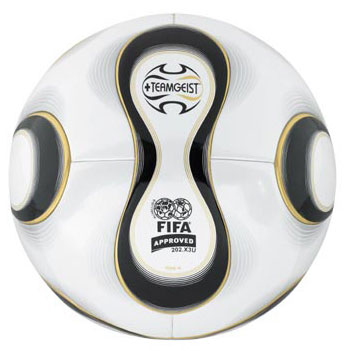
Here’s the official spin from adidas:
The +Teamgeist is the Official Matchball of the 2006 FIFA World Cup. It’s the most accurate football ever produced. No other ball reacts so flawlessly shot after dribble after pass, in the air and on the ground.
• Revolutionary panel shape eliminates surface irregularities to create a perfectly round ball for greater accuracy
• Panels are thermally bonded to create a smooth, seamless kicking surface
• Complete underglass print significantly decreases wear of colors and design
• New carcass retains shape better for improved accuracy and power
• FIFA approved with highest FIFA rating
• 100% PU leather
• Imported
Carcass??
BTW- that’s $130.00
Here’s an idea for a true global index: What’s the cost of the average [actually used by kids] soccer ball in your country? In the US it’s $19.95 for a decent kick-about ball. In Europe? China?
UPDATE:: Reaction to the new ball:
“It is the way a ball should be made,” – David Beckham, England
“The balls design is great, it is going to be a success,” – Kaka, Brazil
“I like this ball a lot because of its return to the more traditional colors,” – Alessandro Nesta, Italy
“When you kick it, it goes in the right direction,” – Zinedine Zidane, France