Announcing our new blog at www.ecosystemwatch.com >>
The idea is fairly simple: If you don’t understand the ecosystem you’re competing in, you can’t compete effectively…
The blog will cover the following topics:
– Blogosphere
– Branding Ecosystems
– Business Ecosystems
– Business Models
– Case Studies
– Disruption
– Ecosystem Maps
– Industry Ecosystems
– Influencers
– Innovation Ecosystems
– Political Ecosystems
– Product Ecosystems
– Social Networking
– Strategy
– Value-Networks
This is a natural offshoot of our Ecosystem Intelligence™ service; take a look…
Why India Will Beat China: Transparency Wins!
The Conrad Group’s William Nobrega writes in BusinessWeek:
“The advantage comes in the form of an entrenched and vibrant democracy that will ultimately drive India to outperform China socially and economically. Messy, frustrating, and more often than not agonizingly slow, India’s democracy would seem to be chaotic at the surface.”
India will eventually outclass China because of its property rights, rule of law, and IP protection, says Nobrega.
Meanwhile in the US: we’re busy protecting the flag and burning the constitution…
Disaster Capitalism: Naomi Klein and the Truth
The Shock Doctrine – or how to use war and other disasters to make money for special interests like the oil lobby.
See more on how this “state of extortion” technique plays in the aftermath of Katrina, or the wildfires in the west, or the use of conserved lands for agriculture.
Now, that’s the truth.
How to Measure Innovation
In some companies, you’ll hear senior executives spout this tired mantra: “Innovation is everyone’s job.” When that happens, head for the exit.
Now, the British are going to tell us how to measure innovation. The National Endowment for Science, Technology & the Arts (NESTA), a nonprofit organization that promotes innovation, wants to create a new index, one that will be industry-specific… blah, blah, blah.
I agree with their premise that traditional methods of measuring innovation, such as the amount of money thrown at R&D, don’t tell the entire story.
But their idea of implementing an industry-based “peer review in which company executives both help to define the innovation indicators and rate each other” is a joke.
Let’s see. Let’s ask the CEOs of Exxon, Chevron, Shell ,and BP to rate their industry on innovative approaches to solving the energy problem. Not funny, is it?
Clayton Christensen says the same thing in this article about creating new value networks.
So what should we measure? How about looking at results?
Can we identify disruptive entrants in an existing industry ecosystem? (Shameless plug: yes, we can – with Ecosystem IQ)
Hey, at least the British are trying. Better than our lame Department of Commerce.
BTW, BusinessWeek does have a Global Innovation Index worth looking at, but again, they’re looking at the establishment, the industry giants that are investing in innovation.
What I want to see is the game-changers. Where’s the next successful car company coming from? Is it Tata or Tesla?
We Can Solve It: Al Gore’s throws down the challenge of our time
Bill Gates and Philanthropy 2.0: shouting for the voiceless
Bill Gates’ greatest achievements lie ahead of him. And this time, he really is going to change the world.
Why? Because he understands that there are some things that just can’t be done by business or the marketplace.
His words:
95 percent — actually, 98 percent — of all medical research is done for rich people. It’s done for baldness, erectile dysfunction, cosmetic surgery. That’s where 98 percent of the researchers are working. …
So the voices of the poor are never heard in this marketplace system. That is, the needs of the poorest, they don’t speak in that prioritization, because they’re not paying for medicines. They can’t.
So today’s prioritization is totally for the richest, for the things that they speak by buying those various medicines for. And so as we take our money, which in total is, compared to the overall market, fairly small, and cause some shift in the favor of malaria, AIDS, tuberculosis, to the degree there’s a finite number of scientists in the world, then you could say, OK, there’s a little bit less on baldness.
Because our money is incremental, ideally you’d be growing the pool of scientists, because you have more money, more jobs, more opportunity there. But it is true that the needs of the very richest might get a tiny bit less attention as we cure tuberculosis.
It’s refreshing to hear this from a leader of Gates’ caliber.
Another point of note: Gates doesn’t want incremental innovation and since he knows the current model of medical research isn’t working, he’s ready to change it.
There’s a lot more on this new version of Gates here, here, and here. What I like about it is the fact that Buffet is on board with him, and that between the two of them, they’re going to redefine the meaning of philanthropy.
The Gates Foundation is focused, and rightly so, on health and development.
But there’s just one thing they’ve forgotten: energy.
As Bob Freling says, “Energy is a human right.” The point Freling makes every day is absolutely critical and one Gates needs to understand: “You can’t have X-rays, or crop irrigation, or vaccines, without electricity. And in places like Africa, the only effective way to get that electricity – when you’re off the grid – is solar power.” So the Gates Foundation is going to have to look at energy as well. And the sooner they do, the faster they’ll get there with their other objectives – food security, health care for the poorest of the poor, etc.
I can’t wait to see more billionaires get on the Philanthropy 2.0 bandwagon. What are you waiting for Larry Ellison? And how ’bout getting A.G. Lafley and the P&G open innovation nerds on board as well. Let’s cure malaria instead of whitening teeth. eh?
Go, Bill, Go.
The Commoditization of the Starbucks Experience
Here’s Howard Schultz in his now classic Valentine’s Day memo in 2007:
As you prepare for the FY 08 strategic planning process, I want to share some of my thoughts with you.
Over the past ten years, in order to achieve the growth, development, and scale necessary to go from less than 1,000 stores to 13,000 stores and beyond, we have had to make a series of decisions that, in retrospect, have lead to the watering down of the Starbucks experience, and, what some might call the commoditization of our brand.
Many of these decisions were probably right at the time, and on their own merit would not have created the dilution of the experience; but in this case, the sum is much greater and, unfortunately, much more damaging than the individual pieces. For example, when we went to automatic espresso machines, we solved a major problem in terms of speed of service and efficiency. At the same time, we overlooked the fact that we would remove much of the romance and theatre that was in play with the use of the La Marzocca machines. This specific decision became even more damaging when the height of the machines, which are now in thousands of stores, blocked the visual sight line the customer previously had to watch the drink being made, and for the intimate experience with the barista. This, coupled with the need for fresh roasted coffee in every North America city and every international market, moved us toward the decision and the need for flavor locked packaging. Again, the right decision at the right time, and once again I believe we overlooked the cause and the affect of flavor lock in our stores. We achieved fresh roasted bagged coffee, but at what cost? The loss of aroma — perhaps the most powerful non-verbal signal we had in our stores; the loss of our people scooping fresh coffee from the bins and grinding it fresh in front of the customer, and once again stripping the store of tradition and our heritage? Then we moved to store design. Clearly we have had to streamline store design to gain efficiencies of scale and to make sure we had the ROI on sales to investment ratios that would satisfy the financial side of our business. However, one of the results has been stores that no longer have the soul of the past and reflect a chain of stores vs. the warm feeling of a neighborhood store. Some people even call our stores sterile, cookie cutter, no longer reflecting the passion our partners feel about our coffee. In fact, I am not sure people today even know we are roasting coffee. You certainly can’t get the message from being in our stores. The merchandise, more art than science, is far removed from being the merchant that I believe we can be and certainly at a minimum should support the foundation of our coffee heritage. Some stores don’t have coffee grinders, French presses from Bodum, or even coffee filters.
Now that I have provided you with a list of some of the underlying issues that I believe we need to solve, let me say at the outset that we have all been part of these decisions. I take full responsibility myself, but we desperately need to look into the mirror and realize it’s time to get back to the core and make the changes necessary to evoke the heritage, the tradition, and the passion that we all have for the true Starbucks experience. While the current state of affairs for the most part is self induced, that has lead to competitors of all kinds, small and large coffee companies, fast food operators, and mom and pops, to position themselves in a way that creates awareness, trial and loyalty of people who previously have been Starbucks customers. This must be eradicated.
I have said for 20 years that our success is not an entitlement and now it’s proving to be a reality. Let’s be smarter about how we are spending our time, money and resources. Let’s get back to the core. Push for innovation and do the things necessary to once again differentiate Starbucks from all others. We source and buy the highest quality coffee. We have built the most trusted brand in coffee in the world, and we have an enormous responsibility to both the people who have come before us and the 150,000 partners and their families who are relying on our stewardship.
Finally, I would like to acknowledge all that you do for Starbucks. Without your passion and commitment, we would not be where we are today.
Onward…
So is Starbucks really turning itself around by going back to its roots?
John Quelch says some interesting things about Starbucks here>>
Are you listening, Krispy Kreme?
Video: Gerald Zaltman on Marketing Metaphors
Active Inertia: Why Good Companies Go Bad
The Economist has just begun a series on “big ideas” in management thinking. These may be the buzzwords of the past, but many of them are worth understanding.
Active Inertia. That’s how successful companies (and governments) lose their way. Here’s how Don Sull explains his idea:
My research suggests that companies fall prey to active inertia—responding to even the most disruptive market shifts by accelerating activities that succeeded in the past. When the world changes, organizations trapped in active inertia do more of the same. A little faster perhaps or tweaked at the margin, but basically the same old same old. Managers often equate inertia with inaction, like the tendency of a billiard ball at rest to remain immobile. But executives in failing companies unleash a flurry of initiatives—indeed they typically work more frenetically than their counterparts at competitors which adapt more effectively. Organizations trapped in active inertia resemble a car with its back wheels stuck in a rut. Managers step on the gas. Rather than escape the rut, they only dig themselves in deeper.
What Sull says is that we get trapped in our assumptions in the following areas:
Strategic frames: What we see when we look at the world, including definition of industry, relevant competitors and how to create value.
Processes: How we do things around here entailing both informal and formal routines.
Resources: Tangible and intangible assets that we control which help us compete, such as brand, technology, real estate, expertise, etc.
Relationships: Established links with external stakeholders including investors, technology partners or distributors
Values: Beliefs that inspire, unify and identify us.
So we just dig a deeper hole.
How do we get out of the mess? It starts with a sense of urgency.
By the way, this idea of active inertia applies at the individual level as well. How many of us go through life doing the same thing over and over?
How to Innovate like Google: Tom Davenport and Marissa Mayer
Two perspectives – one for Tom Davenport:
and the other from Google’s Marissa Mayer:
The “open-culture” thing is key. I wrote about this a while back in a not-so-subtle entry titled: “Google’s Product Development & Management Process Revealed” .
The Secrets to Successful Strategy Execution: Define Responsibilities Clearly and Share Information

Pretty simple, ha? So how come so few companies do this? (That was a rhetorical question, we all know the answer – because they forget about their “greatest asset”).
Read the article here >>
Greenwashing is the New Red, White, and Blue
How do you motivate your employees in this, the age of cynicism?
Instead of handing out Chinese-made flag pins to all their employees (yes, this actually happens) companies can start by supporting a few good causes.
The Economist has a nice write-up on companies taking this leap. A few examples:
– IKEA, the world’s largest furniture-maker, joins forces with Rainforest Alliance and WWF to promote forest certification in China by the Forest Stewardship Council
– Marriott International teams up with Conservation International and the Brazilian state of Amazonas to protect a big area of Amazon rainforest.
– Wal-Mart, the world’s biggest retailer, set up an ambitious programme in 2005 with the long-term aim of becoming a zero-waste, renewably powered enterprise.
OK. Does this mean that business is finally waking up to do the right thing?
Not exactly.
The real danger with the “greening of business” is hypocrisy, i.e. greenwashing:
So if your business is going to go green (and it should), make sure you don’t do it as a PR stunt.
If you do, your company just might end up here >>
Lessons Learned: Branding and Online Communities
Back in 2000 I was the leading an interesting experiment at one of the world’s largest software companies. The idea was simply this: if we build “communities of interest” around a specific topic (e.g. “database management,” or “innovation,” or “quality of experience”) we’ll be able to attract a significant number of our “target” audience and convert them to paying customers over time.
In a year and a half, we built seven distinct communities each supported by an ecosystem of vendors and partners. For four years we tried to make these communities work, and we did, with various levels of success. Along the way we learned several key lessons and I mention them here because while they seem basic, few companies ever seem to get them right:
Communities build Brand Equity
Unaided brand recognition for our company went from 12% to 84% within two years. Our “agency” did the survey and couldn’t believe the findings. Like most agencies, this one was focused on producing “creative” work rather than figuring out how to be useful to the consumer. Of all the sites we built, this was the only one which received “full funding” and was strongly supported ($) by the sponsoring business unit. It became a major hub in the ecosystem we were competing in, and we literally had about 50% of the “target audience” “opted-in” to our email newsletter. Furthermore, in terms of online referrals, this community accounted for as much as 40% (yes, forty percent) of referrals to the online store.
Communities are Self Segmenting
We learned we didn’t have to target or segment anyone. The content did the work for us. Because each community was “vertical” and concentrated on a specific subject, the only visitors we got were people interested in the topics we wrote about. In fact, the some of our more successful sites became the hub in the marketspace we were targeting.
Stop Selling, Start Learning
We didn’t push products on the sites. In fact, we tried hard not to sell. Instead, we focused on educational content from the world’s leading experts. The result, we had “stickiness” numbers even I couldn’t believe. On our best site, the average user spent over an hour per visit. And this number held up every month, for three years in a row. While we tried our best to teach, we also spent a considerable amount of time learning. I’d spend afternoons poring over site statistics – trying to figure out what was going on.
The 90/10 Rule applies
As we studied visitor behavior, we looked at content and author popularity, the clickthroughs and conversion rates, and resilience – which articles or discussions stood the test of time. Surprisingly, we noted that 5% of our authors drove 95% of our traffic. And 5% of our readers drove 95% of our sales. This was the pareto-principle on steroids (Richard Koch was right)!
Communities Drive Demand Generation
10X better than traditional online techniques like SEO and PPC. Our cost per lead was so low, our EVP of Sales couldn’t believe it. He became one of our biggest supporters.
Corporate Marketing is the Enemy
Don’t ever sell “communities” to a marketing department that thinks in terms of quarters and campaigns. As our communities took off, we experienced all sorts of difficulties, not from the outside, but rather from the corporate marketing staff. My boss believed that companies must drive traffic to their branded company URL, and not to a myriad of niche sites with funky names like linuxvalue.com (the site no longer exists, but it did work). Luckily my boss got zapped before I did, and I was able to keep the experiment going over four years and three different corporate marketing regimes. To this day, they don’t get it.
Forget the Wisdom of the Crowd, Focus on Thought Leadership
Communities are not necessarily social networks. We learned early on to allow the leading experts in the field to write about their pet peeves and passions. Sometimes they would come to “virtual blows” – one expert against the other – each presenting their views with wit and learning (and the occasional threat).
Manage the Ecosystem
After a year of slogging, we suddenly noticed that we didn’t have to worry about keywords or search engines ever again. We had become Google favorites. Almost anything we wrote about on any of the sites rose to #1 in Google and stayed there for years. Why? Because we had built a strong enough ecosystem- not a business ecosystem, mind you, but a consumer ecosystem. Our readers loved us. The experts loved us. Google loved us. What a game! All we had to do was focus on quality content. Our ecosystem became impenetrable. We had built a firewall against all competition. One example is particularly striking. Even after we stopped updating the site in question, we remained at #1 in Google for a highly competitive key phrase – not for a month or two, but for straight three years, after we had stopped touching the site at all!
There were a few more lessons we learned as well, but I think I’ve done enough jabbering for today. The end game for me was Double Loop Marketing™ and Ecosystem Intelligence™ – both direct offshoots of my time spent figuring out how to make communities succeed.
Viewer-Driven TV Programming – Is PBS serious?
I think it’s a nice gesture that PBS is asking viewers for programming suggestions:
What would your prime time lineup look like? Would you emphasize news and public affairs programming over science and nature content? Would you make changes to existing shows? What kinds of new series and specials would you bring to the public airwaves?
When they meet in Palm Desert, CA, the executives should take a look at the suggestions, but I feel they should talk to each other as well.
Why? Because there are serious limitations to heeding the Wisdom of the Crowd.
I blogged about Nick Carr‘s take on this subject a while back: “What crowds are good for is producing average results that are not subject to the biases and other quirks of human minds.”
The PBS bigwigs have forgotten their mission. (Maybe not, since a lot of them are now Republicans; I have to confess, when I heard about that I was sure we were soon all going to be watching infomercials on PBS 24/7).
So let’s remind them what public television stands for. What’s the brand personality they need to be faithful to?
Seth Godin weighs in on this issue with a brilliant post about the purpose of the New York Times. Same deal for PBS.
So let’s ask: What’s important? What’s true?
Big opportunity for big stories, PBS. Go where the corporate media can’t go:
News, Education, and the Arts. And don’t forget to add “Global Warming” as a new category.
PBS, you knew that once.
Look what happened to Ted Koppel and Nightline. Or David Brinkley’s This Week. I’ll Fly Away. That’s commercial television. PBS, please don’t go there.
One more thing: make sure every show is archived online for viewing over the Internet. All the way back to the very beginning of PBS (including Mr. Rodgers’ Neighborhood). That would be a real public service. Heck, put ’em all on YouTube.
I’m a fan of customer feedback, but I’m a bigger fan of the customer experience.
Don’t mess this up, PBS.
Ranking Business Gurus: The Librarian’s Dilemma
Tom Davenport has done it again. He’s come up with a list of top business gurus in Rupert Murdoch’s Wall Street Journal.

Using the same methodology he used in his book, Tom tells us that things have changed. These are the new Big Idea
Why all boys? Because the business world still seems to be sexist? Or maybe the women thinkers aren’t focusing on “selling” their ideas as much? Where’s Dorothy Leonard-Barton? Or Tammy Erickson, for that matter?
The Times has its own list of business gurus.
Accenture still points to the 50 Gurus that Tom Davenport came up for them a few years ago.
God is in the details. The issue I have is that Tom and H.J. have not really taken into account how Google works. They’re measuring quantity, not quality.
In terms of popularity, no one uses Lexis Nexis or the SSCI database, except for academics and librarians. So I’ve got to discount those two components of the guru index.
Let’s get less academic and try to measure who’s really getting attention. (By the way, Tom has a great book on that subject as well).
So to measure real-time popularity, here’s what I propose: let’s measure the influence network for each of these management gurus. Let’s see how far their reach extends in the ecosystem they’ve built with their ideas. Let’s look at who’s linking to them. Let’s look at their site traffic. Let’s compare their ecosystem rankings. Let’s take Google, Yahoo, and the blogs into account.
Stay tuned. We’re going to have some fun using our ecosystem mapping tool.

Steve Jobs’ 2005 Stanford Commencement Address
The Steve Jobs story: follow your curiosity, not your curriculum!
Why did Tata buy Range Rover and Jaguar?
Interesting analyses. We are going to see many more such mergers.
India and China are buying up brands.
We are going to see many more such mergers. These are “learning-acquisitions.”
Let’s see what Tata can teach Jaguar, and vice-versa. Value-engineering? Haven’t heard that terms since the 1980s…
Al Gore: Climate Warming 2.0
Go Al Go!
Olympic Torch Twittered out of San Francisco
Here’s how Twitter helped Team Tibet follow the secret torch route as authorities tried to hide the Olympic flame’s dash through San Francisco. It’s nice to see Twitter being put to serious use as a real-time communication tool for its customers.
You can add your voice to the chorus here >>

China has already lost!
Bishop Tutu stands up and tells it…
Will China develop Africa?
Because resource-rich Africa has been left out of the development plans of most Western companies, doesn’t mean that Africa won’t find a way to join the wave of globalization sweeping the world from Asia to Eastern Europe and South America.
So how will Africa do it? Through China and India.
This is a not good news for democracy:
In February 2007, Hu Jintao proudly announced the creation of a new special economic zone complete with the usual combination of export subsidies, tax breaks and investments in roads, railways and shipping. However, this special economic zone was in the heart of Africa—in the copper-mining belt of Zambia. China is transplanting its growth model into the African continent by building a series of industrial hubs linked by rail, road and shipping lanes to the rest of the world. Zambia will be home to China’s “metals hub,” providing the People’s Republic with copper, cobalt, diamonds, tin and uranium. The second zone will be in Mauritius, providing China with a “trading hub” that will give 40 Chinese businesses preferential access to the 20-member state common market of east and southern Africa stretching from Libya to Zimbabwe, as well as access to the Indian ocean and south Asian markets. The third zone—a “shipping hub”—will probably be in the Tanzanian capital, Dar es Salaam. Nigeria, Liberia and the Cape Verde islands are competing for two other slots. In the same way that eastern Europe was changed by a competition to join the EU, we could see Africa transformed by the competition to attract Chinese investment.
As it creates these zones, Beijing is embarking on a building spree, criss-crossing the African continent with new roads and railways—investing far more than the old colonial powers ever did. Moreover, China’s presence is changing the rules of economic development. The IMF and the World Bank used to drive the fear of God into government officials and elected leaders, but today they struggle to be listened to even by the poorest countries of Africa. The IMF spent years negotiating a transparency agreement with the Angolan government only to be told hours before the deal was due to be signed, in March 2004, that the authorities in Luanda were no longer interested in the money: they had secured a $2bn soft loan from China. This tale has been repeated across the continent—from Chad to Nigeria, Sudan to Algeria, Ethiopia and Uganda to Zimbabwe.
Read more here >>
Africa’s “imperialism challenges” will now come from the East.
Pranab Mukherjee, India’s Minister of External Affairs, talks a good game.
So why all the fuss over Africa? And why now?
Do China and India really care about African development?
Or is it the news that Africa is the new oil frontier.
Apparently Africa will account for 12% of global oil supplies in the next few years. And that’s not counting other mineral riches…
Don’t be too eager, Africa. Trust, but verify – as someone once said. And heed this African saying: If a little tree grows in the shade of a larger tree, it will die small. But if a little tree stands side by side with a larger tree, you have the start of a forest.
Theater of the Absurd: China stages “monk violence”?

in case you wondered why these “Tibetan monks” were so violent in Lhasa….
A Theme Song for Tibet: Get Up, Stand Up (Stand Up for Your Rights)
David “Dread” Hinds (Steel Pulse), Sly & Robbie, Aswad, Ini Kamoze and Dennis Brown… mash it!
And here’s the original version by Robert Nesta:
Get Up, Stand Up!
Earth Hour
More fun facts:
The average American produces about 20 tons of the major greenhouse gas carbon dioxide (CO2) every year. That might sound like a lot — and Americans do have among the biggest carbon footprints in the world — but the entire world emits around 27 billion tons of CO2 each year, through transportation, electricity use, deforestation.
So now we have Earth Hour.
Let’s rearrange the deck chairs…
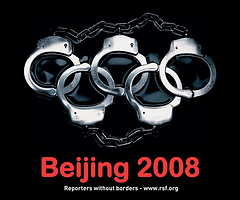
The Ghost of Tiananmen: China, Tibet and the Olympics

When I was a kid in India, one of the fondest memories I have is of a family vacation in the foothills of the Himalayas – eating at a tiny Tibetan roadside dhaba, being fed tons of cho-cho-momo and heaping piles of noodles. The food was great, but what struck me was the poor Indian peasant family sitting across from me eating their fill as well. Why? because the food was so cheap and so good that everyone could afford to eat well. I’ve never forgotten that day.
The family that ran the dhaba were refugees from Tibet, and I was fascinated by the store, the food, and the way they used an abacus to add up the transactions as they happened. That day I became a believer in a free Tibet.
I wrote earlier about China’s country branding issues and the upcoming Olympics.
I’ve also written about how to measure democracy with the “Journalists-in-Jail Index.”
And now we have pictures of the Chinese government beating up on Tibetans splashed across the pages of every major newspaper and magazine.
And don’t forget YouTube:
Here we go again.
This time Chinese officials are blaming the Dalai Lama for the violence. Give me a break. They’ve even got an army of bloggers and hackers working the media sites posting “pro-chinese” accounts all over the place.
Bush, of course, is silent. He knows that China’s in Tibet for the uranium.
I get a feeling the sponsors of the Olympics are in for a rough ride. Here are the brands which stand to get a black eye:
Coca-Cola
McDonalds
General Electric
Visa
Johnson and Johnson
Kodak
Samsung
Panasonic
Atos Origin
Lenovo
ManuLife
Omega
And let’s not forget the Olympic brand itself. This could do it in completely!
Stay tuned and sign a petition>>
UPDATE: More video >>
Video: Ricardo Semler’s Open-Capitalism
I’ve been following Ricardo Semler for many years now.
In 1993, in a fit of madness I slipped a copy of Maverick into the hands of Riley Bechtel – thinking as I did at the time, that this is the only way to get Bechtel to re-engineer itself. Of course I was a little too naive…
Today I don’t think I could work at Semco because I’d rather work for myself. But if I had to get a corporate job again (heaven forbid) I’d choose Semco.
Question: when are they opening a “Semco-proper” office in the US? You can check Semco’s company history here.
Anyway, the revolution has happened and it was televised. Here’s what to expect:
And definitely check this out >> (Journeyman Pictures doesn’t understand YouTube – hence the “Embedding disabled by request”)
Open-capitalism is thriving at Semco, and one of these days, it will show up in your industry. What strikes me though is the fact that this model can be used in non-profits, in government (are you listening, Barack Obama?) and even in the fields without hope – like education. Apparently Bill Gates’ foundation is keeping close tabs on Semler’s schooling experiment.
Online Brand Monitoring: A survey of marketspace analytics vendors and why they fall short
From GE to Target, from IBM to Best Buy, companies of all stripes and sizes are struggling to quantify the effects of Web 2.0 on their companies. What are the blogs saying? Are they positive or negative? What’s happening on Second Life? Where are our customers congregating? Who are the influencers in the marketspace?
The result of this anxiety is a new booming business in “marketspace analytics”—companies that profess to track your brand over time and alert you to news (bad or good) in real time.
Given some of the new findings about buzz in the blogosphere (positive online buzz for cars and trucks doesn’t necessarily translate to volume sales) you have to ask, are they wasting their time?
My take on this is somewhat biased. I view all of these brand monitoring products as the online equivalent of the traditional press-clipping tracking function the PR companies used to cling to as a way to justify their existence.
That said, online brand building is a critical competence for today’s marketer. What matters is not online buzz which is a temporary spike in attention, but what that buzz does to your position in your online ecosystem.
Your competitive position in your ecosystem determines your destiny:
• How do you and your competitors compare in terms of return on marketing investments and relative share of the ecosystem?
• How are the leaders making money, and what is their approach in the ecosystem?
• What is the full potential of your business position in the ecosystem?
• How big is your marketspace—the size of the ecosystem you want to compete in?
• Which parts of the ecosystem are growing fastest?
• Where are you gaining or losing share in the ecosystem or sub-ecosystems you compete in?
• What capabilities are creating a competitive advantage for you in the ecosystem?
• Which capabilities need to be strengthened or acquired to help you compete in the ecosystem?
Because we couldn’t find anything to help us with these questions, we decided to build it ourselves. That’s how our Ecosystem Intelligence™ service came into existence:
(i) to help measure a company’s position in the ecosystem(s) it competes in, and
(ii) to help improve that position in the marketspace over time
Now let’s check out some of the competing brand monitoring vendors:
Biz360: provides customer opinion measurement from thousands of expert and consumer product review websites, shopping sites, blogs and message boards
Cymfony: rated highly by the tech analysts, they claim to “quantify your amount of coverage as well as get expert qualitative interpretation of how effectively your message is being picked up in traditional and social media.”
Skygrid: a search tool that sifts through hundreds of web and mainstream media to show you just one thing: whether the balance of the news on a public company is good or bad, and how the “mood” is changing.
BrandIntel: collects, processes and analyzes online consumer content and applies human analysis to the results in context.
Factiva: monitors your competitors, customers, and industry, with in-depth research and company financial data reports.
MotiveQuest: “sees” the “peaks of passion” in online conversations to understand customer motivations. Again, a combination of proprietary software and human analysts to explore what drives customer behavior.
Nielsen Buzzmetrics: measures consumer-generated media to help companies understand consumer needs, reactions and issues. They use a data-warehouse approach to index customer sentiment.
Scout Labs: allows users to track brands and reactions to those brands. In essence, the company helps companies make sense of positive and negative brand sentiment in blogs, user generated videos, and images.
Umbria: analyzes social media—including blogs, message boards, Usenet, and product review sites. Umbria also adds human insights to their data reports.
And there you have it, all variations on the press-clipping theme.
And unfortunately most companies (including the ones above) don’t get it.
It’s not about tracking buzz, it’s about starting a conversation.
Seth Godin gets it.
Bill Clinton Endorses Obama!
Hat tip to Steel Pulse!
Online Buzz Bubble-Popper: Positive reviews don’t necessarily mean more sales
Positive online buzz for cars and trucks doesn’t necessarily translate to volume sales, period.
Here’s the story in AdAge: “What Web Buzz Does for Car Sales: Not Much”
Turns out that BrandIntel has been monitoring 450,000 comments over the past year. Comments made by “enthusiasts” in consumer discussion forums on auto-information sites such as Edmunds.com, newspaper and magazine sites, and blogs.
Let’s look at the print/paper analogy. This is the equivalent counting the number of press-clippings in the trade mags. As a measure of PR efficacy of getting stories published, it worked great. As an indicator of sales, it didn’t.
What matters in print and online is the credibility of the messenger and the size of the audience. A story in Rupert Murdoch’s WSJ or the NY Times may have a dramatic impact compared to the same story in your local rag.
Online, credibility and audience-size still matter, but so does findability. How easy is the story to find? Does it come up high in Google and to a lesser extent Yahoo? If there is buzz, is the buzz on a hub or a backwater site? Is it getting attention or play through links from other noteworthy sites?
How does one measure that? There is a way – ecosystem relevance – which measures the position and rank of a site within its industry/category ecosystem.
C. K. Prahalad: Democratizing Opportunity
A viable, sustainable economic model is crucial for the future of the planet. Tell ’em, C.K.!
Marketing in a Downturn
Seth Godin writes about “marketing in a recession” :
The challenge for marketers is to figure out how to change the story they are living so that their customers can change the story they tell themselves. What you make, where you make it, who makes it, how it’s priced and sold and … it all adds up to a perception. If you change these elements the story will change too.
His point is that Starbucks becomes the indulgence of someone who has just traded down to a small rental apartment. Gone are the days of $4.00 coffee just for the heck of it.
I think Starbucks is busy changing their story. They’re trying to be a new, upscale McDonald’s – rapidly working to add in a “drive-in have a happy meal” component to their business model. The trouble is in the demographics. Bill Tancer at TIME tells us that “the Big Mac customer base has remained relatively stable, while Starbucks’ coffee-drinkers have diversified. It used to be that Starbucks attracted customers from a small, elite segment of the country; now, its visitors pervade many more segments across America.”
From my own observations at the local Target, I see far more customer buying ICEEs rather than Starbucks coffees. This is the “threat of substitution” that is always around the corner, no matter how good your product is. Seems like the days of mass-luxury are over.
So where does retail find its consumer, er, citizen? Turns out they’re not citizens at all – you’ve got to sell overseas. India and China are experiencing a huge boom in luxury, thanks to an explosion in middle class prosperity. The fortune is in the middle and the bottom of the pyramid.
And if you can’t reach those consumers? I wrote about that in an earlier post about advertising in a recession.
Jeffrey Immelt: India versus China – Trust is a Global Issue for GE
I was talking to Bill Dunk this morning, and we got to the topic of trust as an issue in global business.
I told him I’d seen a video in which Jeff Immelt said something to the effect that in China the concept of win-win is an issue, whereas India is much better at partnerships.
Immediately, Bill dug up this article for me – an interview with Nani Beccalli-Falco, GE International’s chief executive.
From the article:
This is a difficult challenge and it is one that Beccalli-Falco speaks of with surprising candour. He talks of the problems of striking deals in China, where, he says, the values of equity and fairness implied in the West’s ‘win/win’ approach to business are replaced by a more naked self-interest. “In China, they have a tendency to think ‘win for China, OK for you’,” he says. “It makes forming partnerships difficult.”
If you want to get a global perspective on business, you must subscribe (for free) to Bill Dunk’s Global Province >>
And yes, I finally dug up the video:
Watch Immelt’s interview with Rajat Gupta, and listen carefully as Immelt talks about India versus China – right at the very end of the video:
“China has a hard time with win-win. That’s a problem over the long term.India’s much better. There’s a much better sense that India can be a real ally…”
Wow.
China’s got the Olympics this summer… wonder if they’ll let anyone else win a medal…
Interview: Stephen M. R. Covey on “The Speed of Trust”
We did this interview a year ago, but he’s finally (and deservedly) hitting the best-seller lists – thanks to a strong internet-based campaign. The book
Why do you claim that “Trust” is the key leadership competency of the new global economy?
Covey: If you look at the nature of the world today, a foundational condition in Thomas Friedman’s flat world is the presence of trust. Put simply, today’s increasingly global marketplace puts a premium on true collaboration, teaming, relationships and partnering, and all these interdependencies require trust. In the book I point out that partnerships based on trust outperform partnerships based on contracts. Compliance does not foster innovation, trust does. You can’t sustain long-term innovation, for example, in a climate of distrust.
In issue after issue, the data is clear: high trust organizations outperform low-trust organizations. Total return to shareholders in high trust organizations is almost three times higher than the return in low trust organizations.
So we assert that trust is clearly a key competency. A competency or skill that can be learned, taught, and improved and one that talent can be screened for.
Trust is the one thing that affects everything else you’re doing. It’s a performance multiplier which takes your trajectory upwards, for every activity you engage in, from strategy to execution.
How do you identify a high-trust or low-trust organizations?
Covey: Trust is a powerful accelerator to performance and when trust goes up, speed also goes up while cost comes down — producing what we call a trust dividend. How do you know if you have a high trust culture? By observing the behavior of your people. In high trust, high performance companies, we observe the following behaviors:
• Information is shared openly
• Mistakes are tolerated and encouraged as a way of learning
• The culture is innovative and creative
• People are loyal to those who are absent
• People talk straight and confront real issues
• There is real communication and real collaboration
• People share credit abundantly and openly celebrate each others’ success
• There are few “meetings after the meetings”
• Transparency is a practiced value
• People are candid and authentic
• There is a high degree of accountability
• There is palpable vitality and energy–people can feel the positive momentum
Another very visible indicator is the behavior of your customers and suppliers. What is your customer churn rate? Do you have a history of long-term customer and supplier relationships? What is your reputation or brand equity in your marketplace?
Conversely, when the trust is low, there’s a trust tax which changes your trajectory downwards. In our work with organizations, we find that low-trust, low-performance organizations typically exhibit cultural behaviors like:
• Facts are manipulated or distorted
• Information and knowledge are withheld and hoarded
• People spin the truth to their advantage
• Getting the credit is very important
• New ideas are openly resisted and stifled
• Mistakes are covered up or covered over
• Most people are involved in a blame game, badmouthing others
• There is an abundance of “water cooler” talk
• There are numerous “meetings after the meetings”
• There are many “undiscussables”
• People tend to over-promise and under-deliver
• There are a lot of violated expectations for which people make many excuses
• People pretend bad things aren’t happening or are in denial
• The energy level is low
• People often feel unproductive tension–sometimes even fear
These behaviors are all taxes on performance.
The work we do is to establish trust as your organizational operating system. That’s a high-tech metaphor, but it’s appropriate. We know how trust works, how to measure it, how to establish it, grow it, extend it, and sustain it – with all stakeholders.
Why is trust such a hidden variable to many otherwise competent managers?
Covey: Unfortunately, too many executives believe the myths about trust. Myths like how trust is soft and is merely a social virtue. The reality is that trust is hard-edged and is an economic driver.
For instance, strategy is important, but trust is the hidden variable. On paper you can have clarity around your objectives, but in a low-trust environment, your strategy won’t be executed. We find the trust tax shows up in a variety of ways including fraud, bureaucracy, politics, turnover, and disengagement, where people quit mentally, but stay physically. The trust tax is real.
There are many myths about trust, and in my book I present them in a table your readers may find helpful:

So trust is measurable? quantifiable?
Covey: Absolutely, trust is measurable. Smart organizations measure trust in three key ways: 1) actual trust “levels”; 2) the “components” or dimensions that comprise trust; and 3) the “effects”, or impact, of trust.
We have found that one very simple way to measure trust levels is to ask one direct question and roll it up and down throughout the organization. For internal stakeholders ask: “Do you trust your boss?” to employees at all levels of an organization. For external stakeholders, like customers or suppliers, you might ask them: “Do you trust our sales representative or account manager?” These are simple, direct questions that tell us more about our culture than perhaps any other question we might ask.
Now, wouldn’t it be great if “trust” showed up on the financial statements as either a ‘tax’ or a ‘dividend’? Organizations would then use resources to eliminate the tax or create a larger dividend! Although a high trust or low trust culture doesn’t literally show up on financial statements, it does show up in the following ways, which are measurable, observable and economically relevant – all of which make a strong “business case for trust”:

What are the competencies, the behaviors that build trust?
Covey: Trust too often has been pigeonholed as based on character and integrity alone. There’s nothing wrong with that, and that is clearly the foundation, but it’s insufficient.
Trust is a function of both character and competence. Of course you can’t trust someone who lacks integrity, but hear this: if someone is honest but they can’t perform, you’re not going to trust them either. You won’t trust them to get the job done.
That’s one reason why trust has a soft image- because it has been severed from competence and results.
So how does one apply trust to branding?
Covey: When I look at a brand, a brand is nothing more or less than trust with the customer, trust with the marketplace. The principle behind a brand is reputation. The brand stands for a promise and the ability to deliver on that promise. And in that promise is a company’s character and competence, its reputation.
From the character side you start with integrity–honesty, congruence, humility and courage. The courage to be open, to stand for something, to make and keep commitments. Then there’s intent–is there a genuine concern for people, purposes and society as a whole or is profit your sole motive? What’s the company’s agenda? And how does it behave? Sometimes poor behavior is simply bad execution of good intent.
On the competence side, you start with your capabilities–talents, skills, the ability to deliver. Is your company staying relevant, are you continually improving, do you have the right technologies to stay ahead of your competition? Brands need to reinvent themselves from time to time to stay relevant. Finally, look at your results. Your company and your brands are constantly measured based on past performance, present performance and anticipated future performance.
These four dimensions–integrity, intent, capabilities and results–make up the credibility and reputation of your brand. When the trust is high, you get the trust dividend. Investors invest in brands people trust. Consumers buy more from companies they trust, they spend more with companies they trust, they recommend companies they trust, and they give companies they trust the benefit of the doubt when things go wrong. The list goes on and on. On the Internet, a trusted brand versus an untrusted brand–the differences could not be clearer, you only give your credit card number to those you trust. And look what happens when a brand gets diluted or polluted or compromised, we see how fast consumers, and investors, turn away. They quit buying.
These same principles apply equally to companies and individuals.
What about the social responsibility of business? Is this part of the trust equation?
Covey: Initially many companies may move into this arena for PR purposes. More out of fear of not being in the arena, than really participating with their souls. But there are huge benefits that flow from this – the difference it makes with your employees first, then your customers, your suppliers, your distributors, your investors.
The distrust we see all around is suspicion, a response to the corporate scandals and vicious downward cycles of cynicism. But when a company focuses on the principle of contribution for all stakeholders, that becomes good business. Executives need to understand the economic benefits of this trust dividend, especially when the behavior is real, not artificially or superficially created as PR to manipulate trust. We will see more and more companies moving in this direction because it makes economic sense, period.
Trust varies by geography, as you’ve pointed out in your book. How do companies build trust globally?
Covey: There’s no question that trust issues are global issues. There’s also a country tax. The Edelman Trust Barometer tells us, for example, that trust is often based on country of origin. US companies are being taxed in Europe, in Germany, France and England, for example. How can companies like UPS improve their trust rankings?
Trust can be rebuilt. So how do you build trust? By your behavior. We’ve identified 13 behaviors which build trust:
1. Talk Straight
2. Demonstrate Respect
3. Create Transparency
4. Right Wrongs
5. Show Loyalty
6. Deliver Results
7. Get Better
8. Confront Reality
9. Clarify Expectations
10. Practice Accountability
11. Listen First
12. Keep Commitments
13. Extend Trust
Companies need to have a strong promise, because the promise builds hope. Keeping the promise is what builds trust.
My father has an expression: “You can’t talk yourself out of a problem you behaved yourself into.” So it is with trust.
Sometimes it takes a little time, but you can accelerate the process by declaring your intent and signaling your behavior, so others can see it.
People and companies can learn these behaviors. It’s not a simple process which happens overnight. But it is a systemic, cultural process which can happen one leader at a time, one division at a time, one company at a time, and you can see the behavior shifting toward authentic, real trust-building behaviors as opposed to the more common counterfeit behavior of spin and hidden agendas and the like which tend to dissipate and diminish trust.

Is there a danger in being too trusting or even gullible? <
/div>
Covey: One thing about trust is that everyone’s for it.
However, there are three big objections which come up. The first one is that trust is a social virtue, to which I say no, it’s much more than that; it’s a hard-edged economic driver. Secondly, and we hear this all the time: “we can’t do anything about trust, it’s either there or it’s not there.” This too is a fallacy. Trust is a competency. It’s something you can get good at. It’s a strength you personally, and your team and your company can master. Being good at it will elevate every other strength you have.
The third complaint goes along these lines: “We’ve been burned before. We can’t trust everyone. Are you suggesting we trust everybody?” That’s where I suggest you exercise what I call “SmartTrust.” Most leaders have been burned before, so they become distrusting. Our society is that way. After Enron and WorldCom, we pass legislation like Sarbanes-Oxley to force compliance, raising the “tax” on all businesses. The question is, “is there a third alternative?” An alternative where you combine a high propensity to trust with good analysis and judgment, so we can really assess the circumstances, the risk, the credibility of the people involved, so we can extend trust, and build into that trust a stewardship or responsibility.
If you’re not trusted, you tend to reciprocate with distrust. That’s how the vicious cycle of mistrust starts and spirals downward.
There is a risk in trusting people, but the greater risk is not trusting people.
SmartTrust says you look at the opportunity, the risk and the credibility of the people involved. And you add to that verification and analysis. So you trust and verify. As opposed to verify, then trust!
Let’s look at Berkshire Hathaway and Warren Buffet. I mention them in the book as an example of a high-trust company, about the acquisition they made based on a hand shake without due diligence.
But did you know that’s how the entire company operates?
They have a 192,000 employees with 42 different wholly-owned companies. How many people do you think work at corporate headquarters? ‘
Seventeen!
Why? Because they choose to operate in a “seamless web of deserved trust” as Charlie Munger calls it.
This is real. It’s not blind trust, but smart trust.
Thanks so much.
Seth Godin on Being Remarkable
Seth Godin helps you wake up… you can’t be average anymore.
– Design…
– Don’t be safe…
– Don’t be boring…
– Skip the BMW ad…
– it’s Otaku time!
Kevin Coyne’s 21 Questions for Developing New Products
The December 2007 HBR had an interesting article by Kevin Coyne called Breakthrough Thinking from Inside the Box. There’s far more to this article than just the 21 questions, so I urge you to go grab it here!
The approach Coyne and friends describe supposedly works better than brainstorming or strict quantitative analysis >>
“De-average” buyers and users
Which customers use or purchase our product in the most unusual way?
Do any customers need vastly more or less sales and service attention than most?
For which customers are the support costs (order entry, tracking, customer-specific design) either unusually high or unusually low?
Could we still meet the needs of a significant subset of customers if we stripped 25% of the hard or soft costs out of our product?
Who spends at least 50% of what our product costs to adapt it to their specific needs?
Explore unexpected successes
Who uses our product in ways we never expected or intended?
Who uses our product in surprisingly large quantities?
Look beyond the boundaries of our business
Who else is dealing with the same generic problem as we are but for an entirely different reason? How have they addressed it?
What major breakthroughs in efficiency or effectiveness have we made in our business that could be applied in another industry?
What information about customers and product use is created as a by-product of our business that could be the key to radically improving the economics of another business?
Examine binding constraints
What is the biggest hassle of purchasing or using our product?
What are some examples of ad hoc modifications that customers have made to our product?
For which current customers is our product least suited?
For what particular usage occasions is our product least suited?
Which customers does the industry prefer not to serve, and why?
Which customers could be major users, if only we could remove one specific barrier we’ve never previously considered?
Imagine perfection
How would we do things differently if we had perfect information about our buyers, usage, distribution channels, and so on?
How would our product change if it were tailored for every customer?
Revisit the premises underlying our processes and products
Which technologies embedded in our product have changed the most since the product was last redesigned?
Which technologies underlying our production processes have changed the most since we last rebuilt our manufacturing and distribution systems?
Which customers’ needs are shifting most rapidly? What will they be in five years?
Finally, if you want to hire Kevin Coyne, he’s available here >>
JSB on Creativity: Building the DNA of Innovation (Listen up Yahsoft/Microhoo!)
Microsoft and Yahoo need to listen to this carefully…
Everybody’s Going Surfin’ – Catching the Innovation Wave
The latest in a series of Innovation on the Edge articles to appear in BusinessWeek, Catching the Innovation Wave is a clever lesson in how innovation occurs at the relevant edge.

John Hagel and JSB ask executives to:
1. “find relevant edges that will test and push their current performance.”
2. “attract motivated groups of people to these edges to work together around challenging performance issues.”
3. “recognize that the people who are likely to be attracted to the edge are big risk-takers.”
4. “recognize that the edge fosters not just risk-taking, but very different cultures that are also ‘edgy.’ ”
5. “find ways to appropriate insights from adjacent disciplines and even more remote areas of activity.”
6. “bring users and developers of technology close together.”
7. understand “the loose practice network that evolved around big wave surfing.” Performance breakthroughs occur “when seasoned practitioners engage with the technology, especially in close-knit communities, and evolve their practices to better use it…”
Watch the surfing slideshow here, and read a longer version of the article on John’s blog >>
Innovation is Everyone’s Job
Years ago, I was one of the youngest employees to be invited (to this day I still don’t know who nominated me) to speak at Bechtel’s Management Advisory Seminar – a yearly gathering of top managers and staff to discuss the topic of innovation.
While this was supposed to a great honor, it turned out to be a lot of work. It was a day-long affair, and I was to give two speeches. One on “Innovation in Marketing & Sales,” and the other was something like “Innovation in Being Global.” So there I was, the only one foolish enough to be suckered into making two presentations with about 400 people in the room.
As usual I talked too much, waved my hands around too much, and irritated the heck out of the head of our regional office. After the presentation was over, no one had any questions. Later, the head of the office actually asked me to explain everything in a written memo to him.
We never talked about innovation again, but he must have liked my writing style because I ended up doing some serious speech writing for him and a few other senior managers.
That was the extent of my encounter with innovation in the staid world of engineering and construction.
“At least they let you speak,” said one of my supervisors when I asked why no one cared about my recommendations.
So why did no one pay attention in an official capacity? Why is it that everyone praised me in private, and patted me on the head in public, dismissing me as “that passionate fellow”?
Gary Hamel’s blog post “Making Innovation Everyone’s Job” helps me understand why years later.
Here’s what Hamel says:
… it’s surprising that so few companies have made innovation everyone’s job. For the most part, innovation is still relegated to organizational ghettos—it is still the responsibility of dedicated units like new product development and R&D, where creative types are kept safely out of the way of those who have to “run the business.”
Today innovation is the buzzword du jour, but there’s still a yawning chasm between rhetoric and reality. If you doubt this, seek out a few entry-level employees and ask them the following questions:
1. How have you been equipped to be a business innovator? What training have you received? What tools have you been supplied with?
2. Do you have access to an innovation coach or mentor? Is there an innovation expert in your unit who will help you develop your breakout idea?
3. How easy is it for you to get access to experimental funding? How long would it take you to get a few thousand dollars in seed money? How many levels of bureaucracy would you have to go through?
4. Is innovation a formal part of your job description? Does your compensation depend in part on your innovation performance?
5. Do your company’s management processes—budgeting, planning, staffing, etc.—support your work as an innovator or hinder it?
Don’t be surprised if these questions provoke little more than furrowed brows and quizzical looks. Truth is, there are not more than a handful of companies on the planet that have, like Whirlpool, built an all-encompassing, corporatewide innovation system.
Ouch. Innovation wasn’t supposed to happen from the ground up at Bechtel, it was top down. I had crossed the boundaries of the culture of the time. And that’s the point at which I decided I had to leave.
I stuck around for a year or two more – helping build the Bechtel Intranet, working on a company-wide reengineering project, sending a few emails to Riley Bechtel, meeting Fred Gluck, making a few people mad. For some reason, I loved it all.
My seven year “career” at Bechtel ended when I left to teach high school math (that lasted for a year) and never returned to the engineering world again. So much for innovation.
I still look back at my days at Bechtel as a great experience which prepared me for the Internet and consulting in a way that I could not have experienced if I had been an outside-consultant. I saw what worked and why. I understood culture and its contribution to decision-making. I learned about fear and resistance to change. I made a lot of good friends, some of whom I still look up to this very day.
And, most of all, I learned the importance of working for myself.
Here’s more from Hamel >>
Double Loop Marketing: The Blogging Model
Almost every day I get an email from someone asking for “the simplest way to use double loop marketing.”
And I ask them: “Are you blogging yet?”
The simplest form of double loop marketing is the double loop blogging model. It is best used to establish a thought-leadership position – generally embodied by the CEO or a senior executive in the company who is either an expert in the field already, or wishes to establish themselves as one.
It works for large enterprises talking to the masses although it is more effective for SMBs and non-profits targeting a specific audience in their industry.

The four components of the double-loop blogging model are as follows:
1. Thought-Leadership Blog
Goal: Build mindshare
This is the most important component of the double loop marketing model in terms of attention management. The blog helps you establish your credentials and build a relationship with readers. With a few exceptions, it helps if you blog regularly covering topics which entertain and educate. Relax, and be yourself. Be authentic. Don’t blog if you see it as a chore.
2. Vendor Site
Goal: Sell products and services
This is the “second loop” component of the double loop marketing model. The job here is conversion to sales. If you don’t make it easy for customers to buy, they wont. The focus here is helping customers buy with the least amount of hassle. Trust is established through the testimonials (and case studies) of name brand clients. The buying process must be as simple and clean as possible. Support and post-sales interactions are critical to building profitability with follow-on sales. The post-sales funnel must be designed before you sell your first product.
3. Newsletter
Goal: Trust Building & Conversion
Your newsletter is the best way to build loyalty and drive prospects back to your “vendor site” every month. Despite the rumors you may have heard, email is far from dead. Our clients experience a 25-30% boost in revenue each month from their newsletters. The newsletter must be a thought-leadership vehicle, not a sales-driven tool. This makes it an effective vehicle for viral marketing: everytime you send out your newsletter, more people opt-in and become a part of your list. This is the simplest and most effective way to escape the tyranny of search engines and the PPC game.
4. Management
Goal: Process Optimization & Ecosystem Positioning
The management of the three elements mentioned above is a process unto itself. It’s function is optimization – finding and turning prospects into profitable customers at the lowest possible cost.
This component includes devising an ecosystem positioning strategy for the blog, conversion strategies for the vendor site, and opt-in and delivery strategies for the newsletter. All aspects of execution must be tracked and measured against a baseline to continuously improve performance.
Pretty simple, isn’t it? So why aren’t you blogging yet?!