From the New Your Times. This made me so mad, I posted the entire thing:
February 4, 2006
NASA Chief Backs Agency Openness
By ANDREW C. REVKIN
A week after NASA’s top climate scientist complained that the space agency’s public-affairs office was trying to silence his statements on global warming, the agency’s administrator, Michael D. Griffin, issued a sharply worded statement yesterday calling for “scientific openness” throughout the agency.
“It is not the job of public-affairs officers,” Dr. Griffin wrote in an e-mail message to the agency’s 19,000 employees, “to alter, filter or adjust engineering or scientific material produced by NASA’s technical staff.”
The statement came six days after The New York Times quoted the scientist, James E. Hansen, as saying he was threatened with “dire consequences” if he continued to call for prompt action to limit emissions of heat-trapping gases linked to global warming. He and intermediaries in the agency’s 350-member public-affairs staff said the warnings came from White House appointees in NASA headquarters.
Other National Aeronautics and Space Administration scientists and public-affairs employees came forward this week to say that beyond Dr. Hansen’s case, there were several other instances in which political appointees had sought to control the flow of scientific information from the agency.
They called or e-mailed The Times and sent documents showing that news releases were delayed or altered to mesh with Bush administration policies.
In October, for example, George Deutsch, a presidential appointee in NASA headquarters, told a Web designer working for the agency to add the word “theory” after every mention of the Big Bang, according to an e-mail message from Mr. Deutsch that another NASA employee forwarded to The Times.
And in December 2004, a scientist at NASA’s Jet Propulsion Laboratory complained to the agency that he had been pressured to say in a news release that his oceanic research would help advance the administration’s goal of space exploration.
On Thursday night and Friday, The Times sent some of the documents to Dr. Griffin and senior public-affairs officials requesting a response.
While Dr. Griffin did not respond directly, he issued the “statement of scientific openness” to agency employees, saying, “NASA has always been, is and will continue to be committed to open scientific and technical inquiry and dialogue with the public.”
Because NASA encompasses a nationwide network of research centers on everything from cosmology to climate, Dr. Griffin said, some central coordination was necessary. But he added that changes in the public-affairs office’s procedures “can and will be made,” and that a revised policy would “be disseminated throughout the agency.”
Asked if the statement came in response to the new documents and the furor over Dr. Hansen’s complaints, Dr. Griffin’s press secretary, Dean Acosta, replied by e-mail:
“From time to time, the administrator communicates with NASA employees on policy and issues. Today was one of those days. I hope this helps. Have a good weekend.”
Climate science has been a thorny issue for the administration since 2001, when Mr. Bush abandoned a campaign pledge to restrict power plant emissions of carbon dioxide, the main heat-trapping gas linked to global warming, and said the United States would not join the Kyoto Protocol, the first climate treaty requiring reductions.
But the accusations of political interference with the language of news releases and other public information on science go beyond climate change.
In interviews this week, more than a dozen public-affairs officials, along with half a dozen agency scientists, spoke of growing efforts by political appointees to control the flow of scientific information.
In the months before the 2004 election, according to interviews and some documents, these appointees sought to review news releases and to approve or deny news media requests to interview NASA scientists.
Repeatedly that year, public-affairs directors at all of NASA’s science centers were admonished by White House appointees at headquarters to focus all attention on Mr. Bush’s January 2004 “vision” for returning to the Moon and eventually traveling to Mars.
Starting early in 2004, directives, almost always transmitted verbally through a chain of midlevel workers, went out from NASA headquarters to the agency’s far-flung research centers and institutes saying that all news releases on earth science developments had to allude to goals set out in Mr. Bush’s “vision statement” for the agency, according to interviews with public-affairs officials working in headquarters and at three research centers.
Many people working at Goddard Space Flight Center in Greenbelt, Md., and the Jet Propulsion Laboratory in Pasadena, Calif., said that at the same time, there was a slowdown in these centers’ ability to publish anything related to climate.
Most of these career government employees said they could speak only on condition of anonymity, saying they feared reprisals. But their accounts tightly meshed with one another.
One NASA scientist, William Patzert, at the Jet Propulsion Laboratory, confirmed the general tone of the agency that year.
“That was the time when NASA was reorganizing and all of a sudden earth science disappeared,” Mr. Patzert said. “Earth kind of got relegated to just being one of the 9 or 10 planets. It was ludicrous.”
In another incident, on Dec. 2, 2004, the propulsion lab and NASA headquarters issued a news release describing research on links between wind patterns and the recent warming of the Indian Ocean.
It included a statement in quotation marks from Tong Lee, a scientist at the laboratory, saying the analysis could “advance space exploration” and “may someday prove useful in studying climate systems on other planets.”
But after other scientists at the Jet Propulsion Laboratory queried Dr. Lee on the statement, he e-mailed public-affairs officers saying he disavowed the quotation and demanded that the release be taken off the Web site. His message was part of a sequence of e-mail messages exchanged between scientists and public-affairs officers. That string of messages was provided to The Times on Friday by a NASA official.
In his e-mail message, Dr. Lee explained that he had cobbled together the statement on space exploration under “the pressure of the new HQ requirement for relevance to space exploration” and under a timeline requiring that NASA “needed something instantly.”
The press office dropped the quotation from its version of the release, but in Washington, the NASA headquarters public affairs office did not.
Dr. Lee declined to be interviewed for this article.
According to other e-mail messages, the flare-up did not stop senior officials in headquarters from insisting that Mr. Bush’s space-oriented vision continue to be reflected in all earth-science releases.
In the end, the news release with Dr. Lee’s disavowed remark remained up on the NASA headquarters public affairs Web site until The Times asked about it yesterday. It was removed from the Web at midday.
The Big Bang memo came from Mr. Deutsch, a 24-year-old presidential appointee in the press office at NASA headquarters whose résumé says he was an intern in the “war room” of the 2004 Bush-Cheney re-election campaign. A 2003 journalism graduate of Texas A&M, he was also the public-affairs officer who sought more control over Dr. Hansen’s public statements.
In October 2005, Mr. Deutsch sent an e-mail message to Flint Wild, a NASA contractor working on a set of Web presentations about Einstein for middle-school students. The message said the word “theory” needed to be added after every mention of the Big Bang.
The Big Bang is “not proven fact; it is opinion,” Mr. Deutsch wrote, adding, “It is not NASA’s place, nor should it be to make a declaration such as this about the existence of the universe that discounts intelligent design by a creator.”
It continued: “This is more than a science issue, it is a religious issue. And I would hate to think that young people would only be getting one-half of this debate from NASA. That would mean we had failed to properly educate the very people who rely on us for factual information the most.”
The memo also noted that The Associated Press Stylebook and Libel Manual specified the phrasing “Big Bang theory.” Mr. Acosta, Mr. Deutsch’s boss, said in an interview yesterday that for that reason, it should be used in all NASA documents.
The Deutsch memo was provided by an official at NASA headquarters who said he was upset with the effort to justify changes to descriptions of science by referring to politically charged issues like intelligent design. Senior NASA officials did not dispute the message’s authenticity.
Mr. Wild declined to be interviewed; Mr. Deutsch did not respond to e-mail or phone messages. On Friday evening, repeated queries were made to the White House about how a young presidential appointee with no science background came to be supervising Web presentations on cosmology and interview requests to senior NASA scientists.
The only response came from Donald Tighe of the White House Office of Science and Technology Policy. “Science is respected and protected and highly valued by the administration,” he said.
Dennis Overbye contributed reporting for this article.
Marshall Goldsmith: The Need to Win
“One of the most common challenges that successful people face is a constant need to win.”
Marshall Goldsmith says that the more we achieve, the more we tend to want to “be right.”
At work meetings, we want our position to prevail.
In arguments, we pull out all the stops to come out on top.
Even at supermarket checkouts, we scout other lines to see if there’s one that’s moving faster.
He has a very, very good point.
Third World, USA: The Hidden State of the Union
While I was thinking about the “State of the Union,” I fell upon this article – “Decision-Making and Coping by Functionally Illiterate Consumers and Some Implications for Marketing Management” by Madhubalan Viswanathan, Jose Antonio Rosa and James Edwin Harris in the Journal of Marketing .
The article says:
“Over 20% of the US population consists of functionally illiterate consumers, yet we know very little about their thinking and behavior.”
The article talks about how we need to market to these consumers to sell products more efficiently. Here are a few examples of what marketers can do to make the retail environment more friendly to illiterate customers (and for many others as well):
Clear, obvious presentation. Clear presentation of bottom-line prices for all items in a consistent color would enhance the information environment for low-literate consumers. The final price should be plainly presented, in addition to the original price and the discount. Moreover, the use of dollars and cents off rather than fraction or percentage off can make the final price concrete and obvious. Retail outlets should also consider simple computational aids for their customers, such as devices attached to shopping carts that scan product labels and keep running totals.
Consumer-friendly store layouts. Easy store layouts that minimize clutter and confusion are important for all consumers. But the layout takes on even greater significance for functionally illiterate consumers. Of particular significance are changes to layout that take away from the experience of shopping in a familiar environment. Prominent store signs should be supplemented with visual representations of product categories. Similarly, shelf and other in-store displays can communicate product information and make comparisons easier. Graphical representations of size, ingredients, and other information needed for comparisons would also be very helpful.
Helpful staffing. In light of the life experiences of low-literate consumers and issues of self-esteem and dependence, friendliness and trustworthiness are vital in building customer relationships. Their customer loyalty seems to follow from friendly encounters that engender trust. Like many of us, they want to feel understood and appreciated. Specialized training for employees should sensitize them to the unique characteristics of low-literate customers. Such an investment may well lead to a sustainable competitive advantage stemming from strong customer loyalty.
The solutions marketers devise for illiterate consumers may well coincide with solutions for a variety of other groups such as novice consumers, time-constrained consumers, consumers in developing countries, and consumers shopping in different environments, such as a foreign country.
Welcome to the Third World, US of A. Don’t worry about the poor, let’s just make sure we can sell ’em something!
Cartoon: The Protestant Punk Ethic

Social Networking: The Strength of Internet Ties
The internet helps maintain people’s social networks, and connects them to members of their social network when they need help. 60 million Americans have turned to the internet for help with major life decisions. These are the findings of a new report from the Pew Internet & American Life Project.
Summary of findings:
1. The internet helps build social capital.
2. The internet plays socially beneficial roles in a world moving towards “networked individualism.”
3. Email allows people to get help from their social networks and the web lets them gather information and find support and information as they face important decisions.
4. The internet supports social networks.
5. Email is more capable than in-person or phone communication of facilitating regular contact with large networks.
6. Email is a tool of “glocalization.” It connects distant friends and relatives, yet it also connects those who live nearby.
7. Email does not seduce people away from in-person and phone contact.
8. People use the internet to put their social networks into motion when they need help with important issues in their lives.
9. The internet’s role is important in explaining the greater likelihood of online users getting help as compared to non-users.
10. Americans’ use of a range of information technologies smooths their paths to getting help. Those with many significant ties and access to people with a variety of different occupations are more likely to get help from their networks.
11. Internet users have somewhat larger social networks than non-users. The median size of an American’s network of core and significant ties is 35. For internet users, the median network size is 37; for non-users it is 30.
12. About 60 million Americans say the internet has played an important or crucial role in helping them deal with at least one major life decision in the past two years.
13. The number of Americans relying on the internet for major life decisions has increased by one-third since 2002.
14. At major moments, some people say the internet helps them connect with other people and experts who help them make choices. Others say that the web helps them get information and compare options as they face decisions.
Source: Jeffrey Boase, John B. Horrigan, Barry Wellman, Barry, and Lee Rainie. The Strength of Internet Ties. Washington, DC: Pew Internet & American Life Project, January 2006.
Wise companies will look at this report carefully, and figure out ways to use this social power of internetworking.
Cartoon: Employee-Layoff Criteria

Execution: Laurence Haughton on the Art of Follow-Through
Laurence Haughton speaks softly, but his message comes through loud and clear:
Fact 1: 1/2 of all a company’s strategies and initiatives will fail to make it from the drawing board to the front lines
Fact 2: Because 2/3 of all managers follow through using tactics prone to fail
Fact 3: And only 1 out of 10 companies have the tools to address this critical breakdown
A management consultant, lecturer, and business writer, Haughton’s latest book, It’s Not What You Say… It’s What You Do – How Following Through at Every Level Can Make or Break Your Company was published by Doubleday in 2005.
In 2001 Haughton co-authored It’s Not the Big that Eat the Small… It’s the FAST that Eat the Slow– a Wall Street Journal, USA Today, and New York Times bestseller that was translated for sale in 26 countries around the world.

Here’s the interview I’ve been promising to post on the site.
What made you write this book?
I wanted to know why half of all initiatives fail, and what leaders at every level can do about it. Of course, I had preconceived notions of what I thought the problems were, but was surprised to find that almost all of them were dead wrong…
Can you give us an example of that?
The biggest preconceived notion I had was that there wasn’t enough accountability in the world, and that why things didn’t get done. I used to think that people didn’t take completing their work seriously or their bosses didn’t make the consequences serious enough.
I have a very high degree of what psychologists would call conscientiousness, which can make me a real pain to be around. So that’s why I thought I got things done, and others didn’t.
So you’re the worrywart for everyone…
Also a nag. I used to look to blame people. I’ve visited companies that work that way, and I’m now convinced that’s dead wrong.
So the concept that all the world needs is accountability and more dire consequences, or the opposite view- a motivationalist view that all you need is more attaboys! Whichever side you want to be on, they’re both wrong.
The key is that you have to find the line between enough and too much accountability. The line is not that hard to find. I lay out a prescription in the book. But it depends on the type of project you’re working on. For example, is it more important that everyone communicates, coordinates and cooperates or is it more important that you know to last scintilla who it is that specifically dropped the ball that caused an interruption. Pinpoint accountability is totally unproductive in certain industries- the airline industry, for example. Research shows us that managers who take accountability too far, especially in businesses where follow through requires rapid responses to unpredictable changes, chip away at each individual’s willingness to look past personal interests and work with others to make sure what’s expected gets done.
In the book you’re saying that execution is critical. And yet you take Larry Bossidy to task.
It was Linda Lockwood at Charles Schwab who lifted the veil from my eyes about the Larry Bossidy’s memo in his book. She’s the one who said it was the “same old corporate gobbledygook.” Bossidy’s memo did not set clear expectations. And Linda wondered aloud: “How could managers tell when they had achieved Bossidy’s objectives?”
I can tell you that woke me up.
Then I started exploring the difficulty that people have when directions aren’t clear.
My book describes 4 building blocks that were developed after research showed us that 66% of managers use tactics that are prone to fail. And the tactics fall under the 4 building blocks I describe in my book. I use the 4 building blocks to make it plain, to explain step-by-step what to watch out for.
It’s so important that you have measurable objectives but even more important, you’ve got to have clarity. It was Einstein who said that if a scientific theory can’t be explained to a child it’s probably worthless.
Think of the stuff that you read – the obtuse language, the jargon – in the marketing world and HR world for example.
The team leader’s job is to make people understand, not confuse them. Not everyone has to be as smart as the leader as Linda pointed out, but everyone has to understand where we’re going as a team.
So let’s talk about the 4 building blocks…
The four building blocks are:
1. Having a clear direction so everyone knows exactly where they’re headed
2. Matching the right people to each goal
3. Getting the right level of buy-in (you have to outmaneuver the CAVE people)
4. Unlocking the individual initiative in every member of the team
Simple enough. But it’s far more complicated than you’d expect.
The first building block is clear direction that says that if you talk to people, more that half the time people can’t see a connection between what they’re doing and what the corporate objectives are. Why cant; they. It starts with the fact that as leaders, as managers we’re not clear. Sometimes we’re trained to say things in a vague and general way instead of doing what Douglas Smith says- make success measurable. Be specific, have some idea about how you measure the results you want and how the accountability gets divided in the team. To begin, just ask yourself- “is what I told them to do measurable, is it specific enough?”
In the book I describe the executive who is told by a 16 year old kid that “sometimes it seems like you’re writing to impress yourself.”
It’s our job to make sure that what we say makes sense and is understood at every level of the company- by both platinum level players and nickel level players, and everyone in between.
We all need to recognize that we have empathy inside us, and that we can up our ability to empathize. In the book I talk about reading between the lines. Take the world of the high-end restaurant business. A very competitive business, low barriers to entry… so how do you compete? How do you compete with people who are paid $12-15 dollars an hour?
In the book we tell readers about Richard Coraine of the Union Square Hospitality Group in Manhattan. They have created a process of “enlightened hospitality” which I describe as a real-time sixth-sense of their customer’s expectations, followed by an effort to exceed those expectations. Coraine tells us the story of how a reservations person noticed the guest whose valise had a broken grip (he held it under his arm so his client wouldn’t notice). While the guest entertained his client over lunch (at a quiet table selected by the host), the valise is sent around the block and the strap is reattached. When the guest comes to check out, the host hands him the bag by the grip to show him its fixed, without a word being exchanged. That’s “enlightened hospitality.”
The key is to “put yourself in someone’s shoes.” That’s what Coraine has created, a recipe for that includes smarts, heart, and courage. There’s another story he tells us in the book as well, but you’ll have to read it.
You mean the one about “chicken soup and crackers” after midnight?
(Laughs) Yes.
You mention how critical it is to make accurate assessments. How does that work?
Here’s something else that keeps coming up: “We tried that and it didn’t work, so we tried something else.”
How many times do executives try a change program and when it doesn’t work, they simply come up with another change initiative. This is a huge problem.
But some companies have the courage to stay the course. Take the case of SSM Health Care, another company I outline in the book. After 5 years of spending money and seminars and intense work on total quality management, a senior executive gets asked “Are we still doing CQI?” CQI was the continuous-quality-improvement initiative they had introduced five years earlier.
To their credit, they realized they had been “mucking around.” So they dug in. Something was missing. And it came out that the problem was that they were not making accurate assessments. They were trying to solve problems before they did a decent stab at the root-cause.
Ask “why” 5 times. The tendency is to try to fix something as soon as you see something wrong. Problem is people try to fix problems quickly, but they don’t fix the root cause. Why? Because they didn’t ask why enough.
The Five Whys is not new. It comes to us from Taiichi Ohno, the creator of the Toyota Production System. He believed that if managers wanted to start with a clear and accurate assessment of any problem, they had to ask why five times before trying to create a solution.
I also mention the case of Bill Zollars at Yellow Transportation– he wanted the company to start exceeding customer expectations by making sure their clients were very satisfied, not just satisfied, mind you, but very satisfied. He found out that the assessment his VP of Marketing had made of customer satisfaction was way, way off. And he found this out because he delved deeper. He checked the accuracy of their assessments.
Let’s talk about choosing the right people – the second building block…
Sure – I come from a background where you hire for experience. While researching this book, I found out that sometimes it’s more important to hire attitude over experience.
There’s another myth out there that says that anyone can accomplish anything if they just put their mind to it. There’s so much junk science out there that I had to really to clear the weeds, to find out what really works.
For example, research tells us those managers who make sure there’s the right fit between people and their goals before they take action double the likelihood of success.
There are people who are perfectly suited for the New York Yankees style of management. Others aren’t.
Sometimes the HR bureaucracy doesn’t give you the time. I talked to a manager who said they had 45 minutes to interview each candidate, which was simply not enough to get to know someone before hiring them.
HR sometimes is its own worst enemy.
Now at IKEA we have something different. Why? Because Pernille Spiers-Lopez, the president of IKEA North America. spent four years as manager of human resources for IKEA North America before being named president. She doesn’t have to put up with the nonsense. They’ve totally reinvented the HR function and it’s a beautiful thing to see. I did not talk about this in the book, but the IKEA hiring process gives them a competitive advantage.
[Note: Working Mother magazine named IKEA North America one of the 100 best companies for working mothers and singled out Spiers-Lopez for its Family Champion Award. The company provides benefits not widely offered retail workers in the U.S: full medical and dental insurance for those who work as little as 20 hours a week, including coverage for domestic partners and children; paid maternity leave; tuition assistance; a 401(k) matching plan and flexible work schedules. Spiers-Lopez was named president in 2001, when sales staff turnover was 76%. The next year these and other policies helped the company slash turnover to 56%.]
HR people are dying to get a seat at the strategy table. They have to be invited to the table because they bring something to the table. Traditional HR does not.
The key again is to connect personal goals to the goals of the organization. And sometimes that doesn’t just happen. As a leader, you have to make it happen. And if HR is going to be relevant, its got to become better at identifying and discovering talent.
And you’re only going to make that happen if you can outmaneuver the CAVE people.
Who are these CAVE people?
Anand Sharma at TBM Consulting Group gave me that acronym.
CAVE stands for Citizens Against Virtually Everything.
Just as our bodies have an immune system that assaults everything new and unfamiliar, organizations have their own auto-immune response that impulsively and instinctively attacks everything new or different- the CAVE people. They work overtly and covertly to undermine the change initiative your company is depending on. In the book I outline the strategy for outmaneuvering them, to give your change initiative a fighting chance of success.
Can you give us a hint how? How do you outmaneuver the CAVE people?
Anand Sharma was very kind to share these insights with our readers. I go into the details in the book, but essentially:
1. Kick off your change initiative with a “wow” event.
2. Blitzkrieg them (follow through so fast the CAVE people don’t have time to organize resistance)
3. Create disciples from the rank and file
4. Take your success story straight to the top
The bottom line is to execute, you simply have to get past the CAVE people.
Why are some people so motivated? And others so unmotivated? And why do incentive plans not work? That’s something I examine in the book as well.
This is all great, actionable knowledge for executives who want to get things done. We should let people buy the book to get the full story. Thanks for all your time.
Thank you.

A must read for everyone from the CEO on down…
The Irrelevance of Walter Cronkite
MWW’s Michael Kempner tells us:
“When I hear his [Walter Cronkite’s] comments today, it strikes me that there is no better example of how materially the media has changed since the 1960’s. Today, no one person and no single television network newscast own the hearts and minds of the American public. Cronkite’s words and the parallels to the power of his 1968 comments clearly illustrate how diffused and muddled the media has become since that time. Today, it’s more likely that public opinion will be shaped by a group of unknown bloggers, Internet coverage, and 24 Hour Cable News than a talking head on ABC, NBC or CBS. While network news still has an important place in informing and influencing opinion, they are now but one piece of the puzzle. Today, public opinion is more likely to be shaped by a person’s favorite ideologically attuned media outlet or by “group reporting,” where scores of media chase each others’ stories, than by a singular and powerful voice.”
Kempner’s comment made me think- aside from the fragmentation of media, people don’t listen anymore. They are closed to voices outside their comfort zone. Not only is there no conversation, there is no attempt at dialogue. Either/Or. For us or against us. And this explains why people who listen to Pat Robertson won’t hear any other voices, period.
I’m guilty too. I listen to the voices I want to hear, and discount others. I’m not saying everyone should have equal time. But it helps to have different perspectives. Edge perspectives.
Is there anything or anyone that unites us? Events, perhaps, like Katrina or the World Cup. But even with Katrina, we saw the bifurcation of reality based on politics.
Chris Charron: The Digital Experience

Chris Charron defines a digital experience as products and services integrated end-to-end under the control of a single application. Digital experiences have three parts: 1) available content and services; 2) personal control devices; and 3) portable players and peripherals. All of these parts come together under one application in a single business model.
This is a good start, but it is a “business-view” of experience. Digital experiences are not restricted to on application or a single business model. That’s why businesses are having such trouble dealing with digital experiences.
Digital experiences are transcendent experiences, and go beyond content and services. The part Chris Charron leaves out is interaction. And digital interactions span applications, devices, and most importantly, business models.
Human beings are not business models.
Ask Walker Percy about that! [Hat-tip to William Dunk]
Cartoon: The Day the Cows Turned Carnivorous

Trust: Mad Cows & Japan
I don’t blame the Japanese at all. At least they’re trying to protect their citizens. From Marketwatch:
“Japan said it will halt U.S. beef imports until Washington clarifies how the parts got into the shipment. Japan lifted a ban on U.S. beef just a month ago.
“U.S. agriculture authorities are investigating how a shipment of animal parts at risk for mad-cow disease wound up in Japan despite a pledge not to export those parts, the government said Friday.”
Here’s what shocked me in the article:
“The incident comes on the heels of a two-year ban on U.S. beef imports into Japan that Tokyo imposed after discovering a case of the disease in December 2003.”
Hello!
I gave up eating beef a few years ago; can’t say I miss it at all. Does anyone trust the government anymore?
Oh, mercy mercy me
Oh, things ain’t what they used to be
No, no
Where did all the blue sky go?
Poison is the wind that blows
From the north, east, south, and sea
Oh, mercy mercy me
Oh, things ain’t what they used to be
No, no
Oil wasted on the oceans and upon our seas
Fish full of mercury
Oh, mercy mercy me
Oh, things ain’t what they used to be
No, no
Radiation in the ground and in the sky
Animals and birds who live nearby are dying
Oh, mercy mercy me
Oh, things ain’t what they used to be
What about this overcrowded land?
How much more abuse from man can you stand?
My sweet Lord
My sweet Lord
My sweet Lord
PR vs. Advertising: Barking up the Wrong Tree

Again, from the Economist:
“…PR is surprisingly effective, at least according to a recent study by Procter & Gamble, the world’s biggest consumer-products group. P&G is a firm that marketers pay a lot of attention to, not least because of its advertising budget of some $4 billion. It has always been at the cutting-edge of marketing—P&G is credited with inventing the television soap opera as a new way to sell goods. But with fewer people watching television and the circulation of many papers and magazines declining, the firm has become pickier about where it spends its advertising budget. Increasingly, it wants a measurable return on investment from its campaigns.”
Read it in the news >>
My point- at least PR is trying to tell a story.
So how does advertising fight back? With knowledge and entertainment, and yes, branded-experiences. Problem is most agencies are too stupid. Maybe it’s the stupidity of the clients.
Both PR and Ad agencies are inauthentic. Why do you want to hear propaganda and lies all day long? Give us truth, knowledge, insight, and a little bit of humor. Talk, don’t preach. Get a conversation going. And don’t talk about your products unless I ask you a question.
Of course, I’m talking about double loop marketing.
Stupidity 101: Newspapers and Freebies
Asks the Economist:
“IN A letter about pay-rises to staff at the Sun last year, Britain’s biggest-selling newspaper, Rebekah Wade, its editor, remarked that in future the paper’s success would probably depend more on free CDs and DVDs than on its journalists. British newspapers are frenziedly giving things away, and in Germany, France, Italy, Poland and throughout Latin America papers are also increasingly relying on freebies to try to attract new readers. In Britain the circulation of national newspapers fell by 3% in 2005, following a 2% decline in 2004. The same pattern of falling circulation is being repeated across Europe and the United States. So are all the free gifts a sign of desperation from newspapers, or an entirely sensible new marketing strategy?”
My “hero” Rupert Murdoch, owner of the Sun and the Times, said last November that he dislikes it because “people grab the paper, tear the DVD off and throw away the paper”. He’s right.
This is the same kind of stupidity that software companies engage in when they give away free T-shirts. They don’t attract the target audience, but end up with droves of kids wearing “.NET” T-shirts. A friend of mine used to give away free T-shirts to the homeless, until his boss found out. Hurts the brand, you know.
Bet you 85% of the people grabbing the CDs and DVDs don’t read the paper at all.
This is what I call GM-style management.
Read all about it!
Don’t Cry for Hollywood
From the Economist:
” Hollywood took 7% less at the box office in 2005 than in 2004 and growth in sales of DVDs has slowed. Internet video threatens the satellite and cable systems of companies such as News Corporation and Time Warner. Dozens of advertisers are shifting budgets from television to such places as the internet and billboards. Brand-owners hate it that people are using digital video recorders to avoid their pitches. And if media firms move on to the internet themselves, they risk losing their films and television programmes to pirates.
and
“Any media business has two products to sell: its content (to readers and viewers); and its audience (to advertisers). The task for old media is first to protect its advertising revenues by amassing audiences online and, second, to offset their viewers’ intolerance of mass-advertising by making them pay more for content—which they are increasingly willing to do. It will not be easy, but then saving the heroine never was. ”
Read the article >>
Hollywood has lost its imagination. The irony of it all – Michael Eisner gets his own show on creativity and innovation while the very company he helped destroy [Disney] is negotiating vigorously to acquire Pixar.
Cartoon: The Hollow Men

John Hagel: Consumer Electronics Show – in Shanghai?
“I expect that we may not see CES in Las Vegas that much longer. Any bets on when it will move to Shanghai?”
The global innovation landscape is changing. And Hagel’s got his finger on the pulse.
Doug Smith: What Do People Who Work at the IRS Stand For (Part 2)?
Doug Smith lets the IRS have it:
“Ought the people at the IRS care about and seek to reduce cheating? Of course. But, when employees at IRS go home at night and tell their family about ‘what their shared values stand for’, do they seek to say, ‘we believe so strongly in catching cheaters that we accept and indeed defend the need to make poor, innocent and law abiding people even poorer.’ ”
Strong stuff >>
I’m amazed at Doug Smith’s constant and unrelenting fight to set things straight. Take a look at www.douglasksmith.com. See what I mean?
Underwhelming: McKinsey’s 2006 Predictions
The nerds at McKinsey are at it again with their sweeping generalities and “big-picture” historical perspectives.
The article – Ten trends to watch in 2006 – is rather underwhelming:
“Those who say that business success is all about execution are wrong. [what?!!] The right product markets, technology, and geography are critical components of long-term economic performance. Bad industries usually trump good management, however: in sectors such as banking, telecommunications, and technology, almost two-thirds of the organic growth of listed Western companies can be attributed to being in the right markets and geographies. Companies that ride the currents succeed; those that swim against them usually struggle. Identifying these currents and developing strategies to navigate them are vital to corporate success.
“What are the currents that will make the world of 2015 a very different place to do business from the world of today? Predicting short-term changes or shocks is often a fool’s errand. But forecasting long-term directional change is possible by identifying trends through an analysis of deep history rather than of the shallow past. Even the Internet took more than 30 years to become an overnight phenomenon.”
Here are the trends they’ve identified. Wow, I’m speechless.
Macroeconomic trends
1. Centers of economic activity will shift profoundly, not just globally, but also regionally.
2. Public-sector activities will balloon, making productivity gains essential.
3. The consumer landscape will change and expand significantly.
Social and environmental trends
4. Technological connectivity will transform the way people live and interact.
5. The battlefield for talent will shift.
6. The role and behavior of big business will come under increasingly sharp scrutiny.
7. Demand for natural resources will grow, as will the strain on the environment.
Business and industry trends
8. New global industry structures are emerging.
9. Management will go from art to science.
10. Ubiquitous access to information is changing the economics of knowledge.
Advice to CEOs – if this is the advice you’re paying McKinsey for, save your money! Just read your Economist and the Global Province every week and you’ll come out ahead!
Poor show, Mr. Davis. If you’re listening, Fred Gluck – it’s time to get back in and take names and kick some …
Singapore: Getting Ready for the Bird Flu
Here’s how Singapore is dealing with the bird flu:
1) they have a website: http://www.flu.gov.sg/
2) they have a Bird-Flu Brochure available in English, Chinese, Malay, and Tamil
3) they have a Powerpoint presentation
If you think this is funny, consider that they’re ahead of the US. Why? See below >>
4) they have a stockpile of Tamiflu [The US doesn’t…]
Who Speaks for the Earth?
Time for a rant…
From the Guardian:
“It is on climate change that Labour has chalked up its worst record since it came to power. Tony Blair may have been good on the rhetoric in the run-up to the G8 last year (though his wobbles on Kyoto did huge damage) but the domestic front has been an abysmal failure of broken promises and backtracking. “Betrayal” doesn’t quite convey the intensity of the environmental movement’s shock at how, despite all the evidence of the urgency of tackling climate change piled up by scientists over 2005, the government has succeeded in doing very little other than reigniting an old (and many can reasonably argue, irrelevant) debate about the nuclear option.
“But the anger and frustration is only intensified by the fact that, frankly, outside a few well-informed environmental activists, nobody is much bothered. The environment was virtually invisible in the 2005 election. Even more galling, environmentalists saw the hundreds of thousands of development campaigners pouring on to the streets of Edinburgh and the millions who watched Live8 and asked themselves: why can’t we match that?
“Looked at objectively it makes no sense. Climate change will dwarf the damage the common agricultural policy subsidies wreak on African farmers; it is already costing at least 150,000 lives a year as warmer temperatures encourage disease, and erratic rainfall will starve millions in coming years. Here is an issue that makes all the aid and debt deals of 2005 look like an afternoon parlour game. Yet such was the momentum of the Make Poverty History campaign that climate change slipped off the public radar and environmental groups felt they couldn’t compete.”
So who speaks for the Earth? Certainly not Exxon. Not Bush or Blair.
Well, the Earth speaks for herself. And we just are beginning to feel her anger:
– The prairie burns, children.
– The ice-caps are melting.
– The frogs are dying.
– Goodbye polar bears.
It doesn’t matter if you’re red or blue, get ready for three or four Katrinas a year.
We may be teaching sustainability to a few kids here and there, but our business leaders are too blind and our political leaders too corrupt.
Will the mainstream media ever cover this?
Grizzly-shooting, anyone?
Women Leaders Sit in the Back of the Bus
“There’s no substitute for personal experience, and both O’Connor and Ginsburg suffered sex discrimination in trying to get an education and a decent job practicing law afterward. O’Connor was offered only legal secretary positions after getting her law degree. Ginsburg was asked by the law school dean what it felt like to occupy a place that could have gone to a deserving man, and she was refused even an interview for law clerk after graduating. The stated reason? Her gender. Those kind of experiences undoubtedly played a role in Ginsburg’s consistently pro-woman rulings and O’Connor’s upholding of principles underlying women’s rights in the workplace.”
With Alito, there are justified fears that women (and minorities) will continue to be given the seats in the back of the bus- by business, government, and society.
Read the article from Alternet >>
Meanwhile, Gloria Steinem says:
“In a general way, women become more radical as they get older. The pattern is that women are conservative when they’re young. That’s when there’s the most pressure on us to conform, when we’re potential child bearers and sex objects. And we lose power when we get older. Which is a very radicalizing experience.” Men are the opposite, she said — rebels when they’re young, uptight when they’re grown-ups.”
I sort of agree with her.
The sad thing is that for business in the US, women are the key differentiators. Look at Japan – where women (for the most part) aren’t even allowed on the bus.
Treating women as second-class workers is just bad for business.
From Peter Drucker:
“Knowledge gives choice. It also explains why we suddenly have women in the same jobs as men. Historically, men and women have always had equal participation in the labor force — the idea of the idle housewife is a 19th-century delusion. Men and women simply did different jobs. There’s no civilization in which the two genders did the same work. However, knowledge work knows no gender; men and women do the same jobs. This, too, is a major change in the human condition.”
and
“The greatest competitive advantage of the United States is that it attracts top knowledge workers from around the world — not just because they earn more money but because they are treated as colleagues, not as subordinates. Knowledge workers don’t believe they are paid to work 9 to 5; they believe they’re paid to be effective. Organizations that understand this — and strip away everything that gets in their knowledge workers’ way — will be able to attract, hold, and motivate the best performers. That will be the single biggest factor for competitive advantage in the next 25 years.”
Too bad we’re turning our backs on this as a nation.
See also: Advice to Women who would be CEOs: “Stay away from HR”
EmoryLeadership.org: Blogging on Global Leadership and Performance
Emory’s Peter Topping has just started blogging at EmoryLeadership.org.
His blog is about leadership and it discontents… Here’s his POV:
“I work with managerial leaders every day. My emphasis is on helping them find ways to enhance their leadership effectiveness incrementally – based upon their current leadership context.
“My purpose in offering this blog is to engage in dialog about how to do that at the highest possible level – what are the optimal ways to enable individuals to be better managerial leaders?”
Advice to Women who would be CEOs: “Stay away from HR”
Another blurb in Fortune caught my eye:
Why aren’t there more female CEOs? Interestingly, that question (Nov. 14) inspired many more comments from men than from women, and plenty of them echoed this one, from Henrik S.: “When a man in a high position fails, the reason people give is never ‘because he’s a man.’ Imagine, for example, how different the press coverage would have been if Michael Eisner had been Michelle Eisner.” Most correspondents passed along advice for young female go-getters. The consensus: More women need to major in the sciences and engineering, go to business school, and, as one reader put it, “stay away from jobs in soft support-staff areas like HR, which don’t usually lead to the top no matter who (male or female) is doing them.”
It is a sad fact that women are just not getting to the top.
The culprit in my view is cultural inertia coupled with myopic vision in the boardroom.
See also: “Leadership in Your Midst: Tapping the Hidden Strengths of Minority Executives” by Sylvia Ann Hewlett, Carolyn Buck Luce, and Cornel West (yes, that Cornel West).
Here’s the article abstract:
All companies value leadership–some of them enough to invest dearly in cultivating it. But few management teams seem to value one engine of leadership development that is right under their noses, churning out the kind of talent they need most. It’s the complicated, overburdened but very rich lives of their minority managers. Minority professionals–particularly women of color–are called upon inordinately to lend their skills and guidance to activities outside their jobs. Sylvia Ann Hewlett, who heads the Center for Work-Life Policy, and her co-authors, Carolyn Buck Luce of Ernst & Young and Cornel West of Princeton, present new research on the extent to which minority professionals take on community service and other responsibilities outside the workplace and more than their share of recruiting, mentoring, and committee work within the workplace. These invisible lives, argue the authors, can be a source of competitive strength if companies can learn to recognize and further cultivate the cultural capital they represent. But it’s hard to convince minority professionals that their employer respects and values their off-hours responsibilities. A lack of trust keeps many people from revealing much about their personal lives. The authors outline four ways companies can leverage hidden skills: Develop a new level of awareness of minority professionals’ invisible lives; appreciate the outsize burdens these professionals carry and try to lighten them; build trust by putting teeth into diversity goals; and, to finish the job of leadership development, help minorities reflect on their off-hours experiences, extract and generalize the lessons, and apply what’s been learned in other settings.
Frankly, it’s even worse than this. Most companies (not just in the US) are still run by paternalistic, chauvinistic and yes, racist, management. I’ll blog about this soon.
In the meantime, stay away from HR, PR, and Accounting- if you want to get to the top, that is.
Andy Grove: “Engage and then plan…”
Harvard’s Richard Tedlow tells us the Andy Grove story in Fortune:
“At Intel he (Andy) fostered a culture in which “knowledge power” would trump “position power.” Anyone could challenge anyone else’s idea, so long as it was about the idea and not the person–and so long as you were ready for the demand “Prove it.” That required data. Without data, an idea was only a story–a representation of reality and thus subject to distortion.”
An example? How Grove managed his prostrate cancer treatment:
“…when he was diagnosed with prostate cancer in 1995, Grove found himself in the position of most patients: frightened, disoriented, and entirely reliant on the advice of doctors. Their advice was straightforward: Surgery was the best option, and that was pretty much all there was to it.
“Was it, though? It took very little to discover that there was much, much more to it. There were alternatives to surgery. No surgeon advised him to take them seriously. But the expert opinions, Grove soon determined, were just that–opinions, based on little if any hard data. Data did exist. What Grove found most shocking is that no one had done the hard work of pulling it together. Plainly, Grove would have to do it himself.
“The patient, in effect, became his own doctor.”
and-
“What Grove found most appalling, in the end, was the utter fixity of belief among doctors who failed to separate knowledge from conventional wisdom. Even the doctor who carried out Grove’s procedure was captive to it. “If you had what I have, what would you do?” Grove asked him at one point. The doctor said he’d probably have surgery. Confounded, Grove later asked why. The doctor thought about it. “You know,” Grove remembers him saying, “all through medical training, they drummed into us that the gold standard for prostate cancer is surgery. I guess that still shapes my thinking.”
On technology and strategy:
“His (Grove’s) speech was a strong statement about strategy. Understanding comes from action. So “be quick and dirty,” he said. “Engage and then plan. And get it better. Revolutions in our industry in our lifetime have taken place using exactly this formula. The best example is the IBM PC”–created on the fly by a team in Boca Raton.”
There’s more… Read the article >>
Book Value Deal: Jimmy Carter + Doug Smith
If you’re interested in values and business sustainability, you should check out this double book deal on Amazon.com. For the rest of this month, you can buy On Value and Values by Doug Smith together with Our Endangered Values by Jimmy Carter and save $20.76…
See the details on Doug Smith’s site >>
Getting Your IT Nerds to Innovate
Few studies have studied adoption of IS innovations by IS development (ISD) organizations. I just found a study that does.

Apparently researchers observed ten factors explaining radical innovation.
Seven factors were internal or organizational factors of which four characterize a configuration of capabilities that promote radical innovation within the firm. These four are: 1) Depth of Knowledge Resources; 2) Specialists; 3) Diversity of Knowledge; 4) Related Assets. The remaining three internal factors relate to features of processes where these capabilities are mobilized in ways that promote radical innovation. These three are: 5) Intra-firm Structural Linkages; 6) Experimentation; and 7) Technological Opportunism.
In addition to the seven organizational (internal) factors, three additional environmental (external) factors predict radical innovation within ISD organizations: 8) Environmental Dynamism; 9) Unit Autonomy; and 10) Adopters’ IT Strategic Congruence.
Read the report >>
Michael Porter: The Relationship between Innovation & Living Standards
During the 1990s, Americans found a way to do what seemed no longer possible — grow the economy, create jobs, and increase the standard of living, without driving up inflation. Much of the credit goes to the nation’s ability to develop and commercialize new technology. The result: one of the most robust periods of economic expansion and prosperity of the past century.
Today, the nation is experiencing an economic downturn. While fiscal and monetary policies pump dollars into the economy to boost the level of activity, innovation infuses the economy with growth-incubating new ideas, new products, services, and technologies. National policies and national investment choices have much to do with the growth and capacity of the American economy. For innovation, however, the real locus of innovation is at the regional level. The vitality of the U.S. economy then depends on creating innovation and competitiveness at the regional level.
In healthy regions, competitiveness and innovation are concentrated in clusters, or interrelated industries, in which the region specializes. The nation’s ability to produce high-value products and services that support high wage jobs depends on the creation and strengthening of these regional hubs of competitiveness and innovation.
Led by our buddy Michael Porter, the “Clusters of Innovation Initiative” examined five regions around the country: Atlanta, Pittsburgh, the Research Triangle, San Diego and Wichita.
One key point: “Growth is not the same as prosperity. Growth is only desirable if the standard of living of citizens rises. High growth per se often leads to a rising cost of living that erodes prosperity and degrades natural resources and physical infrastructure that support quality of life.”
My question: are there virtual innovation clusters out there as well? Clusters tied by purpose, but not geography? Is there a way to create and strengthen a virtual innovation cluster?
Read the report, and let’s talk >>
Goldman Sachs’ Environmental Policy Framework
Do you believe this:
Goldman Sachs believes that a healthy environment is necessary for the well-being of
society, our people and our business, and is the foundation for a sustainable and strong
economy.
Goldman Sachs recognizes that diverse, healthy natural resources – fresh water, oceans,
air, forests, grasslands, and agro-systems – are a critical component of social and
sustainable economic development. Forests are particularly important for the
environment and biodiversity. They are vital to water and air quality, and help regulate
climates. Forests are home to thousands of wildlife species, and, at the same time,
represent a natural source of timber. The key challenge for society is to manage the
competing human demands on land, soil and vegetation without undermining crucial
ecosystem functions.
We take seriously our responsibility for environmental stewardship and believe that as a
leading global financial institution we should play a constructive role in helping to
address the challenges facing the environment. To that end, we will work to ensure that
our people, capital and ideas are used to help find effective market-based solutions to
address climate change, ecosystem degradation and other critical environmental issues,
and we will seek to create new business opportunities that benefit the environment. We
will work to identify policy measures that are creative, meaningful and provide real
solutions to environmental problems while recognizing the importance of economic
growth in contributing to the alleviation of poverty. In pursuing these objectives we will
not stray from our central business objective of creating long-term value for our
shareholders and serving the long-term interests of our clients.
Go GS! Make sure you practice what you preach…
Read the full text here >>
Abramoff, Business Ethics, and Peter Drucker on Decision-Making
Find me an honest politician, and I will spare this world. We looked everywhere, but could not find an honest politician.
I’m kidding here, but just barely.
“Abramoff is the central figure in what could become the biggest congressional corruption scandal in generations,” writes the Washington Post.
And today there’s another story: apparently “the U.S. Family Network, a public advocacy group that operated in the 1990s with close ties to Rep. Tom DeLay and claimed to be a nationwide grass-roots organization, was funded almost entirely by corporations linked to embattled lobbyist Jack Abramoff, according to tax records and former associates of the group.”
And:
“Two former associates of Edwin A. Buckham, the congressman’s former chief of staff and the organizer of the U.S. Family Network, said Buckham told them the funds came from Russian oil and gas executives. Abramoff had been working closely with two such Russian energy executives on their Washington agenda, and the lobbyist and Buckham had helped organize a 1997 Moscow visit by DeLay (R-Tex.).”
“The former president of the U.S. Family Network said Buckham told him that Russians contributed $1 million to the group in 1998 specifically to influence DeLay’s vote on legislation the International Monetary Fund needed to finance a bailout of the collapsing Russian economy.”
Everyone knows how corrupt politicians are. These days, it seems worse than ever.
But now we are looking at the Enronization of Business, all business.
If competitive advantage is gained through “bribes,” then why should business ever play straight?
Is corruption the core-competence of successful businesses? What happened to the rule of law?
From Exxon to Wal-mart, businesses have lost their way. In their hurry to boost shareholder value, they are destroying their brands and their future.
They are playing in Box 1 and ignoring Box 3.
So why is this happening? Why are so many smart businesses (and politicians) being so dumb?
The answer comes to us from the late Peter Drucker:
Drucker tells us this story about Alfred P. Sloan Jr. who is reported to have said at a meeting of one of the GM top committees, “Gentlemen, I take it we are all in complete agreement on the decision here.” When everyone around the table nodded in assent, Sloan says: “Then I propose we postpone further discussion of this matter until our next meeting to give ourselves time to develop disagreement and perhaps gain some understanding of what the decision is all about.”
Drucker’s point is that “unless one has considered alternatives, one has a closed mind.” Decision-making for Drucker is best only if based on the clash of conflicting views, the dialogue between different points of view, and the choice between different judgements.”
The first rule of decision-making is that one does not make a decision unless there is disagreement.
Alas, few business leaders or politicians tolerate dissent in their ranks. In fact, they work hard to eliminate nay-sayers.
And that is the root cause of all this corruption. Not money, but bad choices, bad decisions. OK- perhaps it is money after all.
Capturing Attention Data
When you pay attention to something (and when you ignore something), data is created. This “attention data” is a valuable resource that reflects your interests, your activities and your values, and it serves as a proxy for your attention.
I like the AttentionTrust.org model of rights:
Property
You own your attention and can store it wherever you wish. You have CONTROL.
Mobility
You can securely move your attention wherever you want whenever you want to. You have the ability to TRANSFER your attention.
Economy
You can pay attention to whomever you wish and receive value in return. Your attention has WORTH.
Transparency
You can see exactly how your attention is being used. You can DECIDE who you trust.
This is what Google should have done if they were serious about their vision: “Don’t Be Evil.”
Get a Global Mindset, Will Ya?
How do you go about getting a global mindset? That’s a hot topic these days in B-school land…
Aside from learning Hindi and Mandarin and watching soccer on the spanish channel, you could read this book Managing With a Global Mindset
Kidding aside, the best way to get a global mindset is to travel, especially when you are young. Go East!
See globalprovince.com as well.
Tom Davenport: “Was Drucker Wrong?”
If improving knowledge worker productivity is so important, why aren’t more companies doing something about it?
Tom Davenport seeks an answer in this fun post on the BabsonKnowledge blog >>
SBA Incompetence
Doug Smith says: “Getting something — anything — wrong 85% of the time demands extreme “Brownie/FEMA” like incompetence — incompetence on a scale that, seriously, shreds the use of the word ‘administration’. ”
In this case, he’s talking about the Small Business Administration.
Apparently 85% of small businesses that got disaster recovery loans for 9/11 were not impacted by 9/11 in the first place.
Asks Smith: “Are you or anyone you know aware of any program or business or initiative that failed in its purpose and objectives 85% of the time?”
Read all about it >>
MBA Blowback? The Chinese B-School
B-School’s are booming in China, says BusinessWeek:
“For U.S. companies, the emergence of China’s new managerial class has positive and negative implications. For those seeking to penetrate China’s massive market of 1.3 billion people, the graduates of the nation’s new MBA programs will supply a steady stream of local talent with in-depth knowledge of China, something their Western managers can’t provide. But as Western management ideas take root in the nation’s corner offices, multinationals could find themselves confronting a newly powerful adversary: Chinese companies suddenly in possession of the management knowhow needed to go head to head with global giants. Those same ideas — about efficiency, productivity, profitability, and growth — hold vast potential to ignite China’s already blistering economy, raise living standards, and transform the nation from a low-cost manufacturing center to a make-or-break battleground for the global economy.”
Read the full article: China’s B-School Boom
Is this the MBA Blowback? Read JH3 and JSB’s paper on “Innovation Blowback” to see where I’m coming from.
By contrast, in a BW article earlier this year, here’s what they reported about US B-Schools:
“In 2005, just 19% of full-time programs in the U.S. reported an increase in application volume, down from 21% in 2004 and 84% in 2002, when applications reached an all-time high.”
The news for US B-schools just keeps getting worse. A study from the Graduate Management Admission Council shows applications to full-time U.S. MBA programs down for the third consecutive year.
A tale of two empires? One going up, one down? Or is the world just getting flatter?
William Dunk: Systems on the Edge of a Nervous Breakdown
Says Dunk:
“The world of broken systems is also a world of broken communication where citizens will have to be ingenious beyond belief to fight entropy. Broken systems turn ordinary citizens into guerilla fighters.”
Read Dunk’s brilliant “letter” here >>
Better yet, subscribe:
Simply send an email to join-globalprovince@lyris.globalprovince.com. Leave the subject field and the body of the email blank. You will automatically be subscribed to the Global Province.
Robots Easier to Talk to than Humans
“When answering the android’s questions…Japanese subjects were much more likely to look it in the eye than they were a real person.”
The Economist highlights the agenda behind Japan’s race to perfect their robots:
“Many workers from low-wage countries are eager to work in Japan. The Philippines, for example, has over 350,000 trained nurses, and has been pleading with Japan—which accepts only a token few—to let more in. Foreign pundits keep telling Japan to do itself a favour and make better use of cheap imported labour. But the consensus among Japanese is that visions of a future in which immigrant workers live harmoniously and unobtrusively in Japan are pure fancy. Making humanoid robots is clearly the simple and practical way to go.”
Ouch. Read the article here >.
Bethlehem: Walled and Silent
From the Voice of America:
“Every year at this time, Christians around the world turn their attention to Bethlehem, a small city in the West Bank, where, according to Christian tradition, Jesus was born. Christians have lived in Bethlehem for centuries, but now many are leaving. A bloody Palestinian uprising and the construction of a massive security barrier around the city mean the Christmas spirit is quickly disappearing.”
How still we see thee lie…
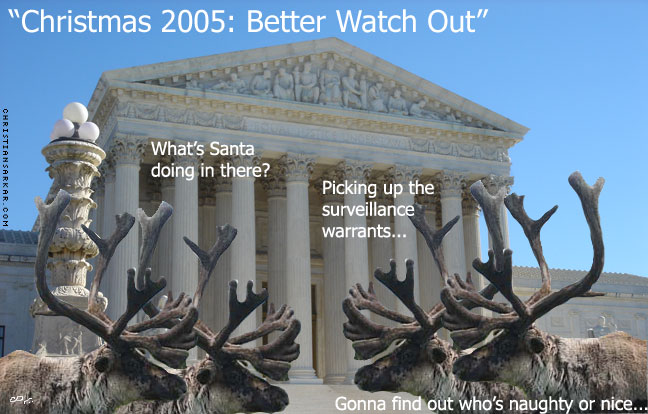
Cartoon: Christmas 2005 – Better Watch Out
Measuring Democracy: The Journalists-in-Jail Index
In 2005, we have 125 journalists sitting in jail (that we know of).
China, Cuba, Eritrea, and Ethiopia are the world’s leading jailers of journalists in 2005, together accounting for two-thirds of the 125 editors, writers, and photojournalists imprisoned around the world, according to a new analysis by the Committee to Protect Journalists.
The United States, which is holding journalists in detention centers in Iraq and Guantánamo Bay, Cuba, rose to sixth among countries jailing journalists, just behind Uzbekistan and tied with Burma, CPJ found.
Is this a good way to measure democracy?
See the numbers here >>