
Again, from the Economist:
“…PR is surprisingly effective, at least according to a recent study by Procter & Gamble, the world’s biggest consumer-products group. P&G is a firm that marketers pay a lot of attention to, not least because of its advertising budget of some $4 billion. It has always been at the cutting-edge of marketing—P&G is credited with inventing the television soap opera as a new way to sell goods. But with fewer people watching television and the circulation of many papers and magazines declining, the firm has become pickier about where it spends its advertising budget. Increasingly, it wants a measurable return on investment from its campaigns.”
Read it in the news >>
My point- at least PR is trying to tell a story.
So how does advertising fight back? With knowledge and entertainment, and yes, branded-experiences. Problem is most agencies are too stupid. Maybe it’s the stupidity of the clients.
Both PR and Ad agencies are inauthentic. Why do you want to hear propaganda and lies all day long? Give us truth, knowledge, insight, and a little bit of humor. Talk, don’t preach. Get a conversation going. And don’t talk about your products unless I ask you a question.
Of course, I’m talking about double loop marketing.
Stupidity 101: Newspapers and Freebies
Asks the Economist:
“IN A letter about pay-rises to staff at the Sun last year, Britain’s biggest-selling newspaper, Rebekah Wade, its editor, remarked that in future the paper’s success would probably depend more on free CDs and DVDs than on its journalists. British newspapers are frenziedly giving things away, and in Germany, France, Italy, Poland and throughout Latin America papers are also increasingly relying on freebies to try to attract new readers. In Britain the circulation of national newspapers fell by 3% in 2005, following a 2% decline in 2004. The same pattern of falling circulation is being repeated across Europe and the United States. So are all the free gifts a sign of desperation from newspapers, or an entirely sensible new marketing strategy?”
My “hero” Rupert Murdoch, owner of the Sun and the Times, said last November that he dislikes it because “people grab the paper, tear the DVD off and throw away the paper”. He’s right.
This is the same kind of stupidity that software companies engage in when they give away free T-shirts. They don’t attract the target audience, but end up with droves of kids wearing “.NET” T-shirts. A friend of mine used to give away free T-shirts to the homeless, until his boss found out. Hurts the brand, you know.
Bet you 85% of the people grabbing the CDs and DVDs don’t read the paper at all.
This is what I call GM-style management.
Read all about it!
Don’t Cry for Hollywood
From the Economist:
” Hollywood took 7% less at the box office in 2005 than in 2004 and growth in sales of DVDs has slowed. Internet video threatens the satellite and cable systems of companies such as News Corporation and Time Warner. Dozens of advertisers are shifting budgets from television to such places as the internet and billboards. Brand-owners hate it that people are using digital video recorders to avoid their pitches. And if media firms move on to the internet themselves, they risk losing their films and television programmes to pirates.
and
“Any media business has two products to sell: its content (to readers and viewers); and its audience (to advertisers). The task for old media is first to protect its advertising revenues by amassing audiences online and, second, to offset their viewers’ intolerance of mass-advertising by making them pay more for content—which they are increasingly willing to do. It will not be easy, but then saving the heroine never was. ”
Read the article >>
Hollywood has lost its imagination. The irony of it all – Michael Eisner gets his own show on creativity and innovation while the very company he helped destroy [Disney] is negotiating vigorously to acquire Pixar.
Britannica vs. Wikipedia vs. Digital Universe vs. Squidoo vs. ?
Who wants to be the knowledge repository for all mankind?
The race is on:
– Encyclopædia Britannica: the free stuff is weak! [rank= 2,839]
– Wikipedia: a controversy on quality [rank = 31]
– Digital Universe: slow going in building out the “portals” [rank = 150,326]
– Squidoo: too quirky? [rank = 6,290]
and of course there’s Google…
I’m betting on two things: “free” and “ease-of-use” – and the winner (today) is Wikipedia.
Underwhelming: McKinsey’s 2006 Predictions
The nerds at McKinsey are at it again with their sweeping generalities and “big-picture” historical perspectives.
The article – Ten trends to watch in 2006 – is rather underwhelming:
“Those who say that business success is all about execution are wrong. [what?!!] The right product markets, technology, and geography are critical components of long-term economic performance. Bad industries usually trump good management, however: in sectors such as banking, telecommunications, and technology, almost two-thirds of the organic growth of listed Western companies can be attributed to being in the right markets and geographies. Companies that ride the currents succeed; those that swim against them usually struggle. Identifying these currents and developing strategies to navigate them are vital to corporate success.
“What are the currents that will make the world of 2015 a very different place to do business from the world of today? Predicting short-term changes or shocks is often a fool’s errand. But forecasting long-term directional change is possible by identifying trends through an analysis of deep history rather than of the shallow past. Even the Internet took more than 30 years to become an overnight phenomenon.”
Here are the trends they’ve identified. Wow, I’m speechless.
Macroeconomic trends
1. Centers of economic activity will shift profoundly, not just globally, but also regionally.
2. Public-sector activities will balloon, making productivity gains essential.
3. The consumer landscape will change and expand significantly.
Social and environmental trends
4. Technological connectivity will transform the way people live and interact.
5. The battlefield for talent will shift.
6. The role and behavior of big business will come under increasingly sharp scrutiny.
7. Demand for natural resources will grow, as will the strain on the environment.
Business and industry trends
8. New global industry structures are emerging.
9. Management will go from art to science.
10. Ubiquitous access to information is changing the economics of knowledge.
Advice to CEOs – if this is the advice you’re paying McKinsey for, save your money! Just read your Economist and the Global Province every week and you’ll come out ahead!
Poor show, Mr. Davis. If you’re listening, Fred Gluck – it’s time to get back in and take names and kick some …
China’s 5 Surprises + 1
From S+B:
Five facets of business in China may surprise most outsiders:
1. Local entrepreneurs are interested in producing global brands, not just low-cost commodities
2. China has become a hotbed for rapid innovation
3. Executives from around the world are moving to China for the long haul
4. Good management and transparency are starting to count more than patronage, at least in some sectors
5. China is becoming a catalyst for growth in emerging markets throughout the developing world.
Let’s add another surprise:
6: China is becoming a market for high-end luxury items once thought to be “exclusive” for the western elite and Middle-East oil-barons.
Also:
“Because they are in such a hurry to make a place for themselves, and because it is still early in the life cycle of their ambition, Chinese entrepreneurs tend to give the impression that they don’t care much about quality. However, that is not universally true. Many of them recognize the trade-offs among cost, quality, and time that exist for any startup, and they have explicitly chosen designs and processes that sacrifice quality for the sake of speed and cost savings.
“But this doesn’t mean that China will always be a nation of commodity enterprises; indeed, many Chinese businesspeople know the price of a Motorola phone in Chicago or a pair of Nike sneakers in Manhattan. They ask themselves, “If I can make these things, why can’t I sell them for higher prices?” Some of them are already laying the groundwork for the evolution of their industries from low-cost producers of shoes, handsets, and components to branded enterprises.”
Read the entire article here.
This will come back to bite almost all of our western “outsourcers.” See “Innovation Blowback” by JSB and JH3 >>
EmoryLeadership.org: Blogging on Global Leadership and Performance
Emory’s Peter Topping has just started blogging at EmoryLeadership.org.
His blog is about leadership and it discontents… Here’s his POV:
“I work with managerial leaders every day. My emphasis is on helping them find ways to enhance their leadership effectiveness incrementally – based upon their current leadership context.
“My purpose in offering this blog is to engage in dialog about how to do that at the highest possible level – what are the optimal ways to enable individuals to be better managerial leaders?”
Jakob Nielsen: Google, Yahoo are Leeches!
Usability guru Jakob Nielsen says: “search engines extract too much of the Web’s value, leaving too little for the websites that actually create the content.”
And: “In the long run, every time companies increase the value of their online businesses, they end up handing over all that added value to the search engines. Any gain is temporary; once competing sites improve their profit-per-visitor enough to increase their search bids, they’ll drive up everybody’s cost of traffic.”
According to Nielsen, “liberation from search dependency is a strategic imperative for both websites and software vendors.”
What does he mean? He means that companies need to focus on search engines for initial acquisition, but then bring them directly to the site- i.e. keep ’em coming back for more.
Again, his words: “The question is: How can websites devote more of their budgets to keeping customers, rather than simply advertising for new visitors?”
Nielsen offers the following suggestions:
– Email newsletters
– Request marketing
– Affiliate programs
– Newsfeeds
– Stick your URL onto any physical product you sell
– A hardware component that’s hardwired to connect to your site’s service
– Mobile features
I have a powerful answer: ’tis double loop marketing!
Read Nielesen’s post >>
Bonus: an interview I did with Jakob Nielsen years ago now…
Bill Gates Worries about Big Blue, not Google
“The biggest company in the computer industry by far is IBM. They have the four times the employees that I have, way more revenues than I have. IBM has always been our biggest competitor. The press just doesn’t like to write about IBM,” said Gates in an interview on Wednesday ahead of his keynote speech at the Consumer Electronics Show in Las Vegas…
Wait till the Google-Desktop takes over MS-Office.
What’s Google-Desktop? It’s how Google will take over your PC via the web. Fits in nicely with a $100 PC don’t you think?
What does a web-based desktop look like? Take a look at this.
OK, I admit it has a ways to go, but I know Google will do this right. They’re going to add an “open-office” component to the web-desktop. You’ll be able to do your word-processing, your spreadsheets, your presentations, your email, your calendar, your RSS subscriptions, your blog, your IM, your VOIP, your video-conferencing, your downloading, your podcasts, your news, your search, and your shopping all at Google.com. That’s going to be the real Google Pack!
And that’s why AOL went with Google, not Microsoft.
Microsoft will become a B2B software company, and yes, IBM will be the biggest competitor in that space.
Michael Porter: The Relationship between Innovation & Living Standards
During the 1990s, Americans found a way to do what seemed no longer possible — grow the economy, create jobs, and increase the standard of living, without driving up inflation. Much of the credit goes to the nation’s ability to develop and commercialize new technology. The result: one of the most robust periods of economic expansion and prosperity of the past century.
Today, the nation is experiencing an economic downturn. While fiscal and monetary policies pump dollars into the economy to boost the level of activity, innovation infuses the economy with growth-incubating new ideas, new products, services, and technologies. National policies and national investment choices have much to do with the growth and capacity of the American economy. For innovation, however, the real locus of innovation is at the regional level. The vitality of the U.S. economy then depends on creating innovation and competitiveness at the regional level.
In healthy regions, competitiveness and innovation are concentrated in clusters, or interrelated industries, in which the region specializes. The nation’s ability to produce high-value products and services that support high wage jobs depends on the creation and strengthening of these regional hubs of competitiveness and innovation.
Led by our buddy Michael Porter, the “Clusters of Innovation Initiative” examined five regions around the country: Atlanta, Pittsburgh, the Research Triangle, San Diego and Wichita.
One key point: “Growth is not the same as prosperity. Growth is only desirable if the standard of living of citizens rises. High growth per se often leads to a rising cost of living that erodes prosperity and degrades natural resources and physical infrastructure that support quality of life.”
My question: are there virtual innovation clusters out there as well? Clusters tied by purpose, but not geography? Is there a way to create and strengthen a virtual innovation cluster?
Read the report, and let’s talk >>
Piper Jaffray on Google: Target Price = $600
We believe the stock will hold its multiple a year from now for the following reasons:
• Given the company’s performance, market share gain, and the pipeline of new
products, we believe outperformance is still very likely;
• We expect the global search market to grow by 41% in 2006 and maintain a
CAGR of 37% over the next five years;
• We expect Google to continue to gain market share in 2006. In 2005, the
company gained an additional 5% market share in the U.S. alone;
• Google’s brand continued to gain strength as the release of new innovative
products such as Google Maps and Gmail enhanced the consumer’s Internet
experience;
• Google’s innovations are fueling an impressive pipeline of new initiatives
particularly Google’s Ad Network and Google Base, which should become
notable revenue generators by the end of 2006;
• Expectations for Google most likely remain conservative – we note that we have
raised our forward estimates every quarter of 2005 from our 2006 net revenue
estimate of $4.7B before Google’s Q1 reporting to our current estimate of $8.8B,
an increase of more than 87% since April;
• Despite being the most talked about stock of 2005, GOOG remains significantly
less widely owned than other key technology names and has yet to be added to
the S&P 500.
While the stock may have its ups and downs throughout the year, we believe it will
reach $600 by the end of 2006 and we prefer to have one 12-month price target
rather than raise it every quarter.
The above factors are leading us to raise our one-year price target to $600, sharply higher than our previous $445 target, but based on fundamentally the same reasoning taken one year further out. Our previous target of $445, which GOOG exceeded briefly in intra-day trading in mid-December, was based on 50x our proforma 2006 EPS estimate. Our new price target, which we feel is attainable by GOOG 12 months from now, is based on 50x our 2007 proforma EPS estimate. Although such a high multiple may seem aggressive, we believe that given Google’s dominant position in an already large yet still rapidly growing market, its phenomenal brand power, and its status as a technology leader justifies such a valuation. Also, importantly, it’s likely 2007 estimates will come up throughout the year, as we have seen this pattern for 2006 estimates play out in 2005. As such, we believe the ending multiple will be well below 50x.
We believe Google is an iconic company that, like Microsoft and eBay before it, has defined a new and vital industry. Such market leading technology companies have traditionally traded with peak valuations in the 50x-60x range. EBAY, for example, has traded between 38x and 158x its one-year forward earnings estimate since 2000 with an average forward multiple of 70x. Even excluding the bubble years of pre-2001, eBay had maintained a multiple generally above 55x. Currently the other leading Internet companies, Yahoo, eBay, and Amazon trade at an average of 45x 2006 proforma EPS estimates, with Google only slightly higher than average at 47x (and notably below Amazon’s multiple of 52x). We believe that over the next year as Google’s lead in search and online advertising becomes even more apparent and its growth far exceeds its closest comparables (we predict GOOG will grow revenue by 52% in 2006 while YHOO, EBAY, and AMZN will only grow by 27%, 34%, and 19%, respectively), investors, who may be inclined to take some profit now given GOOG’s gains in 2005, will increase their holdings of Google.
Read the full report on Battelle’s site >>
Goldman Sachs’ Environmental Policy Framework
Do you believe this:
Goldman Sachs believes that a healthy environment is necessary for the well-being of
society, our people and our business, and is the foundation for a sustainable and strong
economy.
Goldman Sachs recognizes that diverse, healthy natural resources – fresh water, oceans,
air, forests, grasslands, and agro-systems – are a critical component of social and
sustainable economic development. Forests are particularly important for the
environment and biodiversity. They are vital to water and air quality, and help regulate
climates. Forests are home to thousands of wildlife species, and, at the same time,
represent a natural source of timber. The key challenge for society is to manage the
competing human demands on land, soil and vegetation without undermining crucial
ecosystem functions.
We take seriously our responsibility for environmental stewardship and believe that as a
leading global financial institution we should play a constructive role in helping to
address the challenges facing the environment. To that end, we will work to ensure that
our people, capital and ideas are used to help find effective market-based solutions to
address climate change, ecosystem degradation and other critical environmental issues,
and we will seek to create new business opportunities that benefit the environment. We
will work to identify policy measures that are creative, meaningful and provide real
solutions to environmental problems while recognizing the importance of economic
growth in contributing to the alleviation of poverty. In pursuing these objectives we will
not stray from our central business objective of creating long-term value for our
shareholders and serving the long-term interests of our clients.
Go GS! Make sure you practice what you preach…
Read the full text here >>
Clicks and Conversion Rates in 2005
I just read a Brian Eisenberg article in which he says:
“Depending on whom you ask, average conversion rates are between 2 and 4 percent. By today’s standards, you get bragging rights and the full dose of hero treatment if you can maintain a conversion rate of 5 percent or above. You have deity-like status if your conversion rate approaches double digits. the world’s finest players sport double-digit conversion rates of somewhere around 12-14 percent.
“Of course, I’m referencing top-line conversion: Tthe number of visitors who take the macro action you want them to divided by the total number of site visitors.Aa double-digit conversion rate seems unimaginable to some, but experience demonstrates it’s certainly possible. We’ve seen it happen time and again.”
The funny thing is I have a client, who for some reason, is unimpressed by a 44% conversion rate I’ve gotten for them over the past year. Some months it went down to 39%, in other months it was up as high as 53%. I’m not kidding. And the client still doesn’t understand how amazing this is.
What’s amazing about Double Loop Marketing is just how effective it can be. For instance, my record-breaking conversion rate was 98% for an offer on a landing page from John Hagel and JSB. Now granted, JH3 and JSB are smart people, and when they give away something for free, it’s not difficult to see that they’d have a great conversion rate. That said, 98%?!! I’m still in shock over that one.
This year I’ve resolved to publish a book on the power of Double Loop Marketing, with a few, real-life case studies comparing traditional online marketing approaches with Double Loop Marketing tactics. God and the devil are both in the details, as they say. John Hagel’s has committed to writing the foreword for the book, so I think that itself will make the book worth reading 🙂
Another Service in Googlespace
Google keeps on introducing micro-services. Here’s one I find very, very interesting: Blogger Web Comments for Firefox.
Despite the geek-inspired name of the service, it’s another brilliant move. Here’s how it works:
As you visit any given page in Firefox, a comment panel featuring blog posts linking to this page will appear on the bottom right of your browser. Clicking on any of the entries will open that blog post in a new tab. You can toggle between the compact and extended comment lists, or even hide the panel completely. To bring it back, just click the icon or the icon in the lower right corner of your browser and select “View comments.” When there are lots of comments, you can click on the “Show lots more…” link, which will open a new tab in your browser with all Google Blog Search results.
Pretty nifty, ha?
Of course, to add your own comments on the page you’re on, you’ll need to have a Blogger account.
What it does for Google is take it one giant step further into the social-networking-wisdom-of-crowds space. And they didn’t have to acquire anyone to do it.
Learn more about Google’s product development process >>
Abramoff, Business Ethics, and Peter Drucker on Decision-Making
Find me an honest politician, and I will spare this world. We looked everywhere, but could not find an honest politician.
I’m kidding here, but just barely.
“Abramoff is the central figure in what could become the biggest congressional corruption scandal in generations,” writes the Washington Post.
And today there’s another story: apparently “the U.S. Family Network, a public advocacy group that operated in the 1990s with close ties to Rep. Tom DeLay and claimed to be a nationwide grass-roots organization, was funded almost entirely by corporations linked to embattled lobbyist Jack Abramoff, according to tax records and former associates of the group.”
And:
“Two former associates of Edwin A. Buckham, the congressman’s former chief of staff and the organizer of the U.S. Family Network, said Buckham told them the funds came from Russian oil and gas executives. Abramoff had been working closely with two such Russian energy executives on their Washington agenda, and the lobbyist and Buckham had helped organize a 1997 Moscow visit by DeLay (R-Tex.).”
“The former president of the U.S. Family Network said Buckham told him that Russians contributed $1 million to the group in 1998 specifically to influence DeLay’s vote on legislation the International Monetary Fund needed to finance a bailout of the collapsing Russian economy.”
Everyone knows how corrupt politicians are. These days, it seems worse than ever.
But now we are looking at the Enronization of Business, all business.
If competitive advantage is gained through “bribes,” then why should business ever play straight?
Is corruption the core-competence of successful businesses? What happened to the rule of law?
From Exxon to Wal-mart, businesses have lost their way. In their hurry to boost shareholder value, they are destroying their brands and their future.
They are playing in Box 1 and ignoring Box 3.
So why is this happening? Why are so many smart businesses (and politicians) being so dumb?
The answer comes to us from the late Peter Drucker:
Drucker tells us this story about Alfred P. Sloan Jr. who is reported to have said at a meeting of one of the GM top committees, “Gentlemen, I take it we are all in complete agreement on the decision here.” When everyone around the table nodded in assent, Sloan says: “Then I propose we postpone further discussion of this matter until our next meeting to give ourselves time to develop disagreement and perhaps gain some understanding of what the decision is all about.”
Drucker’s point is that “unless one has considered alternatives, one has a closed mind.” Decision-making for Drucker is best only if based on the clash of conflicting views, the dialogue between different points of view, and the choice between different judgements.”
The first rule of decision-making is that one does not make a decision unless there is disagreement.
Alas, few business leaders or politicians tolerate dissent in their ranks. In fact, they work hard to eliminate nay-sayers.
And that is the root cause of all this corruption. Not money, but bad choices, bad decisions. OK- perhaps it is money after all.
Joe Vitale: How to Write a Press Release to Get Attention
Just before the last US presidential election, I asked Joe Vitale to write a product press release for one of my clients. The product was a political toy- a frisbee for dogs- one for Kerry-bashers, and one for Bush-bashers.
Here’s what he wrote:
Who Would Your Pet Vote For?
New Online Poll Lets Pets Decide Next US President
If you can’t decide who to vote for this November, there’s a better way to make a decision than flipping a coin: Let your pet decide.
“This race is going to the dogs anyway,” says the three mysterious men in Arizona who created the world’s first polling booth online for pets at http://www.xxxxxx.com
“We thought we would simplify the process by creating a poll where our pets can go vote,” they explain.
The creators also developed a way to determine if your pet is a Republican or Democrat. There are twenty categories of statements. For example:
If your pet likes to display affection in public, it may be a Democrat. If it doesn’t like to show affection, it may be a Republican.
If you pet sues incompetent vets, it may be a Democrat. If it always gets the best in vet care, it may be a Republican.
“We didn’t stop with just the poll,” says the creators. “If your pet wants to get out some aggression, it can get one of our chewable Frisbees and tear the heck out of it.”
It’s a cloth Frisbee with a caricature of either George Bush or John Kerry that has the international sign for “no” across the face. There’s a navy-blue border with stars, and a squeak toy inside.
“People may find it comforting to chew on one, too.”
Who will the pets decide should be our next President?
Watch for the results at http://www.xxxxxx.com
*** end ***
The results? In 48 hours we got 12 responses, 8 for national radio-talk shows. Part of it was the product, part of it was the “is your pet a Democrat or a Republican” angle I dreamed up, part of it was the distribution of the press release. But the most important part was the way in which Joe Vitale captured your attention with words. It was a press release that had to be read.
Copy is king. Hypnotic copy builds kingdoms.
Mars vs. Venus: How Men and Women Use the Internet
Here are some highlights from a new report from Pew Internet and American Life which shows how men’s and women’s use of the internet has changed over time.
The percentage of women using the internet still lags slightly behind the percentage of men. Women under 30 and black women outpace their male peers. However, older women trail dramatically behind older men.
Men are slightly more intense internet users than women. Men log on more often, spend more time online, and are more likely to be broadband users.
In most categories of internet activity, more men than women are participants, but women are catching up.
More than men, women are enthusiastic online communicators, and they use email in a more robust way. Women are more likely than men to use email to write to friends and family about a variety of topics: sharing news and worries, planning events, forwarding jokes and funny stories. Women are more likely to feel satisfied with the role email plays in their lives, especially when it comes to nurturing their relationships. And women include a wider range of topics and activities in their personal emails. Men use email more than women to communicate with various kinds of organizations.
More online men than women perform online transactions. Men and women are equally likely to use the internet to buy products and take part in online banking, but men are more likely to use the internet to pay bills, participate in auctions, trade stocks and bonds, and pay for digital content.
Men are more avid consumers than women of online information. Men look for information on a wider variety of topics and issues than women do.
Men are more likely than women to use the internet as a destination for recreation. Men are more likely to: gather material for their hobbies, read online for pleasure, take informal classes, participate in sports fantasy leagues, download music and videos, remix files, and listen to radio.
Men are more interested than women in technology, and they are also more tech savvy.
Still, the data shows that men and women are more similar than different in their online lives, starting with their common appreciation of the internet’s strongest suit: efficiency. Both men and women approach with gusto online transactions that simplify their lives by saving time on such mundane tasks as buying tickets or paying bills.
Men and women also value the internet for a second strength, as a gateway to limitless vaults of information. Men reach farther and wider for topics, from getting financial information to political news. Along the way, they work search engines more aggressively, using engines more often and with more confidence than women.
Women are more likely to see the vast array of online information as a “glut” and to penetrate deeper into areas where they have the greatest interest, including health and religion. Women tend to treat information gathering online as a more textured and interactive process – one that includes gathering and exchanging information through support groups and personal email exchanges.
Read the complete report here >>
The Pre-Blog Era: Looking Back on Online Communities
Back in 2001, the Pew Internet and American Life Project reported that:
“Some 84% of Internet users have at one time or another contacted an online group. Tens of millions of Americans have joined communities after discovering them online. And many are using the Internet to join and participate in longstanding, traditional groups such as professional and trade associations. Furthermore, many Americans are using the Internet to intensify their connection to their local community.”
That was before the blogosphere took off. I wonder what it’s like now? If anyone has some data on this, please share if possible!
Read the full report here >>
Santa Goes Online: Record Holiday Sales for Online Retailers
Several online merchants reported record sales during the holiday shopping season, including online retail giant Amazon.com, which said popular items were iPod music players, video games, coats and jewelry.
Amazon said it had its best holiday sales season ever, with more than 108 million items ordered. The busiest day for the world’s largest online store was Monday, Dec. 12, when more than 3.6 million items were ordered, or 41 items per second. The most expensive item purchased during the period was a pair of diamond earrings worth $94,000.
A study from Nielsen/NetRatings, Goldman Sachs and Harris Interactive found that between Oct. 29 and Dec. 16 holiday online retail spending reached $25 billion, a 25 percent increase from the same period last year. Shoppers spent the most on clothing, followed by computers and hardware, consumer electronics, books and toys, and video games, the study found.
Read all about it >>
Linking Strategy to Execution

One of these company’s got their strategy right, the other was not so lucky. Of course, it wasn’t luck…
Read this MercerMC commentary on strategic planning >>
The Amazon.com Work Process in Pictures

From BusinessWeek: See how the world’s largest online retailer ensures that gifts get delivered on one of the busiest shopping — and shipping — days of the year.
Here >>
Jesus, CEO – The Marketing of Virtue
Virtue is now, packaged, branded and sold.
America’s most successful churches are modelling themselves on businesses, says the Economist.
Is this Peter Drucker’s fault? He was good friends and a strategic advisor to Rick Warren, for example…
Tough decision: join your tennis-&-golf-club OR the church-club…? What would Jesus do?
Most Admired CEOs for 2005
Burson-Marsteller and the Economist Intelligence Unit (EIU) report on the “most admired” CEOs for 2005.
The 2005 CEO Capital™ study asked more than 600 global business influentials in 65 countries to write in which CEO or chairman they admire most in the business world today.
Result? Bill Gates, Microsoft’s chairman and chief software architect, came out as the world’s most admired business leader. The CEO/chairman rankings appear below.
format: Rank CEO/Chairman Company Country
1 Bill Gates Microsoft U.S.
2 Steve Jobs Apple U.S.
3 Warren Buffett Berkshire Hathaway U.S.
4 Michael Dell Dell U.S.
5 Richard Branson Virgin Group U.K.
6 John Browne BP U.K.
7 Carlos Gohsn Nissan Motor & Renault Japan/France
8 N.R. Narayana Murthy Infosys Technologies India
9 Jeffrey Immelt General Electric U.S.
10 Rupert Murdoch News Corporation Australia
11 John Bond HSBC Holdings U.K.
12 John Chambers Cisco Systems U.S.
13 Jorma Ollila Nokia Finland
14 Terry Leahy Tesco U.K.
15 Lakshmi Mittal Mittal Steel Netherlands
Several interesting characteristics about the world’s top 15 most admired leaders surfaced:
1. Despite the predominance of American companies among the top four most admired leaders, more than half (nine of 15 or 60 percent) represent other regions — UK (4), Finland (1), Netherlands (1), Japan/France (1), India (1) and Australia (1).
2. Eight of the top 15 leaders (53 percent) are company founders.
3. All of the global most admired are insider CEOs (CEOs who have been with the same company for three years or more).
4. No female CEOs or chairmen were chosen.
Hmmm… I wonder how many of these CEOs will mess up in 2006? I can’t say I think any of them will. But Gates has the potential to lose big in the next three years.
My vote goes to Ricardo Semler. And keep an eye out for Eric Schmidt!
Eric Schmidt’s 70 Percent Solution
In an interview in Business 2.0, Google’s CEO explains the magic behind Google’s success: 70/20/10.
What is 70/20/10? It’s how they spend their time at Google:
– 70 percent on the CORE BUSINESS (AdSense, AdWords, Google Search)
– 20 percent on RELATED PROJECTS (Froogle, Google Desktop, Google Local, Google News, Google Print, Google Stocks, Google Toolbar, Google Video)
– 10 percent on NEW BUSINESSES (Blogger, Google Mini, Google Movies, Google Reader, Google Talk, Google Wi-Fi, Picasa)
Here’s how Schmidt describes it:
“…how it works for management: We spend 70 percent of our time on core search and ads. We spend 20 percent on adjacent businesses, ones related to the core businesses in some interesting way. Examples of that would be Google News, Google Earth, and Google Local. And then 10 percent of our time should be on things that are truly new. An example there would be the Wi-Fi initiative — which I haven’t kept up with myself. God knows what they’ve done in the last week. I’ve been too busy on core search and ads.”
There are some more interesting things in the article. Read it here >>
For more on the Google R&D process, read my post: Google’s Product Development & Management Process Revealed >>
The Bean-Counters at CFO.com Give it Freedom
I just got an email from CFO.com; apparently the website is free again:
“After careful consideration and dialogue with our readers, we have decided to once again make CFO.com a completely free website. All current and archived content, including Buyer’s Guides, CFO magazine archives, Today in Finance, and more, is available to everyone at no charge.”
I could be mean and say their content wasn’t good enough, but instead I’ll say- “Welcome back to the advertising business-model!”
Pepsi Stock Tops Coke in Market Value
A landmark moment occurred this week in the cola wars. The value of Pepsi’s stock now exceeds that of arch-rival Coke. Scott Simon and New York Times business columnist Joe Nocera discuss the development in this NPR podcast.
Pheed Read: RSS ads blow away Banner ads
Findings from a very interesting study on RSS advertising by Pheedo:
– Standalone RSS ads are far more successful than inline ads
– Placing RSS ads in every other post yields the highest percentage of click throughs
– RSS content CTR varies significantly based on day of the week
– Mid-week readership of RSS feeds highest
– RSS ads are outperforming similar Web ads
[standalone RSS ads= average CTR of 7.99% versus 20% to 1.17% CTR for rich-media ads]
– Bloglines leads RSS readers in market share
I must say I’m impressed by Pheedo.
Here are the details on their research.
Sense outta NonSense
Brand structure establishes the shape of how a company and its operating units and brands communicate…

also from Sense – page 9. Did I say it was brilliant?
RoCE: Return on Customer Experience
From Lippincott Mercer:
How structural equation modeling helps drive decision-making at a theme park
[click on image to enlarge]
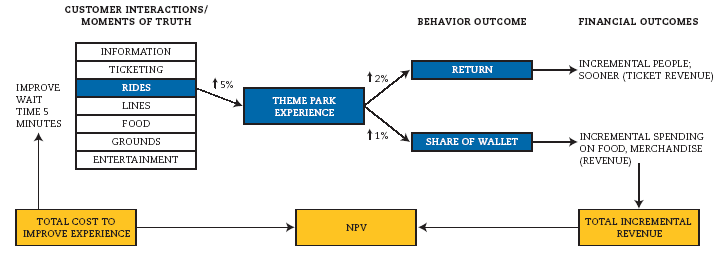
see page 17 from this brilliant issue of Sense.
Warming Up: Adidas’ +Teamgeist

Here’s the official spin from adidas:
The +Teamgeist is the Official Matchball of the 2006 FIFA World Cup. It’s the most accurate football ever produced. No other ball reacts so flawlessly shot after dribble after pass, in the air and on the ground.
• Revolutionary panel shape eliminates surface irregularities to create a perfectly round ball for greater accuracy
• Panels are thermally bonded to create a smooth, seamless kicking surface
• Complete underglass print significantly decreases wear of colors and design
• New carcass retains shape better for improved accuracy and power
• FIFA approved with highest FIFA rating
• 100% PU leather
• Imported
Carcass??
BTW- that’s $130.00
Here’s an idea for a true global index: What’s the cost of the average [actually used by kids] soccer ball in your country? In the US it’s $19.95 for a decent kick-about ball. In Europe? China?
UPDATE:: Reaction to the new ball:
“It is the way a ball should be made,” – David Beckham, England
“The balls design is great, it is going to be a success,” – Kaka, Brazil
“I like this ball a lot because of its return to the more traditional colors,” – Alessandro Nesta, Italy
“When you kick it, it goes in the right direction,” – Zinedine Zidane, France
Happy Chrismahanukwanzakah!
Virgin Mobile pushes it – see www.chrismahanukwanzakah.com – a viral online campaign…
To me this is just tasteless and actually hurts the brand. Why? Because the soul of the Virgin brand is innovative, gutsy and classy. This ad falls short on the third attribute- classy.
Oh well.
Worst Practices in Business Blogging
“The days are over when a business could market a crappy product or treat their customers like marks and assume that the worst that would happen is that they get a few angry letters they could then just dump in the round file.”
So says David Kline in this post “Don’t Mess With the Blogosphere!”
Also: “How many more battered and bloody companies will have to litter the corporate landscape before business wakes up to the new, customer-empowered marketplace we’re living in?”
Good question, David.
Patrick Dixon: Tribal Elders Take Over the Future?
Patrick Dixon warns businesses (and governments) about the socio-demographic changes just around the corner:
“Your company may have a reputation for brilliant leadership, outstanding innovation, clever branding and effective change management, but the business could fail if the world changes and you are unprepared.
“Many debates about the future are about timing, such as the uptake of technology. But the future is also about emotion. Reactions to events such as bird flu are often more important than the events themselves.
Read Dixon’s FT column: “Wake up to stronger tribes and longer life.” See the great little sidebar on futurology.
The 80-20 Rule Online: 18% of Shoppers do 46% of Buying
Nielsen//NetRatings reports that nearly a fifth of the online buying population, or 18 percent, accounts for nearly half, or 46 percent, of total online spending. These buyers, dubbed “Most Valuable Purchasers” (MVPs) by Nielsen//NetRatings, spend more dollars online and make more purchases on the Internet than the rest of the online buying population.
The Nielsen//NetRatings MegaPanel online retail study segmented online shoppers into four categories based on the amount of their online spending (low or high) and their frequency of purchases (low or high). The MVPs, shoppers who spent the most money online and made the largest number of purchases, comprised 18 percent of the online buyers, driving 46 percent of total online spending. In comparison, those spending the fewest dollars online and making the fewest purchases made up the majority, or 55 percent, of online buyers; this group accounted for 21 percent of online purchases.
MVPs are heavy users of comparison shopping tools as compared to other online buying segments. In addition, they skew towards a higher household income, are more likely to be connected via a broadband connection, and are heavier Internet users in both overall time spent online and time spent on retail Web sites.
Takeaway: E-tailers should focus on building extraordinary online experiences for their MVPs. Also their demand generation tactics should target the MVP crowd.
Read the press release for details >>
BusinessWeek: Holiday Tricks
BusinessWeek reports:
“Forrester Research Inc. says online retail sales this holiday will surge 25%, to $18 billion. The increasingly strong profitability of Net commerce is giving retailers the chance to experiment with a stockingful of new sales and marketing tactics. They’re tapping into technologies such as blogs, social networking, and wireless phones to draw shoppers to their sites.
“The experiments are coming from startups to Web giants alike. Yahoo! Inc. is testing Shoposphere, a networking site within Yahoo! Shopping that offers thousands of reviews, blogs, and shopping lists generated by members. Rob Solomon, a vice-president at Yahoo! Shopping, says relying on users lets Yahoo serve markets too small to command space on its front pages.
and
“Yub.com, a site with thousands of product reviews, offers visitors cash-back rewards of up to 10% when they make purchases at more than 60 other sites, including Macy’s and cosmetics retailer Sephora. Yahoo plans to let people earn cash for posting reviews that lead other users to make purchases.”
Read the article >
Keep Web Videos Under a Minute Long – Jakob Nielsen
“You can’t recycle video and expect to create a good online user experience.”
Jakob Nielsen in his latest Alertbox:
“While I’ll surely have many more guidelines later, for now the main guideline for producing website video is to keep it short. Typically, Web videos should be less than a minute long.
“A related guideline is to avoid using video if the content doesn’t take advantage of the medium’s dynamic nature. This doesn’t mean incessant use of pans, zooms, and fades to add artificial movement. It does mean that it’s better to use video for things that move or otherwise work better on film than they would as a combination of photos and text.
“Finally, recognize that Web users are easily distracted, and keep distracting elements out of the frame of your shots. If there’s a road sign in the video, for example, users will try to read it and will thus miss some of the main content.”
Nielsen’s remains at the vanguard of user experience design. Check out his “eyetracking” chart for web video and his 1997 post: “TV Meets the Web.”
Finally, here’s an interview I did with Jakob a while back:”Creating The Loyal Customer.”
Nation-Branding Using Sports Events
A.T. Kearney has a interesting report on how mega-sporting events can transform a city:
“Forgotten neighborhoods get desperately needed makeovers. Massive clean-up efforts curb smog and pollution. Transportation upgrades enhance mobility. Yet for every story of a city cleaned up, there is another of lingering debt and disrepair. Only a few large-scale events live up to their full potential. Even fewer deliver the promised long-term rewards. But for cities and nations that focus on both the immediate and the longer term, they do more than simply host an event, they build a legacy.
“Host nations are far less adroit at capturing the longer lasting, less tangible benefits that can result from a mega-event. These rewards reach into every part of an economy and culture by reinvigorating communities, improving health and educational systems, and cleaning up environments (see figure 1). Hosts tend to treat mega-events as prestige projects that are justified (accurately or not) through a measurement of tangible benefits minus tangible costs. Countries tag on some social programs to help make their case and obtain local support, but both the benefits and the add-ons are rarely integrated into broader national or regional strategies.
“A mega-event should be incorporated into a comprehensive national strategy that captures the tangibles while also advancing a nation’s social and economic development, inspiring passion and national pride, and building a global reputation—all of which can last a lifetime.”

Read the entire report here.
Online Shopping: Cyber-Monday Farce
Why does shop.org do something like this? So they can sell more stuff.
Read the BusinessWeek article “Cyber Monday, Marketing Myth.” Well done, BusinessWeek.
But the Best Buy site was down:

Tom Davenport on Personal Knowledge Management
Says TD: “Most interventions to improve performance in business are at the organizational or process level, but it doesn’t have to be that way. We can also improve individual capabilities. Ultimately, knowledge worker performance comes down to the behaviors of individual knowledge workers. If we improve their individual abilities to create, acquire, process and use knowledge, we are likely to improve the performance of the processes they work on, and the organizations they work for.”
Right on! Read this insightful post on Tom Davenport’s blog- BabsonKnowledge.org.