Amen.
Hillary Clinton’s Swan Song
I’ve always hated the misogyny in this song, but now nothing could be more apropos:
“My husband did not wrap up the nomination in 1992 until he won the California primary somewhere in the middle of June, right? We all remember Bobby Kennedy was assassinated in June in California. I don’t understand it.”
And previously in March:
TIME: Can you envision a point at which–if the race stays this close–Democratic Party elders would step in and say, “This is now hurting the party and whoever will be the nominee in the fall”?
CLINTON: No, I really can’t. I think people have short memories. Primary contests used to last a lot longer. We all remember the great tragedy of Bobby Kennedy being assassinated in June in L.A. My husband didn’t wrap up the nomination in 1992 until June. Having a primary contest go through June is nothing particularly unusual.
Posted by Cathy Sarkar
Video: Amy Tan on creativity
Does death stimulate creativity? There’s something in that – just ask Steve Jobs.
Humble Pie for Steve Ballmer and Tom Friedman
Two separate public incidents with similar overtones.
Today Steve Ballmer got pelted by a egg-throwing Hungarian nerd:
A few weeks earlier, on Earth Day no less, Tom Friedman gets a pie in the face:
Is this “The Wisdom of the Crowd”?
What I found interesting was the reactions of the “victims.” Ballmer cracked a joke and went on. Friedman took it a bit harder – walking off the stage in a huff.
Apparently, this is nothing new for Microsoft execs. Here’s a bonus clip from 2006:
Still, I don’t think this is funny. Especially in this day and age. What ever happened to old fashioned heckling?
Viewer-Driven TV Programming – Is PBS serious?
I think it’s a nice gesture that PBS is asking viewers for programming suggestions:
What would your prime time lineup look like? Would you emphasize news and public affairs programming over science and nature content? Would you make changes to existing shows? What kinds of new series and specials would you bring to the public airwaves?
When they meet in Palm Desert, CA, the executives should take a look at the suggestions, but I feel they should talk to each other as well.
Why? Because there are serious limitations to heeding the Wisdom of the Crowd.
I blogged about Nick Carr‘s take on this subject a while back: “What crowds are good for is producing average results that are not subject to the biases and other quirks of human minds.”
The PBS bigwigs have forgotten their mission. (Maybe not, since a lot of them are now Republicans; I have to confess, when I heard about that I was sure we were soon all going to be watching infomercials on PBS 24/7).
So let’s remind them what public television stands for. What’s the brand personality they need to be faithful to?
Seth Godin weighs in on this issue with a brilliant post about the purpose of the New York Times. Same deal for PBS.
So let’s ask: What’s important? What’s true?
Big opportunity for big stories, PBS. Go where the corporate media can’t go:
News, Education, and the Arts. And don’t forget to add “Global Warming” as a new category.
PBS, you knew that once.
Look what happened to Ted Koppel and Nightline. Or David Brinkley’s This Week. I’ll Fly Away. That’s commercial television. PBS, please don’t go there.
One more thing: make sure every show is archived online for viewing over the Internet. All the way back to the very beginning of PBS (including Mr. Rodgers’ Neighborhood). That would be a real public service. Heck, put ’em all on YouTube.
I’m a fan of customer feedback, but I’m a bigger fan of the customer experience.
Don’t mess this up, PBS.
Bill Gates’ 2007 Harvard Commencement Address
Inevitably, we want to compare this to Jobs’ speech at Stanford.
I’m going to resist that temptation because I feel that Bill Gates has finally found a vision worthy of his (and Buffet’s) billions. And the irony is he had to look outside Microsoft to get it. Well done, Melinda Gates!
‘For what purpose?” he asks. Shouldn’t our best minds be more dedicated to solving our worst problems? Poverty, Clean Water, Sexism… Gates nails it (except for global warming; I suppose he’s left that to Al Gore).
My take: Harvard is failing us, as are our other institutions of higher learning, because they are not helping students develop an “informed conscience” as Gates calls it. Heck, they’re not even helping students develop an “un-informed conscience”!
Part 1
Part 2
Part 3
Part 4
Part 5
Steve Jobs’ 2005 Stanford Commencement Address
The Steve Jobs story: follow your curiosity, not your curriculum!
Al Gore: Climate Warming 2.0
Go Al Go!
Olympic Torch Twittered out of San Francisco
Here’s how Twitter helped Team Tibet follow the secret torch route as authorities tried to hide the Olympic flame’s dash through San Francisco. It’s nice to see Twitter being put to serious use as a real-time communication tool for its customers.
You can add your voice to the chorus here >>

China has already lost!
Bishop Tutu stands up and tells it…
Will China develop Africa?
Because resource-rich Africa has been left out of the development plans of most Western companies, doesn’t mean that Africa won’t find a way to join the wave of globalization sweeping the world from Asia to Eastern Europe and South America.
So how will Africa do it? Through China and India.
This is a not good news for democracy:
In February 2007, Hu Jintao proudly announced the creation of a new special economic zone complete with the usual combination of export subsidies, tax breaks and investments in roads, railways and shipping. However, this special economic zone was in the heart of Africa—in the copper-mining belt of Zambia. China is transplanting its growth model into the African continent by building a series of industrial hubs linked by rail, road and shipping lanes to the rest of the world. Zambia will be home to China’s “metals hub,” providing the People’s Republic with copper, cobalt, diamonds, tin and uranium. The second zone will be in Mauritius, providing China with a “trading hub” that will give 40 Chinese businesses preferential access to the 20-member state common market of east and southern Africa stretching from Libya to Zimbabwe, as well as access to the Indian ocean and south Asian markets. The third zone—a “shipping hub”—will probably be in the Tanzanian capital, Dar es Salaam. Nigeria, Liberia and the Cape Verde islands are competing for two other slots. In the same way that eastern Europe was changed by a competition to join the EU, we could see Africa transformed by the competition to attract Chinese investment.
As it creates these zones, Beijing is embarking on a building spree, criss-crossing the African continent with new roads and railways—investing far more than the old colonial powers ever did. Moreover, China’s presence is changing the rules of economic development. The IMF and the World Bank used to drive the fear of God into government officials and elected leaders, but today they struggle to be listened to even by the poorest countries of Africa. The IMF spent years negotiating a transparency agreement with the Angolan government only to be told hours before the deal was due to be signed, in March 2004, that the authorities in Luanda were no longer interested in the money: they had secured a $2bn soft loan from China. This tale has been repeated across the continent—from Chad to Nigeria, Sudan to Algeria, Ethiopia and Uganda to Zimbabwe.
Read more here >>
Africa’s “imperialism challenges” will now come from the East.
Pranab Mukherjee, India’s Minister of External Affairs, talks a good game.
So why all the fuss over Africa? And why now?
Do China and India really care about African development?
Or is it the news that Africa is the new oil frontier.
Apparently Africa will account for 12% of global oil supplies in the next few years. And that’s not counting other mineral riches…
Don’t be too eager, Africa. Trust, but verify – as someone once said. And heed this African saying: If a little tree grows in the shade of a larger tree, it will die small. But if a little tree stands side by side with a larger tree, you have the start of a forest.
Steel Pulse: Global Warning + EarthJustice
see this >>
Stop Bush’s Forest Giveaway
Idaho contains more unspoiled wild forest than any state outside Alaska, providing the last intact forest habitat for countless fish, wildlife, and plant species. These areas are enjoyed by hunters, anglers, hikers, and all who treasure the backcountry. Yet the Bush administration is making a play in its last days to hand this natural gem over to its friends in the oil, natural gas, timber, and mining industries by weakening the Roadless Area Conservation Rule protections that currently guard it.
The administration’s proposal will open the door to logging millions of pristine acres, risk dangerous toxic contamination from mining, degrade clean fish-bearing streams and important wildlife habitat, and fail to live up to the public’s overwhelming desire to protect all of these areas for future generations.
This forest giveaway could lead to 545 million tons of phosphate being mined on nearly 8,000 unspoiled acres near Grand Teton and Yellowstone National Parks. Any increase in phosphate mining would worsen the already serious problem of selenium poisoning in local streams and aquifers. Selenium is an extremely dangerous contaminant known to cause birth defects, which bio-accumulates in the food web — persisting for centuries after entering the environment.
Six million acres of wild forest or a toxic waste dump? The choice should be clear to any American who values our natural treasures and takes their responsibility to future generations seriously.
Stand up for this glorious and irreplaceable wild forest! Let the Bush administration know that you are against removing Roadless Rule protections for the forests of Idaho. And hurry! The administration is only accepting public comments until April 7th.
Go deh >>
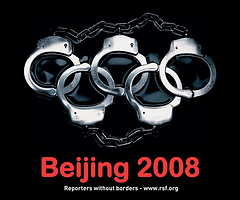
Theater of the Absurd: China stages “monk violence”?

in case you wondered why these “Tibetan monks” were so violent in Lhasa….
How to Treat a Mugger
A positive story (for a change) from NPR Morning Edition:
Mugger robs man.
Man offers mugger his coat and free meal.
Mugger goes to dinner with Man.
Read all about it >>
A Theme Song for Tibet: Get Up, Stand Up (Stand Up for Your Rights)
David “Dread” Hinds (Steel Pulse), Sly & Robbie, Aswad, Ini Kamoze and Dennis Brown… mash it!
And here’s the original version by Robert Nesta:
Get Up, Stand Up!
Rice Revolution Ahead?
From the NYTimes >>
“Rising prices and a growing fear of scarcity have prompted some of the world’s largest rice producers to announce drastic limits on the amount of rice they export.”
And The Economist >>
I remember when Indira Gandhi was kicked out of office when the price of onions got too high. And rice is the staple food of most of Asia… It’s all about the price of rice.
And then there’s Marie Antoinette who, it turns out, did not say: “Qu’ils mangent de la brioche” (let ’em eat cake)…
Earth Hour
More fun facts:
The average American produces about 20 tons of the major greenhouse gas carbon dioxide (CO2) every year. That might sound like a lot — and Americans do have among the biggest carbon footprints in the world — but the entire world emits around 27 billion tons of CO2 each year, through transportation, electricity use, deforestation.
So now we have Earth Hour.
Let’s rearrange the deck chairs…
Chinese Democracy: Patriotic Education

The Economist story Welcome to the Olympics states:
“Resenting criticism of its handling of unrest in Tibet, China wages a gruesome propaganda offensive…”
“Meng Jianzhu, China’s most senior police official, also toured Lhasa on March 23rd and 24th. His words were not encouraging. Monasteries, he said, should step up “patriotic education”—ie, a much resented government-led campaign that requires monks to state their rejection of the Dalai Lama, who is hugely revered in Tibet.”
Patriotic Education? Sounds a bit like our Republicans…
Nice.
Read this report as well: “Trashing the Beijing Road”
As the Earth Lay Dying…
Here are three stories I came across in the last week or so:
1. Chinook Salmon Vanish Without a Trace – “The Chinook salmon that swim upstream to spawn in the fall, the most robust run in the Sacramento River, have disappeared. The almost complete collapse of the richest and most dependable source of Chinook salmon south of Alaska left gloomy fisheries experts struggling for reliable explanations — and coming up dry.”
Here’s my explanation. Apparently this kind of thing happens up and down the Pacific coast of California.
2. Why are thousands of bats dying in New York? – “Bats in New York and Vermont are mysteriously dying off by the thousands, often with a white ring of fungus around their noses, and scient ists in hazmat suits are crawling into dank caves to find out why.”
3. Massive ice shelf collapsing off Antarctica – “Scientists are citing ‘rapid climate change in a fast-warming region of Antarctica’ as the cause of an initial collapse of the Wilkins Ice Shelf. The damage got started at the end of February when an iceberg dropped off and triggered the “runaway disintegration” of a 160-square-mile portion of the 5,282-square-mile shelf.”
Why is it that we’re still sitting here doing nothing?
I’m amazed at companies like Exxon Mobil – they still try to shirk their responsibility for the damage they cause…
And here’s a story about the Japanese whalers – they’re ready to kill Moby Dick!
Wait, there’s more >>
Please pass the popcorn.
The Ghost of Tiananmen: China, Tibet and the Olympics

When I was a kid in India, one of the fondest memories I have is of a family vacation in the foothills of the Himalayas – eating at a tiny Tibetan roadside dhaba, being fed tons of cho-cho-momo and heaping piles of noodles. The food was great, but what struck me was the poor Indian peasant family sitting across from me eating their fill as well. Why? because the food was so cheap and so good that everyone could afford to eat well. I’ve never forgotten that day.
The family that ran the dhaba were refugees from Tibet, and I was fascinated by the store, the food, and the way they used an abacus to add up the transactions as they happened. That day I became a believer in a free Tibet.
I wrote earlier about China’s country branding issues and the upcoming Olympics.
I’ve also written about how to measure democracy with the “Journalists-in-Jail Index.”
And now we have pictures of the Chinese government beating up on Tibetans splashed across the pages of every major newspaper and magazine.
And don’t forget YouTube:
Here we go again.
This time Chinese officials are blaming the Dalai Lama for the violence. Give me a break. They’ve even got an army of bloggers and hackers working the media sites posting “pro-chinese” accounts all over the place.
Bush, of course, is silent. He knows that China’s in Tibet for the uranium.
I get a feeling the sponsors of the Olympics are in for a rough ride. Here are the brands which stand to get a black eye:
Coca-Cola
McDonalds
General Electric
Visa
Johnson and Johnson
Kodak
Samsung
Panasonic
Atos Origin
Lenovo
ManuLife
Omega
And let’s not forget the Olympic brand itself. This could do it in completely!
Stay tuned and sign a petition>>
UPDATE: More video >>
Video: Ricardo Semler’s Open-Capitalism
I’ve been following Ricardo Semler for many years now.
In 1993, in a fit of madness I slipped a copy of Maverick into the hands of Riley Bechtel – thinking as I did at the time, that this is the only way to get Bechtel to re-engineer itself. Of course I was a little too naive…
Today I don’t think I could work at Semco because I’d rather work for myself. But if I had to get a corporate job again (heaven forbid) I’d choose Semco.
Question: when are they opening a “Semco-proper” office in the US? You can check Semco’s company history here.
Anyway, the revolution has happened and it was televised. Here’s what to expect:
And definitely check this out >> (Journeyman Pictures doesn’t understand YouTube – hence the “Embedding disabled by request”)
Open-capitalism is thriving at Semco, and one of these days, it will show up in your industry. What strikes me though is the fact that this model can be used in non-profits, in government (are you listening, Barack Obama?) and even in the fields without hope – like education. Apparently Bill Gates’ foundation is keeping close tabs on Semler’s schooling experiment.
Bill Clinton Endorses Obama!
Hat tip to Steel Pulse!
C. K. Prahalad: Democratizing Opportunity
A viable, sustainable economic model is crucial for the future of the planet. Tell ’em, C.K.!
Marketing in a Downturn
Seth Godin writes about “marketing in a recession” :
The challenge for marketers is to figure out how to change the story they are living so that their customers can change the story they tell themselves. What you make, where you make it, who makes it, how it’s priced and sold and … it all adds up to a perception. If you change these elements the story will change too.
His point is that Starbucks becomes the indulgence of someone who has just traded down to a small rental apartment. Gone are the days of $4.00 coffee just for the heck of it.
I think Starbucks is busy changing their story. They’re trying to be a new, upscale McDonald’s – rapidly working to add in a “drive-in have a happy meal” component to their business model. The trouble is in the demographics. Bill Tancer at TIME tells us that “the Big Mac customer base has remained relatively stable, while Starbucks’ coffee-drinkers have diversified. It used to be that Starbucks attracted customers from a small, elite segment of the country; now, its visitors pervade many more segments across America.”
From my own observations at the local Target, I see far more customer buying ICEEs rather than Starbucks coffees. This is the “threat of substitution” that is always around the corner, no matter how good your product is. Seems like the days of mass-luxury are over.
So where does retail find its consumer, er, citizen? Turns out they’re not citizens at all – you’ve got to sell overseas. India and China are experiencing a huge boom in luxury, thanks to an explosion in middle class prosperity. The fortune is in the middle and the bottom of the pyramid.
And if you can’t reach those consumers? I wrote about that in an earlier post about advertising in a recession.
Jeffrey Immelt: India versus China – Trust is a Global Issue for GE
I was talking to Bill Dunk this morning, and we got to the topic of trust as an issue in global business.
I told him I’d seen a video in which Jeff Immelt said something to the effect that in China the concept of win-win is an issue, whereas India is much better at partnerships.
Immediately, Bill dug up this article for me – an interview with Nani Beccalli-Falco, GE International’s chief executive.
From the article:
This is a difficult challenge and it is one that Beccalli-Falco speaks of with surprising candour. He talks of the problems of striking deals in China, where, he says, the values of equity and fairness implied in the West’s ‘win/win’ approach to business are replaced by a more naked self-interest. “In China, they have a tendency to think ‘win for China, OK for you’,” he says. “It makes forming partnerships difficult.”
If you want to get a global perspective on business, you must subscribe (for free) to Bill Dunk’s Global Province >>
And yes, I finally dug up the video:
Watch Immelt’s interview with Rajat Gupta, and listen carefully as Immelt talks about India versus China – right at the very end of the video:
“China has a hard time with win-win. That’s a problem over the long term.India’s much better. There’s a much better sense that India can be a real ally…”
Wow.
China’s got the Olympics this summer… wonder if they’ll let anyone else win a medal…
Interview: Stephen M. R. Covey on “The Speed of Trust”
We did this interview a year ago, but he’s finally (and deservedly) hitting the best-seller lists – thanks to a strong internet-based campaign. The book
Why do you claim that “Trust” is the key leadership competency of the new global economy?
Covey: If you look at the nature of the world today, a foundational condition in Thomas Friedman’s flat world is the presence of trust. Put simply, today’s increasingly global marketplace puts a premium on true collaboration, teaming, relationships and partnering, and all these interdependencies require trust. In the book I point out that partnerships based on trust outperform partnerships based on contracts. Compliance does not foster innovation, trust does. You can’t sustain long-term innovation, for example, in a climate of distrust.
In issue after issue, the data is clear: high trust organizations outperform low-trust organizations. Total return to shareholders in high trust organizations is almost three times higher than the return in low trust organizations.
So we assert that trust is clearly a key competency. A competency or skill that can be learned, taught, and improved and one that talent can be screened for.
Trust is the one thing that affects everything else you’re doing. It’s a performance multiplier which takes your trajectory upwards, for every activity you engage in, from strategy to execution.
How do you identify a high-trust or low-trust organizations?
Covey: Trust is a powerful accelerator to performance and when trust goes up, speed also goes up while cost comes down — producing what we call a trust dividend. How do you know if you have a high trust culture? By observing the behavior of your people. In high trust, high performance companies, we observe the following behaviors:
• Information is shared openly
• Mistakes are tolerated and encouraged as a way of learning
• The culture is innovative and creative
• People are loyal to those who are absent
• People talk straight and confront real issues
• There is real communication and real collaboration
• People share credit abundantly and openly celebrate each others’ success
• There are few “meetings after the meetings”
• Transparency is a practiced value
• People are candid and authentic
• There is a high degree of accountability
• There is palpable vitality and energy–people can feel the positive momentum
Another very visible indicator is the behavior of your customers and suppliers. What is your customer churn rate? Do you have a history of long-term customer and supplier relationships? What is your reputation or brand equity in your marketplace?
Conversely, when the trust is low, there’s a trust tax which changes your trajectory downwards. In our work with organizations, we find that low-trust, low-performance organizations typically exhibit cultural behaviors like:
• Facts are manipulated or distorted
• Information and knowledge are withheld and hoarded
• People spin the truth to their advantage
• Getting the credit is very important
• New ideas are openly resisted and stifled
• Mistakes are covered up or covered over
• Most people are involved in a blame game, badmouthing others
• There is an abundance of “water cooler” talk
• There are numerous “meetings after the meetings”
• There are many “undiscussables”
• People tend to over-promise and under-deliver
• There are a lot of violated expectations for which people make many excuses
• People pretend bad things aren’t happening or are in denial
• The energy level is low
• People often feel unproductive tension–sometimes even fear
These behaviors are all taxes on performance.
The work we do is to establish trust as your organizational operating system. That’s a high-tech metaphor, but it’s appropriate. We know how trust works, how to measure it, how to establish it, grow it, extend it, and sustain it – with all stakeholders.
Why is trust such a hidden variable to many otherwise competent managers?
Covey: Unfortunately, too many executives believe the myths about trust. Myths like how trust is soft and is merely a social virtue. The reality is that trust is hard-edged and is an economic driver.
For instance, strategy is important, but trust is the hidden variable. On paper you can have clarity around your objectives, but in a low-trust environment, your strategy won’t be executed. We find the trust tax shows up in a variety of ways including fraud, bureaucracy, politics, turnover, and disengagement, where people quit mentally, but stay physically. The trust tax is real.
There are many myths about trust, and in my book I present them in a table your readers may find helpful:

So trust is measurable? quantifiable?
Covey: Absolutely, trust is measurable. Smart organizations measure trust in three key ways: 1) actual trust “levels”; 2) the “components” or dimensions that comprise trust; and 3) the “effects”, or impact, of trust.
We have found that one very simple way to measure trust levels is to ask one direct question and roll it up and down throughout the organization. For internal stakeholders ask: “Do you trust your boss?” to employees at all levels of an organization. For external stakeholders, like customers or suppliers, you might ask them: “Do you trust our sales representative or account manager?” These are simple, direct questions that tell us more about our culture than perhaps any other question we might ask.
Now, wouldn’t it be great if “trust” showed up on the financial statements as either a ‘tax’ or a ‘dividend’? Organizations would then use resources to eliminate the tax or create a larger dividend! Although a high trust or low trust culture doesn’t literally show up on financial statements, it does show up in the following ways, which are measurable, observable and economically relevant – all of which make a strong “business case for trust”:

What are the competencies, the behaviors that build trust?
Covey: Trust too often has been pigeonholed as based on character and integrity alone. There’s nothing wrong with that, and that is clearly the foundation, but it’s insufficient.
Trust is a function of both character and competence. Of course you can’t trust someone who lacks integrity, but hear this: if someone is honest but they can’t perform, you’re not going to trust them either. You won’t trust them to get the job done.
That’s one reason why trust has a soft image- because it has been severed from competence and results.
So how does one apply trust to branding?
Covey: When I look at a brand, a brand is nothing more or less than trust with the customer, trust with the marketplace. The principle behind a brand is reputation. The brand stands for a promise and the ability to deliver on that promise. And in that promise is a company’s character and competence, its reputation.
From the character side you start with integrity–honesty, congruence, humility and courage. The courage to be open, to stand for something, to make and keep commitments. Then there’s intent–is there a genuine concern for people, purposes and society as a whole or is profit your sole motive? What’s the company’s agenda? And how does it behave? Sometimes poor behavior is simply bad execution of good intent.
On the competence side, you start with your capabilities–talents, skills, the ability to deliver. Is your company staying relevant, are you continually improving, do you have the right technologies to stay ahead of your competition? Brands need to reinvent themselves from time to time to stay relevant. Finally, look at your results. Your company and your brands are constantly measured based on past performance, present performance and anticipated future performance.
These four dimensions–integrity, intent, capabilities and results–make up the credibility and reputation of your brand. When the trust is high, you get the trust dividend. Investors invest in brands people trust. Consumers buy more from companies they trust, they spend more with companies they trust, they recommend companies they trust, and they give companies they trust the benefit of the doubt when things go wrong. The list goes on and on. On the Internet, a trusted brand versus an untrusted brand–the differences could not be clearer, you only give your credit card number to those you trust. And look what happens when a brand gets diluted or polluted or compromised, we see how fast consumers, and investors, turn away. They quit buying.
These same principles apply equally to companies and individuals.
What about the social responsibility of business? Is this part of the trust equation?
Covey: Initially many companies may move into this arena for PR purposes. More out of fear of not being in the arena, than really participating with their souls. But there are huge benefits that flow from this – the difference it makes with your employees first, then your customers, your suppliers, your distributors, your investors.
The distrust we see all around is suspicion, a response to the corporate scandals and vicious downward cycles of cynicism. But when a company focuses on the principle of contribution for all stakeholders, that becomes good business. Executives need to understand the economic benefits of this trust dividend, especially when the behavior is real, not artificially or superficially created as PR to manipulate trust. We will see more and more companies moving in this direction because it makes economic sense, period.
Trust varies by geography, as you’ve pointed out in your book. How do companies build trust globally?
Covey: There’s no question that trust issues are global issues. There’s also a country tax. The Edelman Trust Barometer tells us, for example, that trust is often based on country of origin. US companies are being taxed in Europe, in Germany, France and England, for example. How can companies like UPS improve their trust rankings?
Trust can be rebuilt. So how do you build trust? By your behavior. We’ve identified 13 behaviors which build trust:
1. Talk Straight
2. Demonstrate Respect
3. Create Transparency
4. Right Wrongs
5. Show Loyalty
6. Deliver Results
7. Get Better
8. Confront Reality
9. Clarify Expectations
10. Practice Accountability
11. Listen First
12. Keep Commitments
13. Extend Trust
Companies need to have a strong promise, because the promise builds hope. Keeping the promise is what builds trust.
My father has an expression: “You can’t talk yourself out of a problem you behaved yourself into.” So it is with trust.
Sometimes it takes a little time, but you can accelerate the process by declaring your intent and signaling your behavior, so others can see it.
People and companies can learn these behaviors. It’s not a simple process which happens overnight. But it is a systemic, cultural process which can happen one leader at a time, one division at a time, one company at a time, and you can see the behavior shifting toward authentic, real trust-building behaviors as opposed to the more common counterfeit behavior of spin and hidden agendas and the like which tend to dissipate and diminish trust.

Is there a danger in being too trusting or even gullible? <
/div>
Covey: One thing about trust is that everyone’s for it.
However, there are three big objections which come up. The first one is that trust is a social virtue, to which I say no, it’s much more than that; it’s a hard-edged economic driver. Secondly, and we hear this all the time: “we can’t do anything about trust, it’s either there or it’s not there.” This too is a fallacy. Trust is a competency. It’s something you can get good at. It’s a strength you personally, and your team and your company can master. Being good at it will elevate every other strength you have.
The third complaint goes along these lines: “We’ve been burned before. We can’t trust everyone. Are you suggesting we trust everybody?” That’s where I suggest you exercise what I call “SmartTrust.” Most leaders have been burned before, so they become distrusting. Our society is that way. After Enron and WorldCom, we pass legislation like Sarbanes-Oxley to force compliance, raising the “tax” on all businesses. The question is, “is there a third alternative?” An alternative where you combine a high propensity to trust with good analysis and judgment, so we can really assess the circumstances, the risk, the credibility of the people involved, so we can extend trust, and build into that trust a stewardship or responsibility.
If you’re not trusted, you tend to reciprocate with distrust. That’s how the vicious cycle of mistrust starts and spirals downward.
There is a risk in trusting people, but the greater risk is not trusting people.
SmartTrust says you look at the opportunity, the risk and the credibility of the people involved. And you add to that verification and analysis. So you trust and verify. As opposed to verify, then trust!
Let’s look at Berkshire Hathaway and Warren Buffet. I mention them in the book as an example of a high-trust company, about the acquisition they made based on a hand shake without due diligence.
But did you know that’s how the entire company operates?
They have a 192,000 employees with 42 different wholly-owned companies. How many people do you think work at corporate headquarters? ‘
Seventeen!
Why? Because they choose to operate in a “seamless web of deserved trust” as Charlie Munger calls it.
This is real. It’s not blind trust, but smart trust.
Thanks so much.
Seth Godin on Being Remarkable
Seth Godin helps you wake up… you can’t be average anymore.
– Design…
– Don’t be safe…
– Don’t be boring…
– Skip the BMW ad…
– it’s Otaku time!
JSB on Creativity: Building the DNA of Innovation (Listen up Yahsoft/Microhoo!)
Microsoft and Yahoo need to listen to this carefully…
Innovation is Everyone’s Job
Years ago, I was one of the youngest employees to be invited (to this day I still don’t know who nominated me) to speak at Bechtel’s Management Advisory Seminar – a yearly gathering of top managers and staff to discuss the topic of innovation.
While this was supposed to a great honor, it turned out to be a lot of work. It was a day-long affair, and I was to give two speeches. One on “Innovation in Marketing & Sales,” and the other was something like “Innovation in Being Global.” So there I was, the only one foolish enough to be suckered into making two presentations with about 400 people in the room.
As usual I talked too much, waved my hands around too much, and irritated the heck out of the head of our regional office. After the presentation was over, no one had any questions. Later, the head of the office actually asked me to explain everything in a written memo to him.
We never talked about innovation again, but he must have liked my writing style because I ended up doing some serious speech writing for him and a few other senior managers.
That was the extent of my encounter with innovation in the staid world of engineering and construction.
“At least they let you speak,” said one of my supervisors when I asked why no one cared about my recommendations.
So why did no one pay attention in an official capacity? Why is it that everyone praised me in private, and patted me on the head in public, dismissing me as “that passionate fellow”?
Gary Hamel’s blog post “Making Innovation Everyone’s Job” helps me understand why years later.
Here’s what Hamel says:
… it’s surprising that so few companies have made innovation everyone’s job. For the most part, innovation is still relegated to organizational ghettos—it is still the responsibility of dedicated units like new product development and R&D, where creative types are kept safely out of the way of those who have to “run the business.”
Today innovation is the buzzword du jour, but there’s still a yawning chasm between rhetoric and reality. If you doubt this, seek out a few entry-level employees and ask them the following questions:
1. How have you been equipped to be a business innovator? What training have you received? What tools have you been supplied with?
2. Do you have access to an innovation coach or mentor? Is there an innovation expert in your unit who will help you develop your breakout idea?
3. How easy is it for you to get access to experimental funding? How long would it take you to get a few thousand dollars in seed money? How many levels of bureaucracy would you have to go through?
4. Is innovation a formal part of your job description? Does your compensation depend in part on your innovation performance?
5. Do your company’s management processes—budgeting, planning, staffing, etc.—support your work as an innovator or hinder it?
Don’t be surprised if these questions provoke little more than furrowed brows and quizzical looks. Truth is, there are not more than a handful of companies on the planet that have, like Whirlpool, built an all-encompassing, corporatewide innovation system.
Ouch. Innovation wasn’t supposed to happen from the ground up at Bechtel, it was top down. I had crossed the boundaries of the culture of the time. And that’s the point at which I decided I had to leave.
I stuck around for a year or two more – helping build the Bechtel Intranet, working on a company-wide reengineering project, sending a few emails to Riley Bechtel, meeting Fred Gluck, making a few people mad. For some reason, I loved it all.
My seven year “career” at Bechtel ended when I left to teach high school math (that lasted for a year) and never returned to the engineering world again. So much for innovation.
I still look back at my days at Bechtel as a great experience which prepared me for the Internet and consulting in a way that I could not have experienced if I had been an outside-consultant. I saw what worked and why. I understood culture and its contribution to decision-making. I learned about fear and resistance to change. I made a lot of good friends, some of whom I still look up to this very day.
And, most of all, I learned the importance of working for myself.
Here’s more from Hamel >>
Dominic Basulto’s Endless Innovation Blog
Dominic used to run FORTUNE’s blog called The Business Innovation Insider, but they decided, in their infinite wisdom, to kill it.
Brilliant. What stupidity!
Thank goodness he started his own blog. I have to say Dominic Basulto’s blog is quite simply a great gift for all of us! Thank you Dominic.
The Marshall Goldsmith Show
Someone needs to put Marshall on Late Night TV. He’s better than most comedians and infinitely more useful!
Check out this hour-long video of Marshall in action with the nerds at Google >>
Ram Charan: 6 Secrets of Execution
What happens when you work 24X7 for 30 years? You may become Ram Charan.
When I think of Ram I think: “here’s a Peter Drucker without imagination.”
On one hand this is a flaw. On the other hand, it is also his strength. He has shown a remarkable ability to focus like a laser on the business of business. But along the way he may have forgotten how to live. Ram Charan has lived on the road for 30 years – no home, no family. That’s some focus.
Now listen to him on the video as he reveals the “6 secrets of execution.”
The 7th one is obvious: “Life is Work, Work is Life.”
PR Nightmare? The World Bank chops down the Amazon rainforest
Here we go again.
The World Bank is busy funding the destruction of the Amazon rainforest, alleges this article in The Independent.
The World Bank has emerged as one of the key backers behind an explosion of cattle ranching in the Amazon, which new research has identified as the greatest threat to the survival of the rainforest.
Nice. I wonder if this story will be picked up by the “corporate media” in this country. Not if Britney Spears has another nervous breakdown…
Now let’s see… who was the bright guy in charge of the World Bank when this policy was put into place?
Why, none other than our good friend Paul D. Wolfowitz – the mastermind who took us into Iraq.
Good luck going green Mr. Zoellick!
Make Us a Nation: Barack Obama meets Steel Pulse
Here’s what happens when combine my favorite band (Steel Pulse) and my favorite politician (lyrics below). In a corny sort of way, this actually explains Obama’s appeal in a way the pundits cannot.
Make Us a Nation
by Steel Pulse
Chorus:
Yes we are, we gonna make us a nation
That’s based on truth and rights over one groundation
Yes we are, we gonna make us a nation
Of equality and justice and one iration
Wake up from your sleep and slumber
Let’s rise up in numbers
Time for liberation
No time for segregation
You know and I know war is not the way to go
Got to be wise and be civilised and let love flow
Let’s go, oh yes
Chorus
Its greed and jealousy
Separating you and me
And all this tribal war
Zapping all our energy
Cause I’ve got a plan and I’m sure that we can
make it work
Unity is strength, solidarity is all its worth I yearn
Chorus
Equality and justice no more fuss & fight
Gonna make us a nation, gonna make us a nation
Gonna make us a nation oooh!
Gonna make us a nation, gonna make us a nation
Gonna make us a nation oooh!
Chorus
Equality and justice no more fuss & fight
We can make it work for what its worth
Right here on earth its red alert yeah!
A little bit of love coming from the heart
A little bit of love coming from the heart
A little bit of love coming from the heart
A little bit of love coming from the heart
Yeah heh! heh!
Cause all I want is to uplift my nation
To make them walk with pride among creation
Yes! Yes! Yes!
Easy, easy, easy, easy
Yeah
No more fuss and fight
No more fuss – no more fight
No more fuss and fight
P.S. – Check out Bill Dunk’s view on the Obama phenomenon>>
Foreign Affairs: It’s Judgement, Not Experience!
For those of us who say that Obama doesn’t have the experience to lead us in foreign affairs, let me just remind everyone that it’s not experience that counts but judgment. Unlike Dubya, Rumsfeld, Cheney and gang had plenty of experience, but they lacked judgment.
And it was this lack of judgment which led us into Iraq, diverted our attention and resources from Al-Qaeda, and ultimately caused severe damage to our relationships with allies like Germany, France, and yes, England (just ask Tony Blair). And that doesn’t take into account that we’ve dropped the ball on nuclear non-proliferation, Pakistan, Russia, North Korea, Iran, and Saudi Arabia.
So how does a President reach out to mend fences?
It helps if they are liked.
Remember JFK’s “ich bin ein Berliner” line? Well, now the Germans have taken a liking to Obama. Check out these headlines:
– Lincoln, Kennedy, Obama Frankfurter Rundschau
– Der neue Kennedy Berliner Morgenpost
– Dieser schwarze Amerikaner wird der neue Kennedy! Bild
Even the French are into it:
– Obama Superstar Le Monde
In Spain:
Barack Obama: “El cambio ha llegado esta noche a América” El Pais
And how about the UK?
– The first caucus of the revolution Financial Times
– Groundswell for Obama leaves Clinton campaign on the rack Guardian
– The White House? Political earthquake propels Obama towards presidency Independent
– Hope and experience gave Obama the edge Telegraph
– Iowa voters hail ‘turning point’ BBC
Finally, in India, of course the Indians are taking credit for Obama’s victory:
– South Asian organisation a factor in Obama’s success in Iowa Times of India
So much for experience. It’s change, stupid.
Obama Fever: The Tipping Point for Politics 2.0?
The video evidence tells us a new America is dawning:
Are we seeing the end of smash-mouth politics? I hope so.
Brand Destruction 101: How ABC News shot itself in the foot, and how you can watch the latest New Hampshire presidential debate in its entirety
What does it say for ABC when you can download the entire season of full-length episodes of “Desperate Housewives” but not the latest presidential debate held in New Hampshire?
I guarantee you this hurts the ABC brand. What were they thinking? Is this a deliberate “mainstream corporate media” black-out strategy or is this just plain incompetence? Probably both.
ABC News does a great disservice to the American people. Do they think anyone is going to trust Charles Gibson now?
What a joke.
Luckily there are alternatives >>
Score another “win” for YouTube.
Politics 2.0: The Real Story in Iowa
Total Voter Turnout
356,000
Percentage of total vote
24.5% Obama (D)
20.5% Edwards (D)
19.8% Clinton (D)
11.4% Huckabee (R)
America turns the page. Is this Politics 2.0?
8 Business Tech Trends to Watch in 2008
The McKinsey nerds have been doing their homework. In particular they seem to be paying attention to the ideas of McKinsey alumnus John Hagel who foretold almost every single one of these “trends” a decade ago.
In Eight business technology trends to watch they tell us that “Technology alone is rarely the key to unlocking economic value: companies create real wealth when they combine technology with new ways of doing business.”
Here are the eight technology-enabled business trends they’ve identified:
1. Distributing cocreation
“Technology now allows companies to delegate substantial control to outsiders—cocreation—in essence by outsourcing innovation to business partners that work together in networks.”
2. Using consumers as innovators
“As the Internet has evolved—an evolution prompted in part by new Web 2.0 technologies—it has become a more widespread platform for interaction, communication, and activism. Consumers increasingly want to engage online with one another and with organizations of all kinds. Companies can tap this new mood of customer engagement for their economic benefit.”
3. Tapping into a world of talent
“Top talent for a range of activities—from finance to marketing and IT to operations—can be found anywhere. The best person for a task may be a free agent in India or an employee of a small company in Italy rather than someone who works for a global business services provider. Software and Internet technologies are making it easier and less costly for companies to integrate and manage the work of an expanding number of outsiders, and this development opens up many contracting options for managers of corporate functions.”
4. Extracting more value from interactions
“The application of technology has reduced differences among the productivity of transformational and transactional employees, but huge inconsistencies persist in the productivity of high-value tacit ones. Improving it is more about increasing their effectiveness—for instance, by focusing them on interactions that create value and ensuring that they have the right information and context—than about efficiency. Technology tools that promote tacit interactions, such as wikis, virtual team environments, and videoconferencing, may become no less ubiquitous than computers are now. As companies learn to use these tools, they will develop managerial innovations—smarter and faster ways for individuals and teams to create value through interactions—that will be difficult for their rivals to replicate. Companies in sectors such as health care and banking are already moving down this road.”
5. Expanding the frontiers of automation
“Companies, governments, and other organizations have put in place systems to automate tasks and processes: forecasting and supply chain technologies; systems for enterprise resource planning, customer relationship management, and HR; product and customer databases; and Web sites. Now these systems are becoming interconnected through common standards for exchanging data and representing business processes in bits and bytes. What’s more, this information can be combined in new ways to automate an increasing array of broader activities, from inventory management to customer service.”
6. Unbundling production from delivery
“Technology helps companies to utilize fixed assets more efficiently by disaggregating monolithic systems into reusable components, measuring and metering the use of each, and billing for that use in ever-smaller increments cost effectively. Information and communications technologies handle the tracking and metering critical to the new models and make it possible to have effective allocation and capacity-planning systems.”
7. Putting more science into management
“Just as the Internet and productivity tools extend the reach of and provide leverage to desk-based workers, technology is helping managers exploit ever-greater amounts of data to make smarter decisions and develop the insights that create competitive advantages and new business models. From “ideagoras” (eBay-like marketplaces for ideas) to predictive markets to performance-management approaches, ubiquitous standards-based technologies promote aggregation, processing, and decision making based on the use of growing pools of rich data.”
BTW, this “trend” is owned by one Tom Davenport.
8. Making businesses from information
“Accumulated pools of data captured in a number of systems within large organizations or pulled together from many points of origin on the Web are the raw material for new information-based business opportunities.”
Take for example, ecosystema >>
So what have they left out? What business-tech trends have they overlooked?
Here are a few I came up with:
a. Internal Branding
The use of technology to improve internal communications and encourage employee engagement. Read up on Tammy Erickson!
b. The Return of Online Communities
An old idea, but with Web 2.0, companies must learn to engage their partners, suppliers, customers, and yes their competition. This does overlap trend # 4 (extracting value from interactions) but it’s far more than that. More about this from John Hagel >>
c. Greenwashing
Every business, even in the technology world, must learn how to become sustainable in this age of environmental activism. Companies that do so half-heartedly will pay the price.
d. Authentic Marketing
Using technology to drive a company’s message to capture attention using techniques that are authentic and reflect the core values of the company. The key to this will be ecosystem management.
What else?